Feature Highlight: Risk Tiering System – From Opaque Labels to Defensible Classification
AI Governance sits at the intersection of two mandates. AI leadership is responsible for turning new capabilities into business value. The Chief Risk Officer is responsible for ensuring that the resulting systems operate within the firm’s risk appetite. Both need a shared way to determine which AI systems require the greatest scrutiny–without making every deployment follow the same path.
Risk tiering provides that common language. Technology and AI teams supply the operational facts: what the system does, the data it uses, the decisions it influences, its deployment scale, and its potential customer or financial impact. Risk teams define how those characteristics should be interpreted, which tier they produce, and what level of governance, validation, and monitoring is proportionate to that risk.
Yet in many programs, the resulting tier is still captured as a free-text label—chosen through judgment, disconnected from the attributes that should drive it, and difficult to defend when a supervisor asks why a model or AI system is High risk. As inventories grow, this ambiguity can either overwhelm teams with one-size-fits-all controls or leave higher-risk systems under-governed.
ValidMind’s new Risk Tiering System turns that organizational handshake into a governed process. Governance teams configure transparent methodologies, while model owners and risk managers run structured assessments using the facts recorded in inventory. A versioned Risk Tier Assessment preserves the chain from technical and business characteristics to final classification—giving technology teams a predictable path forward while preserving Risk’s independent oversight and effective challenge.
Why risk tiering matters now
Supervisory expectations already assume proportionate controls. Guidance such as SR 26-2, SS 1/23, OSFI E-23, and the EU AI Act all push firms toward consistent, risk-based classification—not ad hoc labels. When tiers live only as free text or formula fields, several issues compound:
- Opaque to business users: Reviewers can’t answer “why is this High risk?” from the platform alone
- Fragmented inputs: Materiality, complexity, and exposure remain scattered across multiple fields with no single scoring view
- Slow methodology change: Methodology changes require technical rework instead of governance configuration
- Weak audit trail: Examinations lack a clear record of who applied which logic, with which inputs, and when
As AI inventories expand beyond classical models into applications, agents, and use cases–see ValidMind’s universal inventory for AI systems–manual tiering does not scale.
Design principles behind the capability
ValidMind’s Risk Tiering System is grounded in principles that regulated programs already recognize:
- Inherent risk first: Classify based on what the system is and how it is used, not on residual controls after mitigation
- Firmwide consistency: Singular published methodology applies across the inventory
- Stable, understandable outcomes: Tier assignments should be explainable to technical and non-technical stakeholders alike
- Shared process, clear ownership: Model owners need an early, structured view of likely tier so development and documentation can align to expectations; organization leadership own the methodology, review outcomes, and can encode expert judgement through overrides and reassessment
In short: Risk Tiering is a shared framework for developers, risk managers, system owners, and senior management–not a hidden score buried in a spreadsheet.
How the Risk Tiering System works: from configuration to assessment
Risk Tiering connects a centrally governed methodology with the business and technical facts captured on each inventory record. Governance teams first configure and publish a reusable Risk Tier Template. Model owners and risk managers then apply that template through a Risk Tier Assessment for an individual model, application, agent, or other supported record.
Configuring your Risk Tiering System
An administrator creates a Risk Tier Template for the applicable inventory record type and policy framework. The template defines:
- Calculation method: With a Scorecard, factor scores are combined and matched against thresholds to assign a tier; administrators can also apply percentage weights when some factors should contribute more heavily than others. With a Risk Matrix, each factor is independently classified into a risk level and the combination of those levels maps to a final tier.
- Tiers and scoring scale: Administrators define the organization’s tier vocabulary, descriptions, and score levels. Clear descriptions help business, technology, and risk stakeholders interpret the outcome consistently.
- Risk factor components: Admin-defined dimensions such as Materiality, Complexity, Regulatory Exposure, and Operational Exposure connect existing inventory fields to scoring rules. Total financial exposure might be translated into numeric bands, while upstream dependency could be evaluated as a binary value and data sensitivity as a categorical match.
- Weights, thresholds, and overrides: Governance teams calibrate how strongly factors influence the result based on the firm’s risk appetite and existing policy. Hard-stop rules can be added as overrides where policy requires a specific outcome based on a defined condition, regardless of the calculated score. This makes the methodology configurable while keeping its logic standardized and visible.
- Publication and versioning: Once validated and published, the template becomes available for assessments at a model or record level. Active Risk Tier Templates are read-only; future methodology changes are made through new versions of the Risk Tier Template, preserving the prior logic for audit.
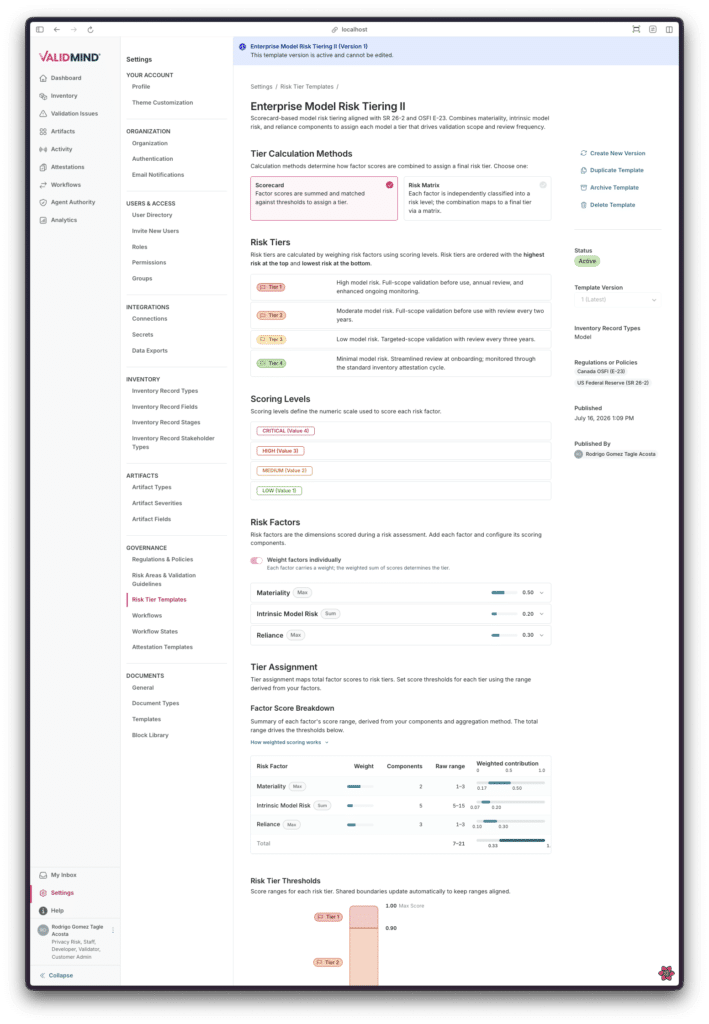
Consider an MRM team configuring a template for probability-of-default models. It defines Materiality, Complexity, Regulatory Exposure, and Operational Exposure as factors, links them to inventory fields such as business decision importance, total exposure, methodology type, and model dependencies, and maps the resulting score to Tier 1–4. The methodology now expresses Risk’s policy using information Technology and the business already maintain in the inventory.
Completing a Risk Tier Assessment
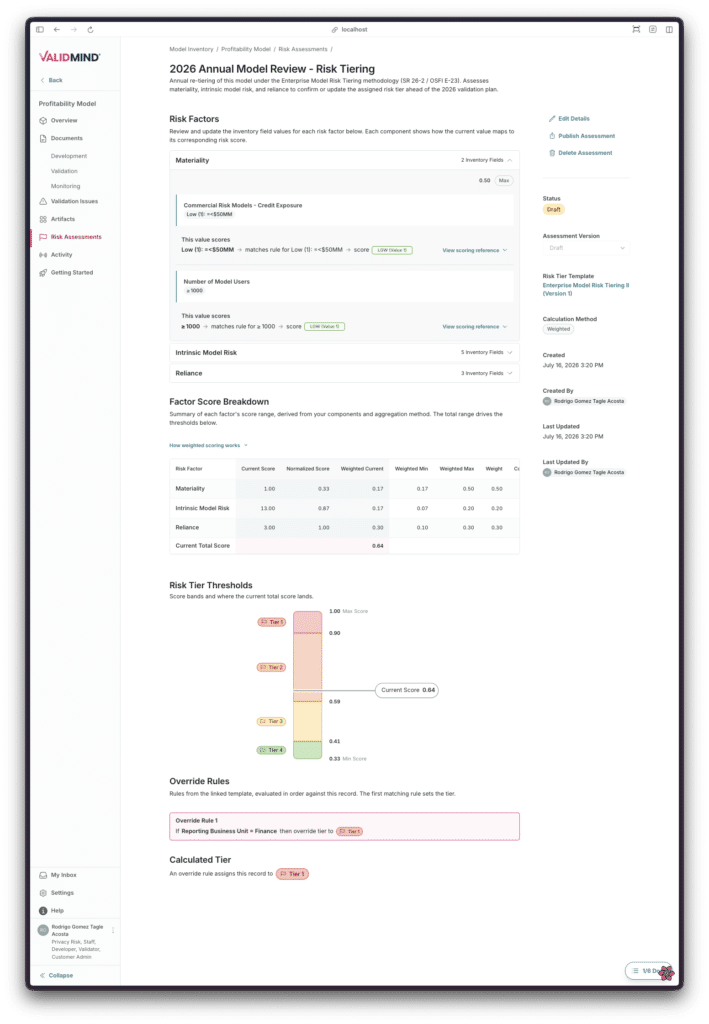
A Risk Tier Assessment does more than calculate a label. It creates a governed record of how the organization evaluated an inventory item, which methodology applied, what information drove the result, and who approved it.
Once a validator or risk manager publishes a risk tier template for an inventory record type, it becomes the organization’s approved standard for that type of assessment. When a developer or model owner creates an assessment from an inventory record, ValidMind automatically links it to that published template—removing the need to choose a template and ensuring assessments follow the approved governance framework. ValidMind automatically brings populated inventory fields into the assessment, reducing duplicate entry and connecting the classification directly to the record’s business and technical characteristics. Users can complete missing inputs and correct the underlying inventory information where necessary.
As inputs are completed, the assessment exposes the complete calculation–not only the resulting tier. Users can review:
- The inventory field values used in the assessment
- How each component was scored
- How component scores produced factor-level results
- How weighting and tier thresholds affected the calculation
- Whether an Override Rule changed the calculated outcome
This transparency is important because a tier without its reasoning is difficult to challenge or defend. A model may be classified as Tier 2, for example, because high materiality is balanced by moderate complexity and limited operational exposure. If an override elevates it to Tier 1, reviewers can see which policy condition triggered that decision rather than encountering an unexplained result.
The assessment remains in draft while the organization completes its review. Once an authorized user publishes it, ValidMind formally assigns the result through the read-only Risk Tier field and preserves the assessment inputs, calculation, template version, and publication history. A subsequent assessment creates a new version without rewriting the prior decision.
ValidMind also protects against classifications becoming silently outdated. If the governing template changes—or an inventory field used by the assessment is updated—the active assessment is flagged for reassessment. Teams can evaluate the record under the current facts and methodology while retaining the history of the previous result.
Rather than treating risk tier as only a questionnaire output or editable inventory label, ValidMind connects four elements in one controlled process: the published methodology, source inventory data, explainable calculation, and versioned assessment decision. That gives Technology a clear understanding of what drives governance requirements while giving Risk and Audit the evidence needed to review, challenge, and defend the outcome.
What this changes for your program
The Risk Tiering System is designed for outcomes governance teams already strive for:
- Transparency: Reviewers see inputs, intermediate scores, and the final tier in one surface
- Consistency: The same published methodology applies across teams, with record-type-aware vocabularies where policy requires them
- Configurability: Methodology belongs to governance admins: factors, components, weights, thresholds, and hard-stop overrides without custom engineering for every change
- Traceability: Versioned templates and assessment history support examinations and effective challenge
- Proportionate controls: Assessed tiers feed the same inventory, workflow, and reporting fabric as the rest of ValidMind, so higher-risk records can attract deeper review while lower-risk records proceed with proportionate effort
It also complements what customers already do with inventory fields and workflows. Calculated fields remain useful for lightweight logic; the Risk Tiering System is the first-class engine when methodology, versioning, overrides, and assessment history must stand up to scrutiny. It turns classification from a static attribute into an operable control: methodology is curated centrally, applied locally, and reused wherever your program needs risk-sensitive behavior.
As inventories diversify across models, agents, applications, and use cases, the same pattern holds: define the policy once in a template, run assessments against the right record type, and let the Risk Tier Assessment drive what happens next. The result is a repeatable handoff between the teams building AI and the Risk function overseeing it—not simply another label on the inventory.
Get started
The Risk Tiering System rolls out with ValidMind’s end-July release. Start by translating your existing policy into a Scorecard using factors and inventory fields you already capture, then pilot assessments before scaling.
New to ValidMind?
Already using ValidMind? Ask your organization administrators to enable Risk Tier Templates under Settings → Governance. Full product documentation will accompany the release.