Compounding agentic intelligence with human judgment
Compounding agentic intelligence with human judgment
David Asermely, ValidMind
In the agentic economy, governance is not a cost of doing business. It is where your organization’s intelligence and judgment compound.
A bank’s fraud agent pauses an outbound wire to a mid-sized importer. Eleven times what that customer usually sends, well off the pattern the agent has learned for them. The pause goes up the agent’s reporting line to a human analyst, who lets the payment through on her own authority: she knows this customer, this is their annual inventory buy, same few weeks every year, same supplier since 2019. She clears it and moves to the next one.
Here is what happens next in an organization that compounds. The reason she gave is captured against the action, in a form an agent can act on later. Weeks later the payment settles clean, and that outcome comes back and marks her call as the right one. Next year, when an agent pauses the same importer’s inventory buy, it remembers what she worked out. The colleague who picks up that case has the answer in front of her before she opens it.
Now scale that. Every agent decision, every approval or rejection, every outcome that comes back becomes feedback: the agents get more intelligent, and the people managing them get better at knowing what authority to hand over. A year in, your agents are not running on a vendor’s model. They are running on the accumulated memory and judgment of your best people, and that is not something a competitor can buy their way out of.
That is the machinery that will separate tomorrow’s agentic winners from its losers, and almost nobody has built it. What happens today is that she approves it, the reasoning goes nowhere, and a year later a different agent pauses the same payment and a different analyst works it out from scratch. We are moving fast to put agents everywhere, but to be successful, we must also scale our most valuable asset: human judgment.
There is a cost pressure hiding in this too, and every governance leader can already feel it. The only way most firms know how to supervise more agent activity is more human attention, and that curve is bending the wrong way. The machinery in this piece is what bends it back.
Two shifts come with this. Your agents stop acting on a model somebody validated last quarter and start acting on judgment your own people produced, which changes every day and has to be watched accordingly. And half the compounding is in the people: a manager learns, grant by grant, how much authority an agent should have.
A while back I wrote that AI adoption starts with a disciplined crawl, and that the lessons from that phase are what let you scale into higher-risk work later. I still believe that. But I left out the hard part, and it took watching agents act to see it. Nothing in the stack is keeping those lessons. The crawl generates them, and the organization forgets them.
01. Where the alpha accumulates
When a firm starts letting agents act on their own, the first instinct is to govern them defensively. Put controls around what they can do. Keep the auditors satisfied. Be able to show, on demand, that nothing has gone wrong. That instinct is correct. If you are deploying systems that price deals and release payments without a human in the loop, you had better be able to prove they are behaving.
To make agents usable, you do have to constrain them, but the defensive frame does not scale intelligence or judgment. And most firms only have fragments today: model logs in one system, approvals in another, outcomes in the warehouse, and no link between the action and the authority behind it. Nothing in that pile can tell you which decisions a human overrode and what happened next.
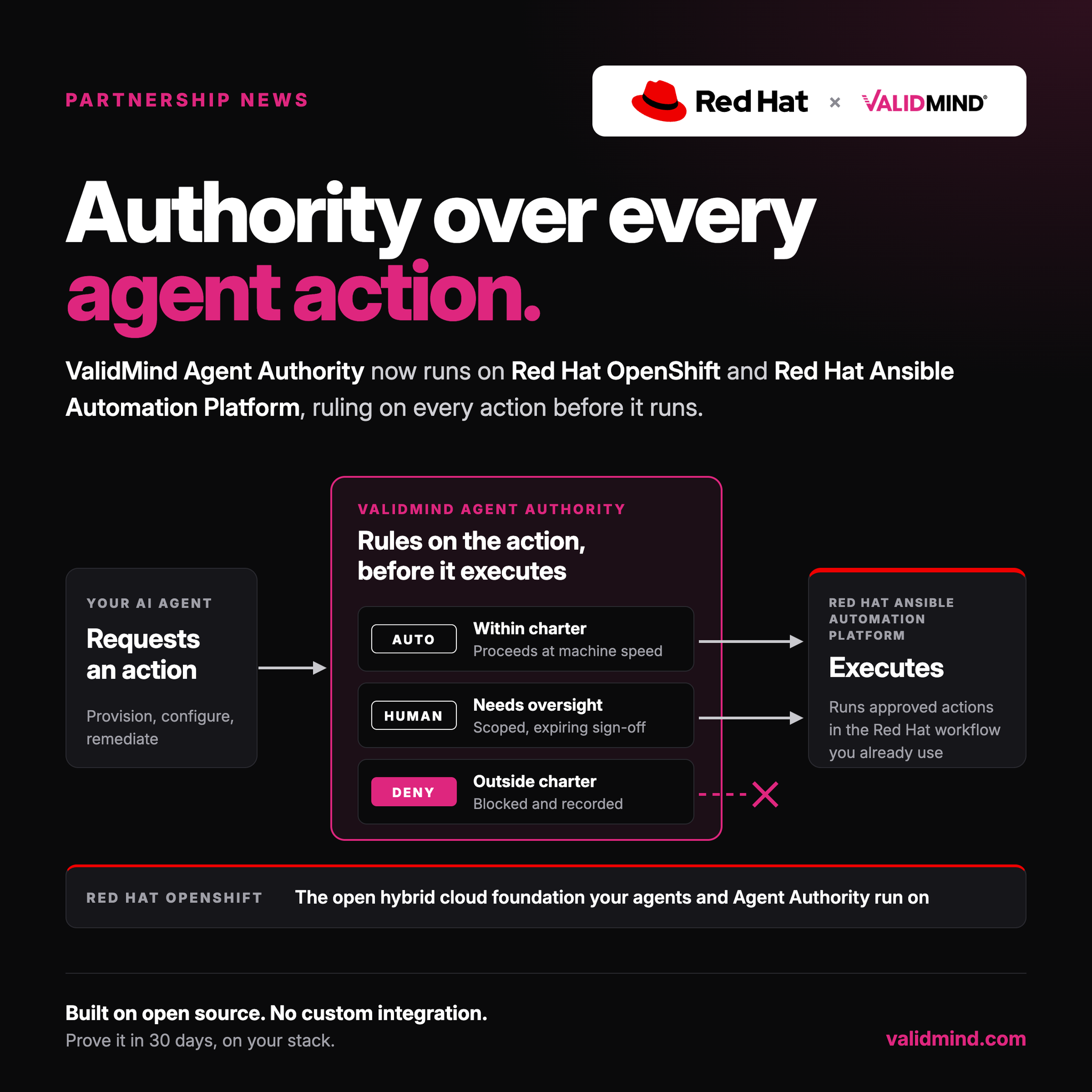
There is a reason that record forms in the governance layer rather than anywhere else. The authority layer is the one thing sitting in the call path of every agent, on every framework, including the agents you did not build. It intercepts the action, evaluates it against the charter that agent is working under, decides, and records what happened. Everything upstream sees one team’s agents; the warehouse sees outcomes with no idea what authority produced them. This is the only place the whole estate passes through. Which also marks the handoff: recording the verdict is where enforcement finishes, and it is exactly where the compounding starts.
That record has to be built deliberately, and here is the argument for building it properly rather than adequately. Assembled with rigor, it stops being an audit trail and becomes a corpus: a structured account of thousands of real decisions made under uncertainty, each one already labeled by whether a control caught it, a human overrode it, or the action worked. Nobody refits a model on it, so this is not training data in the narrow sense. It is something more useful than that: a body of judgment your agents can be made to consult.
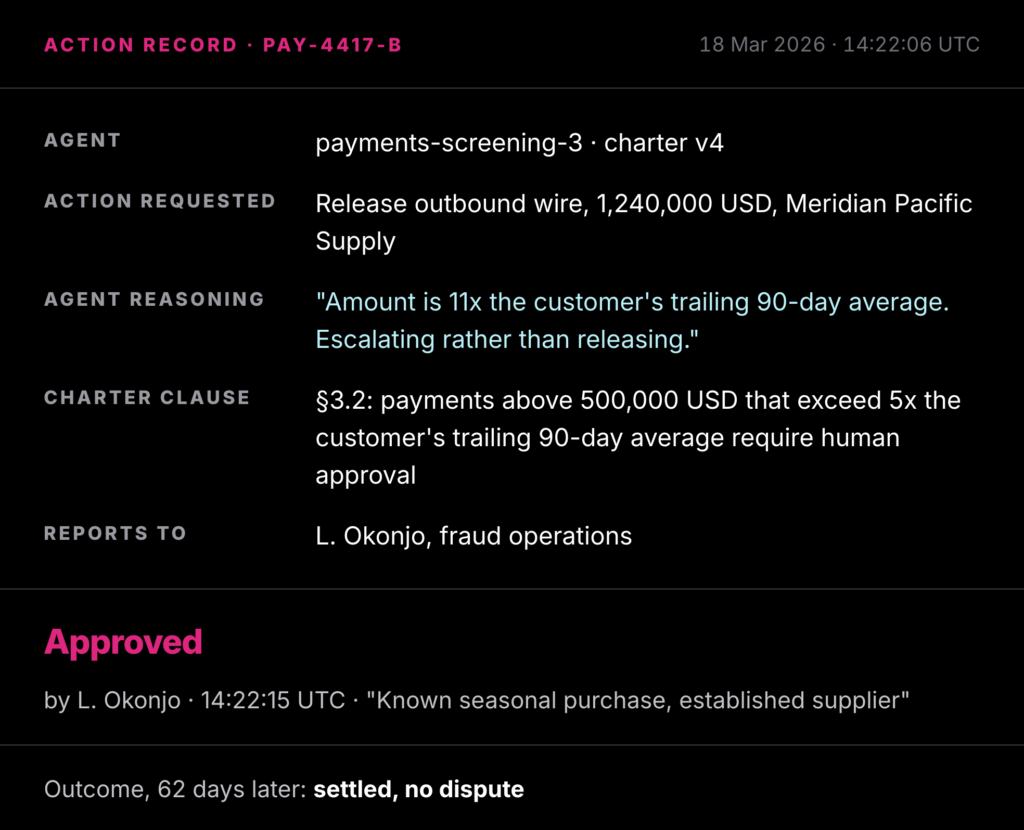
Every field there is a byproduct of enforcing the charter. Ten thousand of them is the corpus.
In the language of the people building these systems, that is context: the material an agent is given before it decides. Most firms are assembling context out of policy documents and procedure manuals, which describe what the institution says it does. The record describes what it actually decided, case by case, and how those decisions turned out. That record holds your firm’s judgment and intelligence, and it is a far better guide to the next hard decision.
The design choices that make an agent auditable are the same ones that make it learnable. That is the AI governance reframe. Policed as a hazard, all that activity is a cost you carry. Mined as an asset, it becomes proprietary weights of your business that no competitor can download, and it compounds every day.

02. The record of authority over an agentic action
There is no version of safe agent autonomy where the agent acts first and you inspect later. Once an agent can move money or price a deal, the only control that means anything is the one that binds before it acts. So the agent asks permission against a charter, someone accountable stands behind the answer, and the verdict is recorded. This is the price of letting agents act at all, and most firms have not yet felt it as a requirement. They instrument the request and the verdict. It is the outcome, arriving weeks later, that makes the record usable.
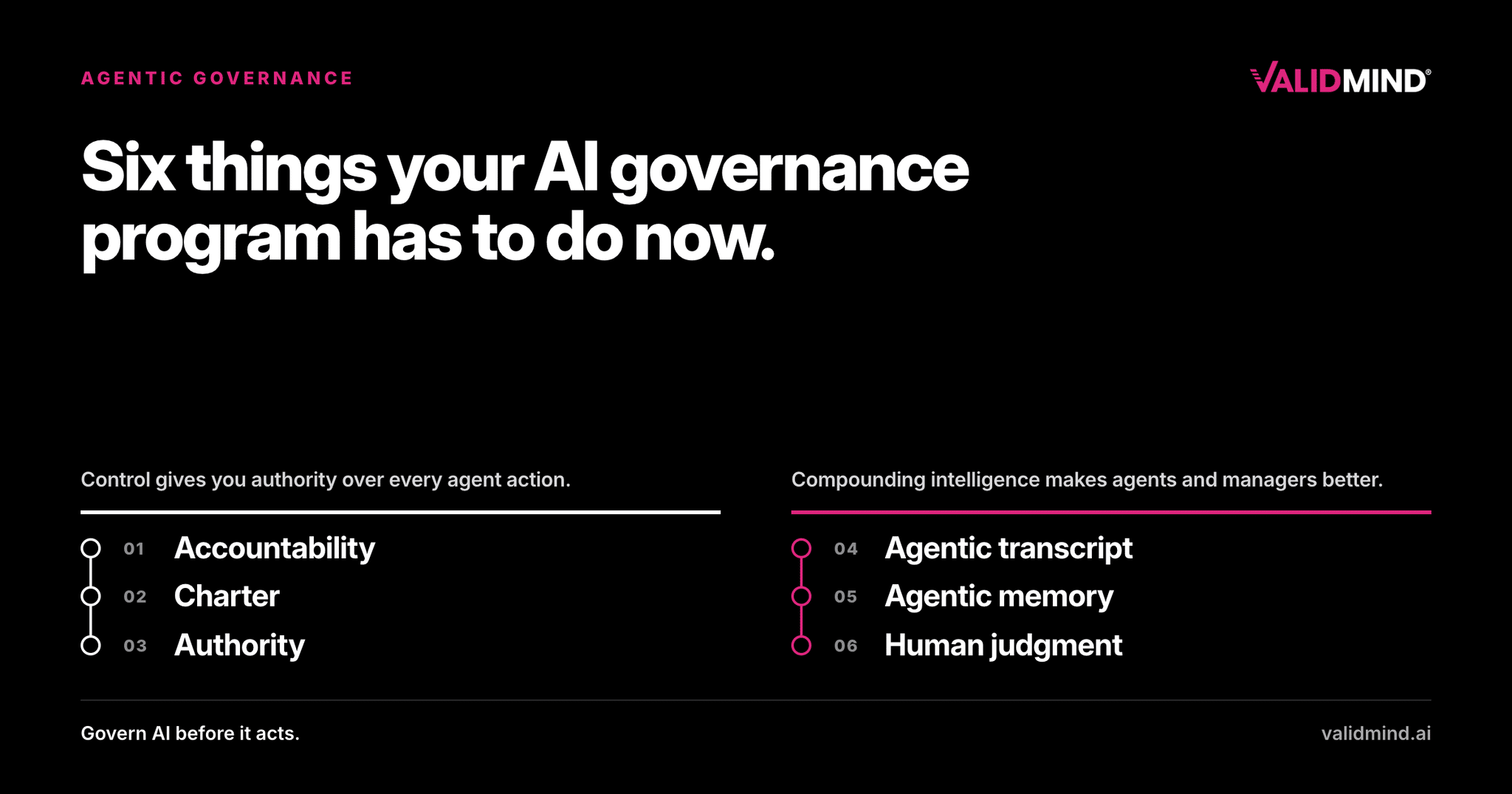
Request, verdict, outcome. That small unit is what the whole organization now runs on, thousands of times a day, and two feedback loops attach to it. The first loop works on what the agent learns. The second loop works on the human, sharpening her expertise and judgment with targeted feedback on the authority she granted.
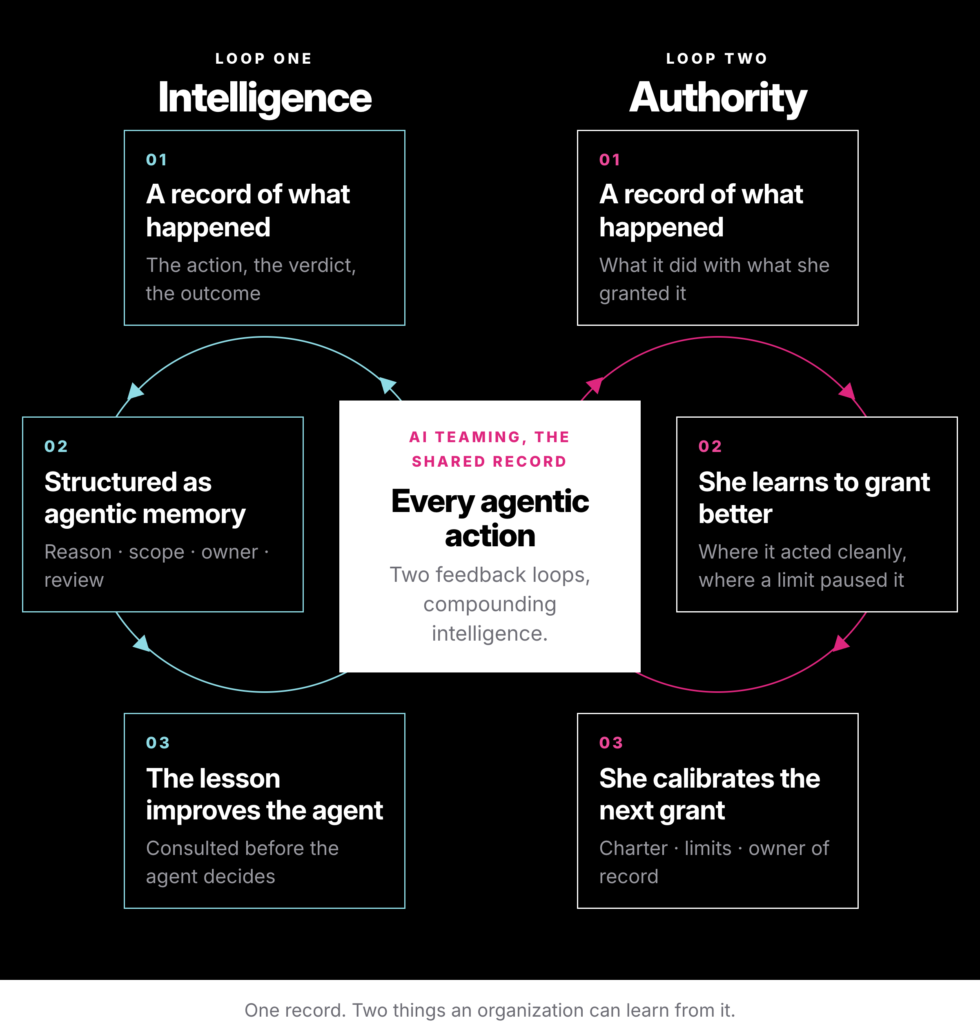
Which means the record has to cover more than the moments something went wrong. An agent working in production has a charter: a statement of what it may do in your name, and the limits it may not cross. Cross one and the action is paused rather than reported on afterward. Every verdict that charter produces teaches you something different. An allowed action tells you whether the agent’s judgment was good. An approved pause tells you whether the approval was right, and if the same limit keeps stopping the same thing, that the limit is wrong. A rejection tells you where the agent’s judgment is off. A denial tells you whether the charter is drawn in the right place.
Most governance systems only keep the exceptions, the pauses and the denials. Those are the cases someone already flagged. The thousands of allowed actions carry just as much signal, whether or not an outcome ever comes back, and that is the corpus almost nobody is building.
03. The first loop: compounding intelligence
Do all of that, and something you never paid for falls out of it. Enforcing authority over an action means recording the action: what the agent asked to do, which clause it tripped, who stood behind the answer, and what happened weeks later. You paid for those fields to hold the agent accountable, and the next agent can learn from every one of them. The backbone of the corpus assembles itself as exhaust from enforcement, almost for free. The cost was never in collecting the record. The work is in what you do with it.
To compound intelligence, those records have to be translated smartly and continuously into working memory: lessons extracted, given conditions, and placed as context where they will change what your agents do tomorrow.
People hear “capture the judgment” and think log the conversation. A log tells you the analyst approved a paused payment. It does not tell you the rule she was applying, the conditions under which it holds, or when it stops holding. Turning a record into a lesson is real work: a usable lesson states the principle rather than the preference, carries the conditions under which it holds and the cases it excludes, arrives while the agent is still forming its assessment, and ideally was independently verified before it went live. Miss any of those and you have an archive, not working memory.
And once a lesson is in that memory, it becomes a live component of the agentic system, shaping what every agent inside its scope concludes. Which means it inherits everything you would demand of any other component: a named owner, validation before it ships, monitoring after, and a way to retire it when it stops being true. A lesson that generalizes too far suppresses the pauses you needed. One drawn too tightly never matches anything again. Two that contradict each other leave the agent taking whichever it happened to retrieve. None of that shows up unless somebody is scoring the decisions made under it.
This is also where oversight itself has to move. We built the discipline to interrogate a model: its assumptions, its inputs, how it holds up under stress. In an agentic system the model is increasingly the least variable part. What changes behavior day to day is the context and the memory feeding it, and that changes constantly, without a release, without a version number, without anyone filing anything. Validation and monitoring have to follow the behavior to where it now lives. The question stops being whether the model is fit for purpose and becomes whether the judgment it is acting on is still true. The good news for anyone with real validation muscle: this is the same discipline you already run, pointed at a new target, which means most of what it takes, you already have.
How to do this well is an open field. Memory and context engineering are moving faster than anything else in AI right now, and I would not bet on a single technique. But every technique that wins will need the same input, which makes collecting the record the one decision you cannot defer. And the richer the record, the better the lessons: one that captures what the agent was weighing, which clause it tripped, and what the approver was looking at gives you far more to generalize from than one that only logs a verdict.
One caveat, since the argument here applies to itself: whatever tool drafts those lessons needs an owner and a review of its own, exactly as the lessons do.
You need that enforcement anyway, and the record it produces feeds loop one the next time a similar case comes up. What improves over time is how well you mine it: as memory and context research advances, the same record yields richer lessons without your gathering it again. And the corpus compounds in a way that is easy to miss. Each record you add does more than sit there as one more example. It adds connections to the context graph, new paths by which the next hard case can find a precedent. The value does not scale with the number of records but with the connections between them, and those grow faster.
The corpus is shared, and that changes the arithmetic. A lesson captured once reaches every agent whose work falls inside its scope, which is a far larger surface than the one analyst who first made the call. Every one of those agents is also generating records, which sharpen that lesson and seed the next one. Ten agents drawing on one corpus are worth considerably more than ten agents each keeping their own notes.
Get it right and every hard call your best people make is worth something the next time it comes up, everywhere in the estate at once. That is the difference between a firm that repeats a thousand judgments and one that makes each of them once.

04. The second loop: compounding judgment
There is a ceiling on how useful an agent can be, and it has nothing to do with how smart the model is. It is set by one person: how much authority the human accountable for it is willing to grant, and how well she grants it. So the second loop works on her. It is the loop in which a manager gets better at granting, by approving the actions that reach her and tuning the charter that decides which ones do.
Raising that ceiling means reaching for the oldest management structure there is. You govern the agent like an employee: it gets a manager, a charter, a reporting line, and a record of what it did. Not policy in a document, but an org chart enforced at the point of action. Treat it as a junior member of staff, and everything else in this loop follows. (I wrote about that org chart at more length in The silicon org chart.)
An agent that can flag a suspicious payment is helpful. An agent that can clear the routine ones on its own, pull the counterparty history, and escalate only what genuinely needs a person is a different kind of helpful. The difference is authority. To make an agent more capable, a human has to grant it some, letting it act in their name, inside limits they set. Our analyst does not want a queue of three hundred pauses. She wants something she can grant a slice of her own authority to, so the only things reaching her are the ones that actually need her.
And that is where approval fatigue does its damage. A human in the loop on every action sounds like control, but an analyst clearing three hundred pauses a shift is not exercising judgment on any of them. The control is nominally intact and functionally gone. Granting authority properly is what makes the remaining reviews real.
Here is the part almost everyone misses. Delegation only compounds if the person granting the authority gets real feedback on what came of it. Grant authority into a void and you learn nothing about whether the agent used it well. Learn nothing, and you rationally grant less next time. The whole system contracts back to what a single person can personally supervise, the exact ceiling we were trying to raise.
And the feedback is not only about the charter. Her verdicts are decisions with outcomes attached, which means loop two eventually hands her something no analyst has had before: a scored history of the calls she approved. The wire she approved settled clean. A few hundred of those and she knows, with evidence rather than instinct, where her judgment is sharp and where it drifts.
So the authority loop is a feedback relationship, and it produces sharper human judgment and clearer accountability.
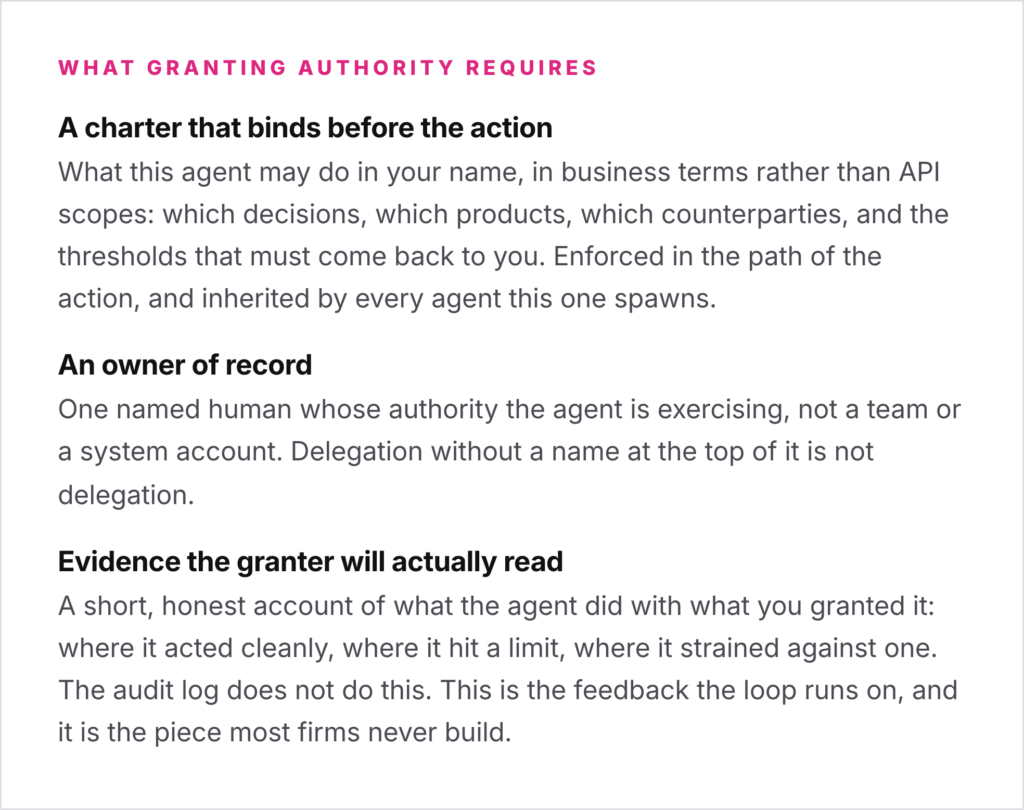
Give a manager that, and they extend more authority with confidence, because they can see what came of the last grant. Starve them of it, and they pull it all back, and they are right to.
05. Learning to manage agents
Notice who this makes valuable.
Managing an agent well is not the same skill as doing the work yourself. It means knowing which slice of your authority to grant and which to keep. How tightly to draw the limits, and when a limit that keeps getting hit is telling you something about the limit rather than the agent. How to read what an agent actually did and decide whether it earned more rope. When to pull authority back without pulling all of it back.
That is a real craft, and almost nobody has practiced it yet. It looks a lot like the craft of managing people. A good manager knows exactly how much to hand a promising junior, and adjusts every quarter. The difference is that here the feedback arrives in hours instead of years, and one person can run twenty of them.
What that looks like in practice is unglamorous, and it is three different disciplines. For the authority loop she reviews the limits her agents hit, because a limit tripped repeatedly is either a charter drawn too tight or an agent reaching past what it should. For the intelligence loop she does the harder thing and samples the actions that went cleanly, because that is where the judgment nobody questioned is hiding. She watches which of her captured lessons are getting retrieved, and which have gone stale. She widens a charter one class of decision at a time, and she can say out loud what evidence made her willing to do it.
The third discipline is the one almost no team runs: reading what her agents refused. Refusals never report back, so a charter that only ever sees its own approvals slowly convinces itself its limits were right, and the record looks immaculate the whole way. Your credit teams know the shape of this already. Somebody has to sample what was blocked.
The people who get good at this will be worth a great deal. I suspect it becomes one of the most valuable skills in the company within a few years. Today it appears on no job description anywhere.
06. Why the two loops compound
Run them separately and each is useful. Run them together and they multiply.
The intelligence loop grows the agent. Every correction makes its next decision better. The authority loop grows the manager: every grant she gets feedback on teaches her where to draw the next one, and a manager who grants well lets agents carry more of the load without babysitting each step. One raises how smart your agents are. The other raises how much your people will trust them with.
They also feed each other, which is the part that makes it compounding rather than merely additive, and the returns are not linear in the number of agents you run. Captured judgment is what makes a manager willing to grant more. She extends further when the agent has already absorbed the lessons that used to require her attention. And more authority produces more consequential actions with real outcomes attached, which is exactly the raw material the intelligence loop needs. Each turn of one loop makes the next turn of the other cheaper.
This is the cost curve from the opening, bending back. Captured judgment means a lesson is reviewed once rather than relearned in every deal. Authority with feedback means a manager can safely extend further instead of personally inspecting each action. Your governance headcount does not have to grow in lockstep with your agent count. Without something that keeps the judgment, it will anyway.
07. The gap is quiet at first
A compounding gap is survivable right up until it is not. Two firms deploying the same agents on the same models will look identical for a year. One of them is keeping the judgment and granting authority with feedback. The other is generating the same record and letting it settle into an archive. You cannot tell them apart from the outside until the distance is already too large to close, because the firm that compounded did not get there in a quarter.
At ground level it is smaller than that, and easier to picture. Our analyst explains, one time, why this importer’s annual inventory payment is not a fraud signal. Someone checks that she is right. And every agent that screens a payment after her already knows it.
David