AI Governance for Agents
Agentic system
The best agentic systems don’t just make the model smarter. They sharpen the manager’s judgment too.
That happens because agentic systems don’t just answer, they act: reading, writing, transacting, and delegating against your real data, records, and money. Acting like that needs a structure most AI-system conversations never require: a named person, accountable for what the agent does, backed by a charter enforced at every action. That structure is the Authority Node.
Enforced at every agent, every action
The Authority Node
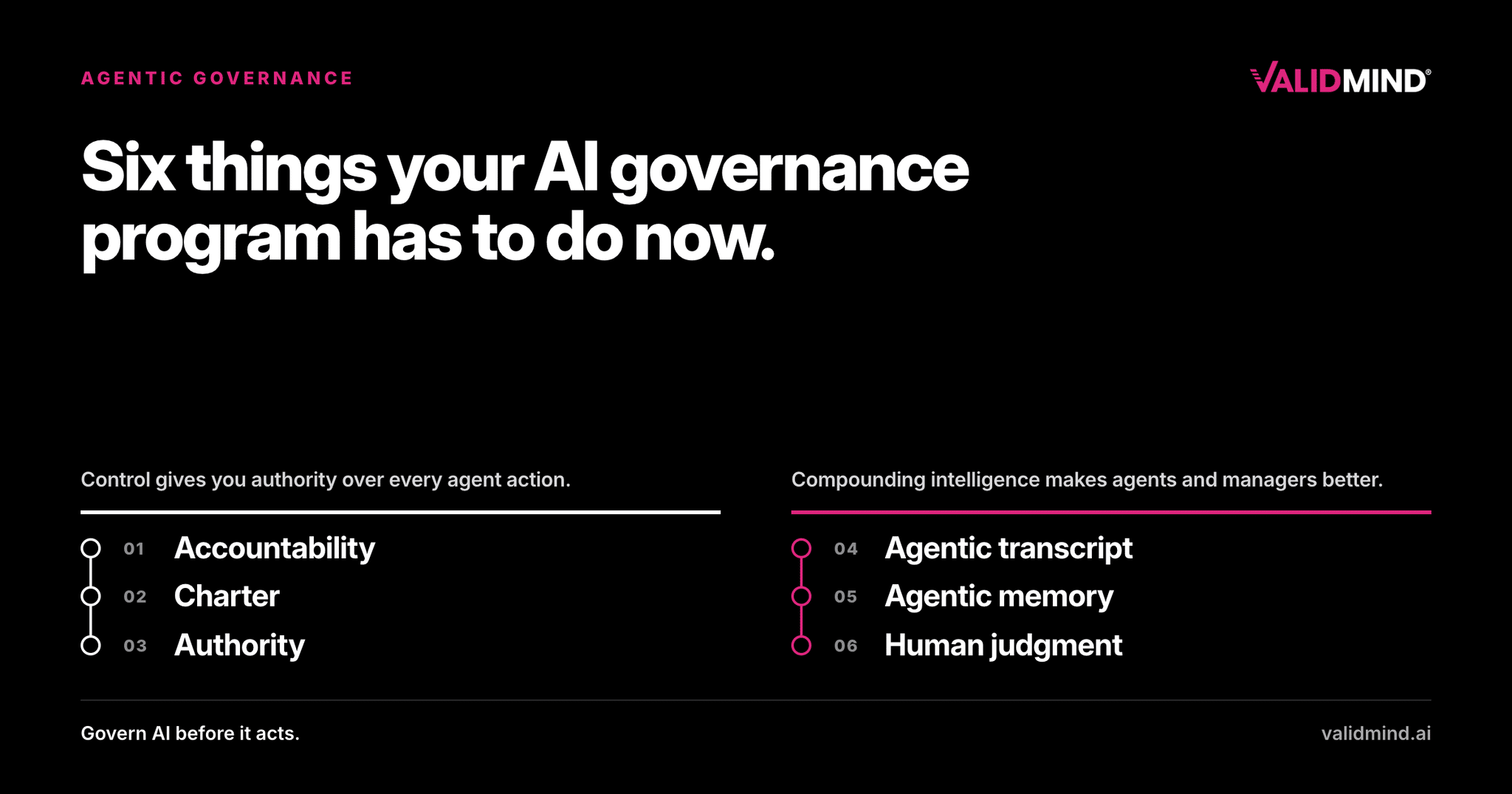
A named, accountable person; an Agent Charter enforced before every action; and a transcript of the request, verdict, and outcome. This is agentic governance, and it produces two feedback loops that compound AI intelligence and the quality of human judgment.
The Manager
A named person who answers for what the agent does, the same way a manager answers for the people who report to them. Issues the Authority Lease: how much of her own authority she extends to the agent, task by task. Approves what exceeds it.
The Agent Charter
The rules the agent works under, written down and enforced at the point of action.
Scope of workAuthority ceilingProhibited actionsEscalation path
the agent acts within these limits
The Agent
Model: reads the request and picks which tool to call, with which arguments. Its context comes from working memory, so the same model makes better decisions because it’s drawing on what was already worked out.
Tools
Where it stops writing text and starts changing your data, records, or money.
The four things an agent can actually do
Read
Query data, documents, systems of record
Write
Create or update records
Transact
Move money, submit, execute
Delegate
Call another agent or service
Produced by the Authority Node
The Management Transcript
The Authority Node produces a transcript of every check.
01 · Request
What it asked to do
The action it proposed, what it was weighing, and which charter clause it tripped.
02 · Verdict
Allowed, approved, or denied
What the charter allowed on its own, and who stood behind it when the action went above the agent’s limit.
03 · Outcome
What actually happened
Arrives weeks later. This is the field that turns a transcript into something worth learning from.
Feeds working memory. Outcomes become candidate lessons for the next agent that hits a similar case.
Feeds the manager back. Verdicts and outcomes score the grant she made, the raw material for tuning the Agent Charter.
Governed like a component
Working Memory
Transcripts turned into lessons the agent can act on: the principle, the conditions it holds under, and the cases it excludes. Not a log of what was said. A statement of what was learned. It captures human judgment as much as agent experience: what your best person decided when a case didn’t fit the charter, not only what the agent tried on its own. Shared, so one lesson reaches every agent in its scope. Owned, validated before it ships, monitored after, retired when it stops being true.
What the transcript compounds
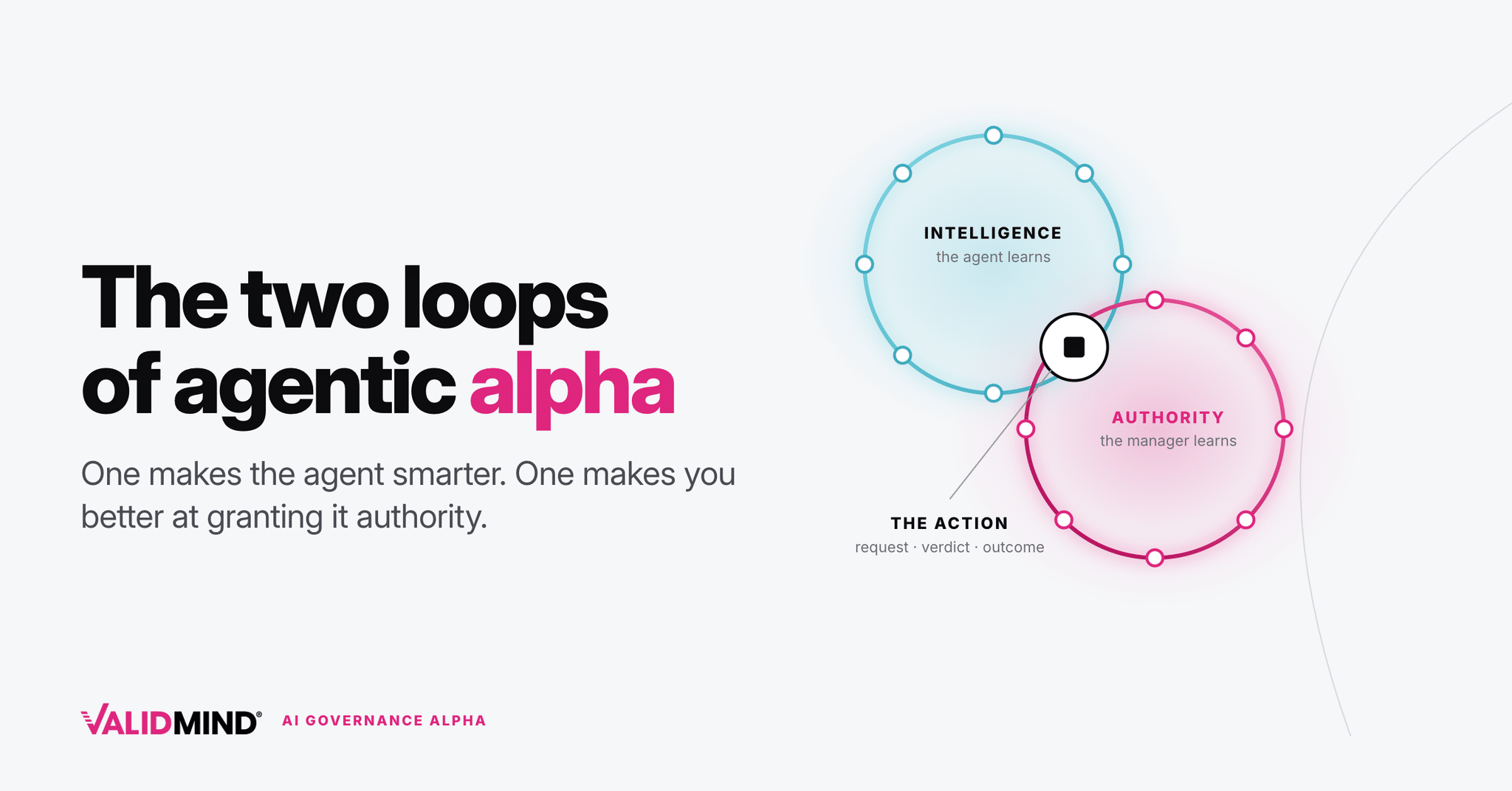
Run separately, each is useful. Run together, they compound.
Loop 1 · The intelligence loop
The agent gets better
- 01A decision is recorded, with the reason a human gave, not just the verdict.
- 02The reason becomes a lesson: the principle, the conditions it holds under, the cases it excludes.
- 03The lesson enters working memory, owned, validated, monitored, retired when it stops being true.
Back to the model as context
The next agent to see a similar case already knows what your best person worked out, everywhere in the estate at once.
Loop 2 · The judgment loop
The manager gets better
- 01She grants a slice of authority, set in the charter, so only what genuinely needs her reaches her.
- 02Outcomes come back scored: what the agent cleared, what she approved, and how each turned out.
- 03She tunes the charter. A limit that keeps getting hit is telling her about the limit, not the agent.
Back to the Authority Node as a wider grant
She extends more authority with evidence rather than instinct. Grant into a void and she rationally grants less next time.
Where this leaves the job
Managing agents is a skill most managers don’t have yet.
Granting authority, reading outcomes, tuning the charter. It’s built the way every management skill is built. Through feedback.