Feature Highlight: Universal Inventory for AI Systems
It’s clear regulated industries need a universal inventory for AI systems.
AI programs in regulated industries are no longer “just” model portfolios. They are interconnected systems: foundation and traditional models, generative applications, agents and orchestration flows, datasets and pipelines, vendor tools, and the business use cases that justify and constrain them. Boards and supervisors increasingly ask for oversight of AI systems end to end—not only whether a single model was validated, but how components fit together, who is accountable, and what changed over time.
Yet many governance platforms still assume a single primary object—typically a model—and force everything else to fit into that shape. The result is familiar: duplicate or overloaded records, shadow spreadsheets, and audit narratives that describe process workarounds instead of the true architecture.
ValidMind has now released a universal inventory for AI systems, with configurable inventory record types to respond to that gap. ValidMind now lets administrators define the primary record types that represent your AI landscape, allowing the platform to function as a flexible record inventory, not only a traditional model inventory.
From Model-Centric Catalogs to System-Level Truth
A model-first inventory made sense when portfolios were smaller and dominated with traditional statistical or machine learning models with clear owners and lifecycles. Modern AI governance is not model-only. The same governance function must account for use cases (why an AI capability exists), applications (how it is exposed to users or systems), agents and flows (how work is decomposed and automated) and data (what feeds decisions and how it is governed). Each can carry entirely different development and operating lifecycles, risk, ownership, and evidence expectations.
When all of that is forced into a single record type, teams adapt in predictable ways: they overload fields, misuse categories, or stand up parallel inventories outside the system of record. Regulators and internal audit then review a catalog that reflects workarounds, not production reality—which erodes trust in reporting and slows every downstream review.
ValidMind now supports a universal inventory for AI systems: administrators can configure inventory record types to match whatever AI landscape requires. That means you are not choosing from a short, fixed menu of objects; you can define the record types your program needs across the full breadth of AI systems, whether that is Models, AI Systems, Use Cases, Applications, Agents, Data products, Tools, or any additional types your taxonomy requires. The inventory becomes legible to both the business and compliance because each governed object has a clear identity and a defensible place in your hierarchy, rather than being squeezed into a one-size-fits-all “model.”
In other words, the platform is built to scale with the AI ecosystem you actually run—not the one a rigid schema assumes.
What Configuration Unlocks
Administrators define these inventory record types so governance matches program policy and operating reality, not a vendor’s default schema. The scope is intentionally open-ended: as your AI footprint grows, you can add and refine record types to capture new categories of risk and ownership—without hitting a structural ceiling that forces unrelated objects back into a single bucket.
That delivers several concrete advantages:
- Fidelity to how you run the program: Registration screens, required fields, and stakeholder roles can match the object being governed. A data lineage-heavy data object does not need the same form as a customer-facing application or a classical credit model.
- Clearer accountability: When record types mirror real ownership, reviews and attestations land with the right stakeholders—instead of hiding agents, applications, and data behind a catch-all “model.”
- Stronger traceability: Artifacts, workflows and documentation attached to records that mean what stakeholders think they mean. That reduces ambiguity in audit trails and makes cross-functional handoffs easier to explain.
- Better use of automation: Custom fields remain first-class regardless of record type—usable in filters, analytics, workflow conditions, and permissions—so record types are operational definitions, not cosmetic labels.
Together, these capabilities turn the inventory from a passive list into a structured backbone for governance: what you register is what you govern, in the language your firm already uses, and the inventory itself can expand to match the full scope of AI systems you choose to oversee.
Why Inventory for AI Systems Matter for Oversight
Expectations from SR 11-7, SS 1/23, OSFI E-23, the EU AI Act, and board-level AI oversight programs all push toward accountability, proportionate controls, and lifecycle evidence across AI and model risk. Demonstrating compliance is much harder when your system of record does not mirror how AI is actually built, deployed, and monitored.
When inventory structure aligns with real systems, several governance problems get simpler:
- Risk tiering and routing can key off the right attributes for each record type so high-risk generative use cases are not managed with fields designed for a low-frequency scoring model.
- Reporting and dashboards aggregate meaningful cohorts—models vs. agents vs. data—instead of blending unlike items into one denominator.
- Cross-functional review becomes faster because reviewers see objects that match their mental model: legal and privacy may focus on use cases and applications; model risk on models; data governance on datasets.
None of this replaces human judgment; it removes friction around the wrong abstraction so teams spend time on substance, not reconciling terminology.
Fit With the Broader Platform
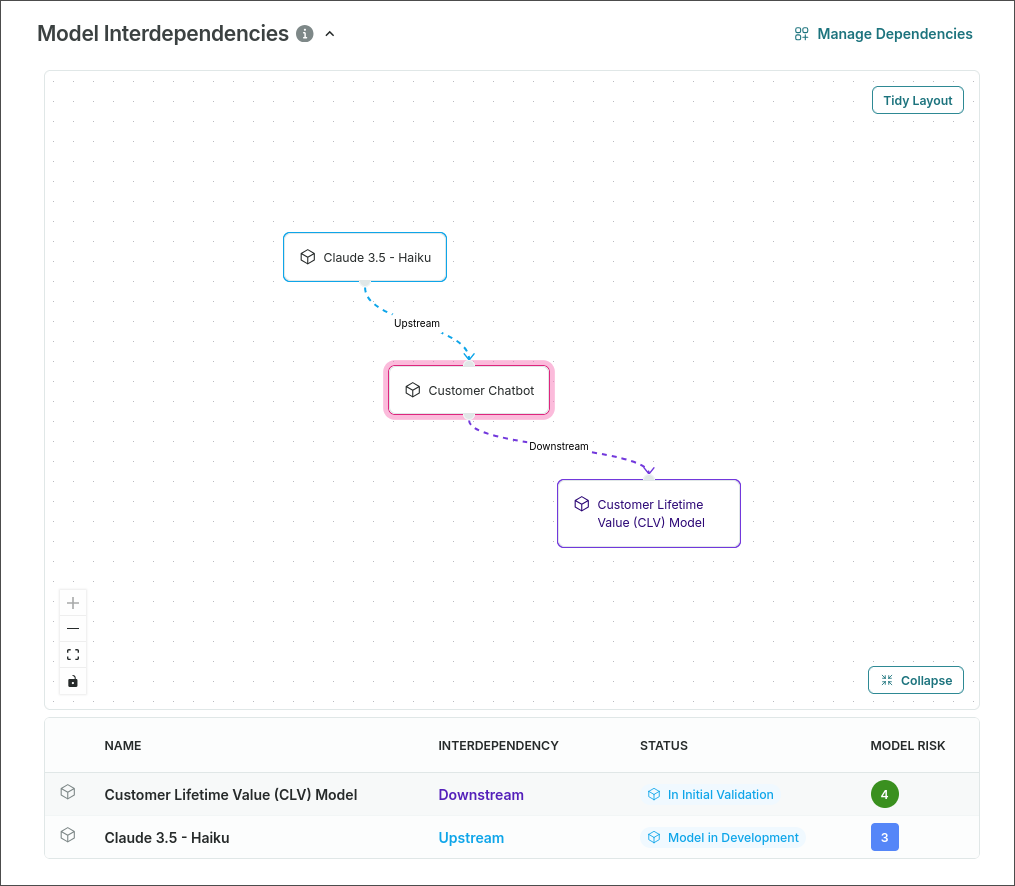
Inventory record types sit alongside the rest of ValidMind’s governance pillars: workflows, documents and templates, dependencies, lifecycle stages, and stakeholders. Together, they move the product from a two-tier mental model toward a unified, extensible inventory for AI systems that can grow with AI adoption, without sacrificing auditability or central control. Admins stay in charge of how the taxonomy evolves; teams get an inventory that reads the way the business thinks about AI.
The approach also complements integrations: metadata from ML registries, cloud AI services, and ticketing systems can land on the appropriate record type, preserving context whether you are syncing a SageMaker endpoint, a Bedrock agent, or a Jira epic. Governance stays synchronized with operational systems without collapsing diverse resources into a single mislabeled bucket.
Get Started with ValidMind’s Universal Inventory for AI Systems
New to ValidMind? See how a unified inventory for AI systems and automation work together for AI governance and model risk management: Request a demo
Already using ValidMind? Work with your administrators to define inventory record types that match your taxonomy, then align metadata fields, registration rules, workflows, and documentation templates to each type.