Agents put intelligence into your organization. Alignment is what makes it compound.
 Blog
Blog
Agentic governance
Agents put intelligence into your organization. Alignment is what makes it compound.
Enterprise spending on generative AI came to roughly $37 billion last year, according to Menlo Ventures. That’s a 3x increase from the year before. S&P Global puts 58% of organizations actively looking for places to put agents to work.
At the same time, Gartner predicts more than four in ten agentic AI projects will be cancelled by the end of 2027, citing escalating costs, unclear business value, or inadequate risk controls.
I think those two things are connected. Capability is arriving faster than most organizations can absorb it, and what limits a firm at this point usually isn’t the model it picked. It’s whether the organization is set up to turn what an agent does into something the organization actually keeps.
What an agent needs to get better
It’s general intelligence. To be successful it needs the context of your organization and its assigned tasks. It also needs to be granted authority.
Here’s my current thinking on how an organization builds that.
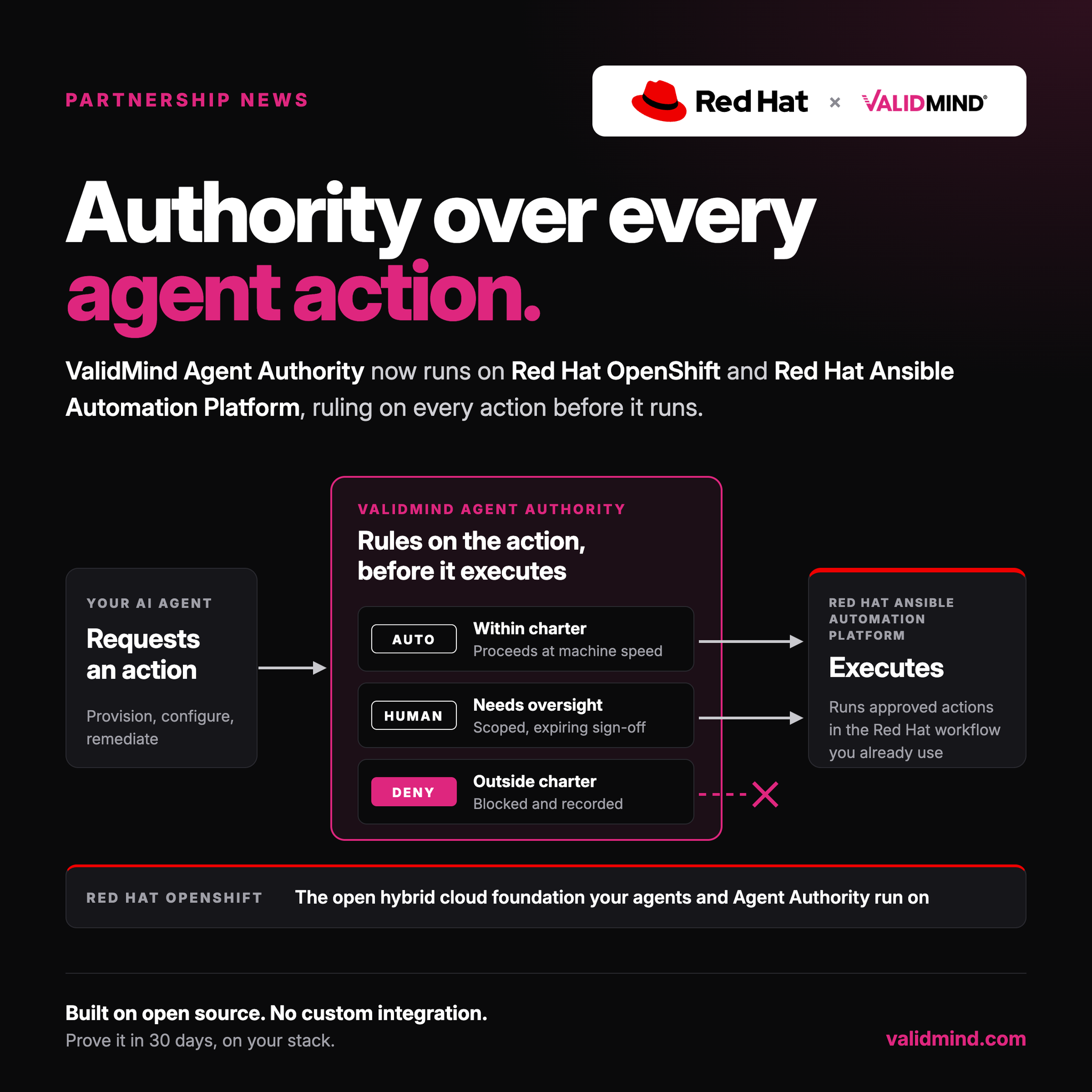
That authority will be assigned and tuned by the human accountable for the agent’s actions. A charter will be written down, defining what the agent is allowed to do, what it requires human approval to do, and what it is not allowed to do. This charter should be binding, in the sense that the action is checked before it runs rather than reviewed some time after.
The agent then acts, and each action should produce a record. Not a log of tool calls. The record should include:
- what the agent proposed and why
- the charter’s decision
- any human approval, with rationale
- what actually happened
The outcome is what makes the record so valuable. To improve an agent’s performance you need to give it feedback specific to the task. What went right, what went wrong, and the reasoning behind the calls a human made along the way, which is the part that usually goes uncaptured.
Done well, those records become a corpus your data governance teams and stewards can transform into your organization’s working memory. It holds the lessons and the human judgment behind them, so the next decision is a smarter one.
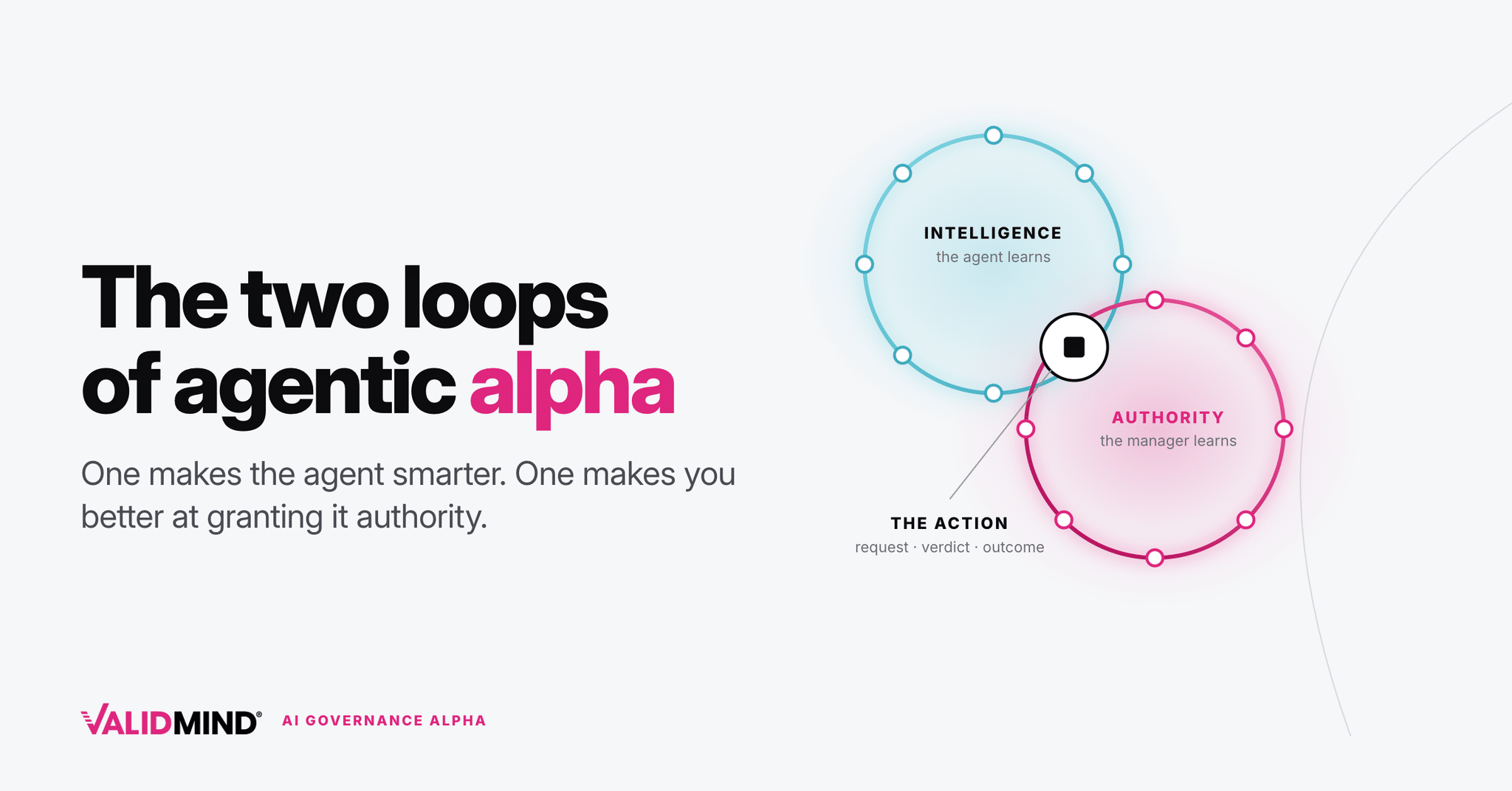
Then the loop closes in two places. The memory gives the agent the organizational context it needed at the start, so the next agent to hit a hard case already knows what your best person worked out. The outcomes give the manager evidence, so the charter gets tuned on what actually happened rather than on instinct.
Almost no firm has all of this running today. The agents went into production faster than the supporting structure could be built.
Why it takes organizational alignment
Alignment brings teams together with different perspectives, and it’s those perspectives that compound intelligence across the organization.
Making the authority binding is IT. Someone has to build the check that runs before the action does, inside the systems the agent is calling. If the charter only exists in a document and never in the execution path, then what you have is a policy rather than a control.
Granting the authority is the business. A named owner decides how much of their own authority to extend, task by task, and then answers for what the agent does with it in the same way they answer for the people who report to them. Nobody else can really make that call, since nobody else holds the authority being lent out.
Turning the record into memory is data governance and data stewards. Classification, retention, lineage, quality and ownership all apply here from day one, because that record is going to hold decision rationale and almost certainly customer detail. This is work nobody else in the building does, and to be honest nobody else would be any good at it.
Deciding whether a lesson should stand is risk. One person’s judgment, made on one difficult afternoon, is about to become a rule that shapes a thousand later actions that nobody is going to review one by one. Someone independent needs to ask whether that reasoning was sound or whether it just happened to work out.
Each of those took a different career to build. A data steward isn’t going to set risk appetite, and a business owner isn’t going to run lineage. Four teams, four vantage points, and the record only gets built when all of them contribute.
When AI advised, alignment wasn’t as critical. Now it is.
What it looks like when the record isn’t there
Mostly, it looks fine. The agents run, the dashboards are green, and the audit trail is complete in the narrow sense that you can reconstruct what happened. Nothing fails, nothing escalates, and nobody files anything.
What’s missing is improvement. An agent that handled a hard case in March will handle the same case in November no better than it did the first time, because whatever your best person worked out that day went into a log and stopped there. The manager grants the same narrow authority next quarter as last quarter, because no outcome ever came back scored against the grant they made.
That’s the expensive version of unclear returns, and it’s hard to spot, because there’s no failure anyone can point at. The agents just never start compounding.
These teams were arranged to operate independently for good reasons, over many years, in a world where operating independently worked perfectly well. The requirement changed underneath them.
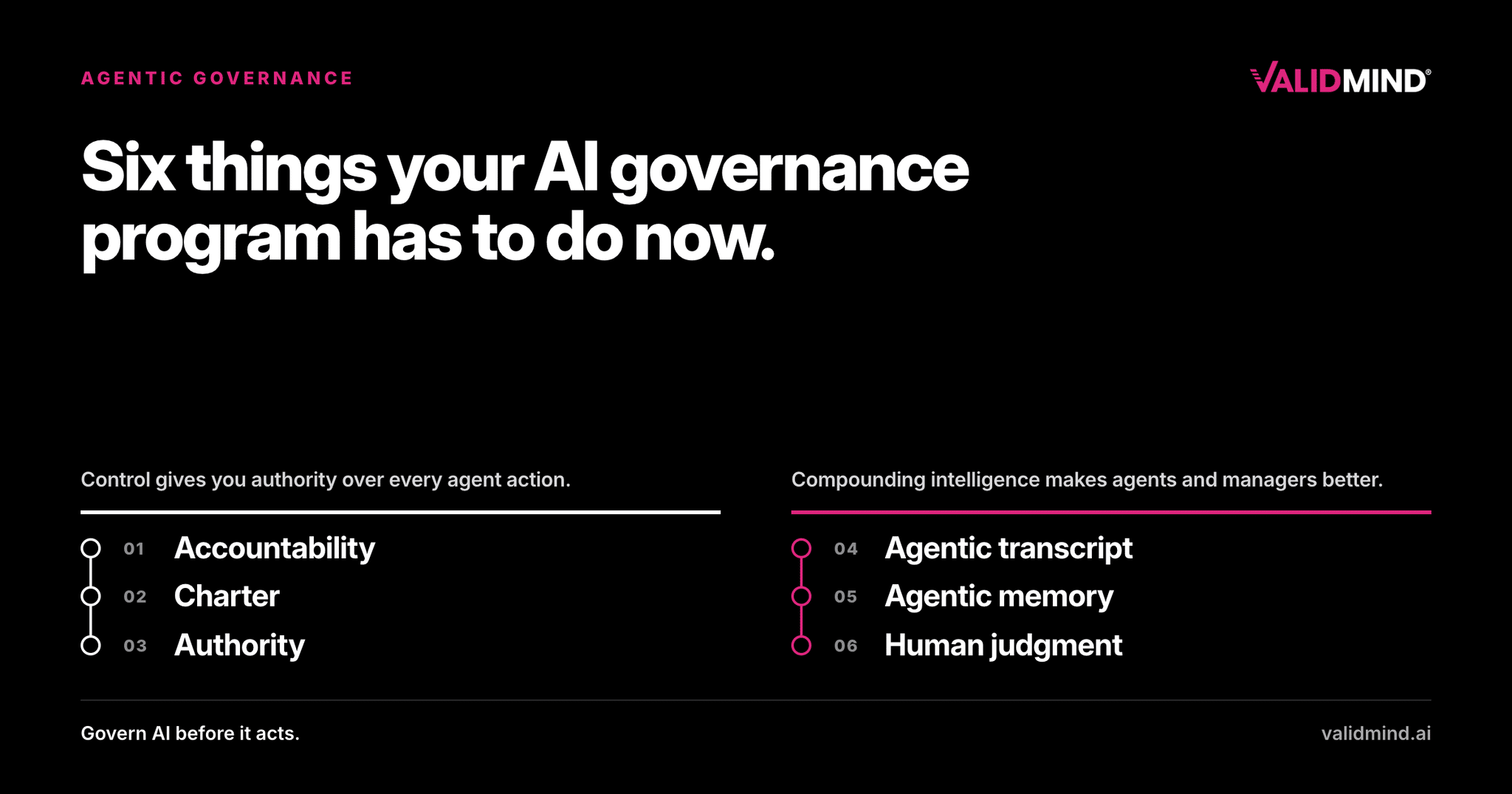
Six things an organization needs before its agents can compound
Control gives you authority over every agent action.
01Accountability
One named person accountable for every agent in the firm, and every individual agent assigned to an owner.
02Charter
Written and validated for each agent: scope of work, authority ceiling, prohibited actions, escalation path.
03Authority
Every action interrogated against the charter before it reaches a tool.
Auto-runAsk for human approvalStop
Compounding intelligence makes agents and managers better.
04Agentic transcript
A new data asset in its own right. It needs an owner, a classification and a retention rule from day one.
05Agentic memory
Lessons built from the record and governed like any other asset: owned, lineage intact, quality monitored, retired when it stops being true.
06Human judgment
Managers who get better at granting authority, because outcomes come back scored against the grants they made.
Managing agents is the new skill
The work is changing. A manager who used to direct people now also directs systems that act. You decide how much of your own authority an agent gets, for which tasks, up to which limit, and then you find out whether that was the right call.
That’s becoming a core skill, and it’s arriving quickly. In Indeed and YouGov’s May survey, 41% of employers already expect their people to build and manage AI agents, while 14% of workers say they’re comfortable doing it.
It’s also a skill that needs evidence to build. Most agent strategies are built around deployment and control: how many, how fast, how safely. Those are the right first questions. But a strategy that compounds intelligence needs one more thing, and it sits on the manager’s side of the loop. She widens an agent’s authority, and the only way to know whether that was a good call is to see what happened after.
That’s what the record gives a manager. She sets a limit. Over a couple of quarters she can see what the agent handled on its own, what came to her for approval, what she said yes to, and how each of those turned out. Then she adjusts the limit.
And because it’s written down, the organization can see what good looks like: which managers extend authority well, which hold back longer than they needed to, and what the difference was. That makes this something you can train for and reward.
People get better the same way the agents do. Build the record and both loops run.
I’d like to hear how other firms are building this skill.
Your agents are either going to get better over time or they aren’t, and I don’t think the difference comes down to which model you picked. It comes down to whether four teams in your building can manage to build one record together.