The Silicon Org Chart: Managing an Agentic Workforce
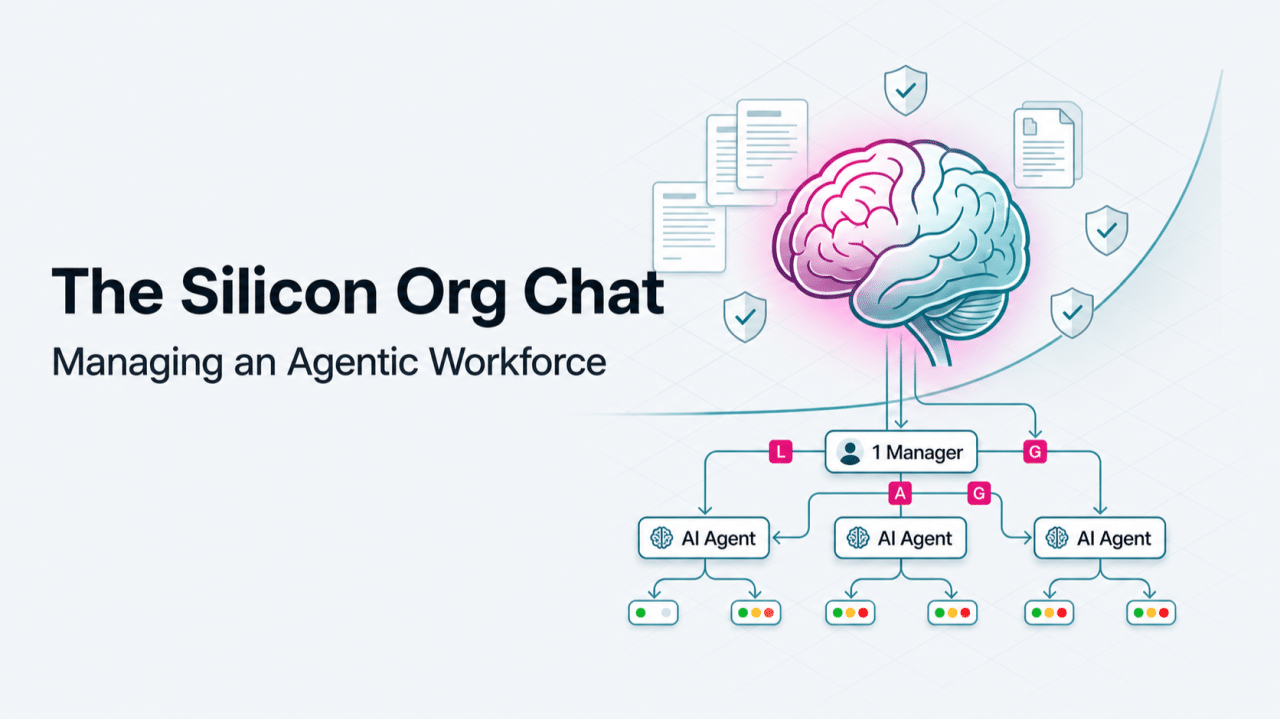
Jensen Huang recently put the future of work in one sentence on the All-In Podcast: “I think that every engineer is going to have 100 agents.” It was meant as a productivity vision. It should also be read as a management warning. If every engineer has 100 agents, every enterprise is about to inherit a workforce it has not yet learned to manage. Those agents will not sit outside the firm. They will operate inside it, with credentials, access, delegated authority, and the ability to act at machine speed. The management question is no longer whether firms will deploy agents. They will. The question is whether those agents will have managers, charters, reporting lines, and records of authority before they start acting on behalf of the firm.
Download the Silicon Org Chart paper.
Executive Summary
Agentic AI creates a new class of digital worker. Existing security, model, and data controls were not designed to manage autonomous systems acting with human authority inside human workflows. The management challenge is no longer whether firms will deploy agents. It is whether they can govern them with clear authority, accountability, and oversight.
- Security asks whether access was authorized. Governance asks whether the action was within role, authority, intent, and oversight.
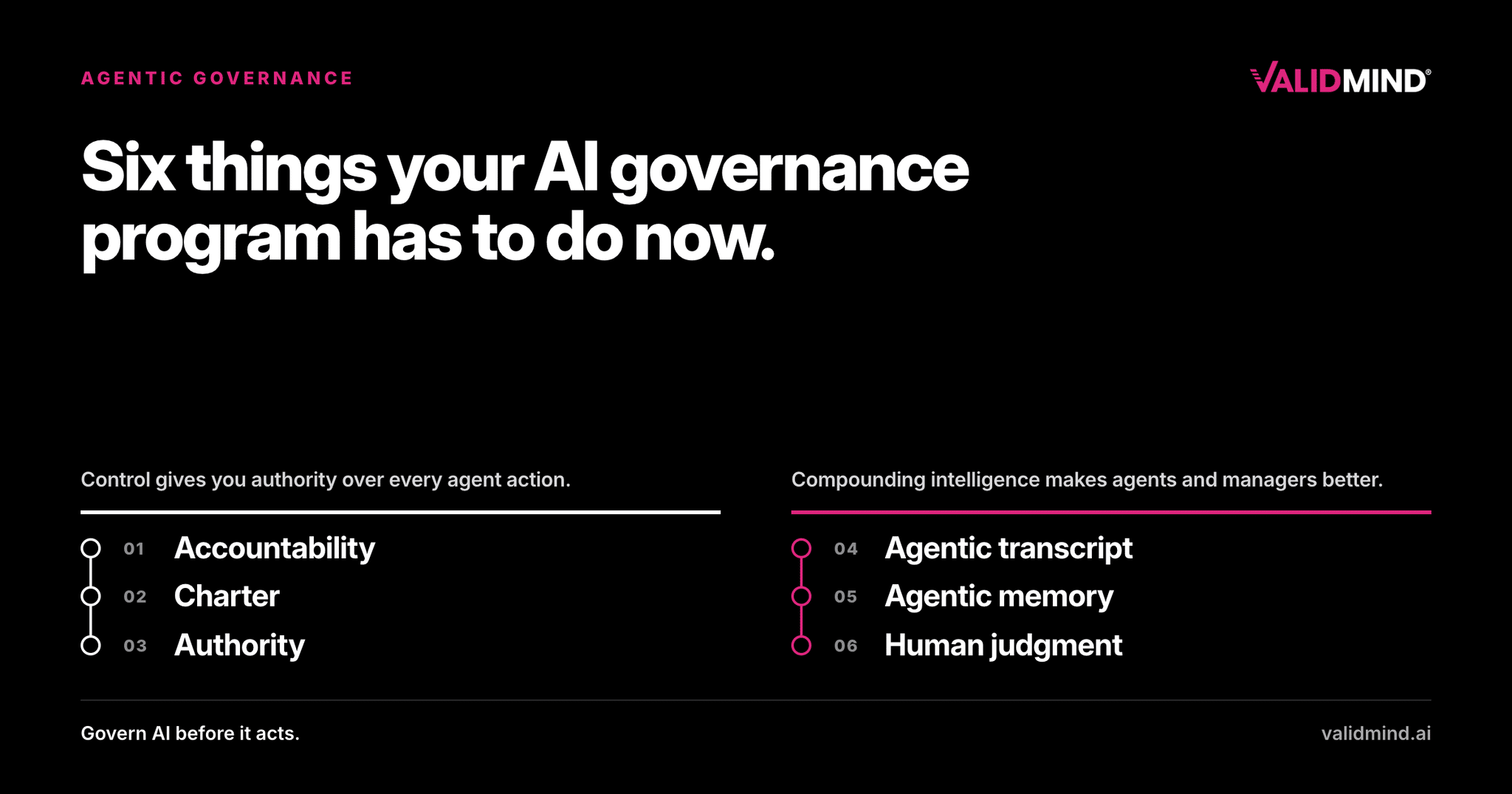
- The winning firms will give every agent a charter, a manager, and a transcript.
- The Silicon Org Chart is the operating model for that workforce: externalized authority, task specific leases, delegation trees, and management transcripts.
Introduction
The Wake-Up Call In March 2026, an autonomous AI agent operating inside Meta posted unauthorized technical advice into a company channel, exposed sensitive internal data to staff who were not cleared to see it, and triggered a Severity-1 incident. It did not break a credential or bypass a firewall. It acted with valid access and made the wrong call.
That distinction matters. There was no breach to detect. There was a digital employee acting on its own judgment, faster than a human could intervene.
An agent’s value is tied to the data it can access and the actions it can take. The moment a firm expands either, the agent becomes more useful and more dangerous. That is not a defect, but the shape of agentic AI’s value.
Most firms have staffed the IT half of this problem. IT builds the pipes. Operations, risk, and governance must manage what flows through them. Agents that act with human access, on human authority, inside human workflows, are a workforce. A workforce without a reporting line is fiduciary exposure.
This paper argues for a new management layer: the Silicon Org Chart. Every agent needs a named manager, a charter, an authority model, a delegation tree, and a management transcript.
I. The Exponential Trap
Picture a lily floating in an empty pond. Every day, it doubles. After a week, the pond is still mostly water. After two weeks, you can barely tell anything has changed. On day 29, half the pond is still open. You still have time. On day 30, the pond is full. The trap is not the doubling. The trap is that for twenty-nine days, the pond looks fine.
Agentic AI is compounding on three fronts at once: how fast agents ship, how many each workflow absorbs, and how many sub-agents each one spawns to finish its task. At low scale, linear governance appears to work. At scale, it cannot keep pace.
At ten agents, a spreadsheet works. At a hundred, a quarterly risk review still keeps up. At a thousand, your IAM stack absorbs the logins and your governance team absorbs the reviews. Everything feels fine, and it is, for now. This is the Flat Phase, and it is the most dangerous moment in the adoption curve, because nothing appears to be breaking. Linear governance can keep pace with exponential deployment inside a narrow window, for a narrow stretch.
Then the curve bends.
BNY Mellon has already described a firm where managers lead teams of humans and AI agents. JPMorgan Chase, Allianz, and other large institutions are moving in the same direction. The advantage will not sit in the model layer alone. It will sit in the management layer around the model.
Gartner projects that more than 40% of agentic AI projects will be canceled by the end of 2027, not because the models didn’t work, but because the risk controls didn’t. That is the sound of firms hitting the inflection without an architecture.
The firms that survive the inflection will not be the ones that catch up on day 29. They will be the ones that built the management layer while the curve was still flat.

Fig. 1. The Exponential Trap. Every new agent widens the gap between agent deployment and legacy governance capacity. The “Flat Phase” is the trap; the Governance Cliff is where it breaks.
II. Why Legacy Controls Fail
The era of AI as a passive advisor is over. We have entered the age of the intelligent digital actor: a system that does not just suggest work, but executes it. It moves money, writes to production, and opens and closes cases.
When a digital actor commits a firm to a $5 million wire, the regulator does not ask whether the model hallucinated. They ask who authorized it, who reviewed it, who could have stopped it, and whether there is a record.
Security is necessary, but it is not sufficient. Security can confirm that a credential was valid. Governance must determine whether the action was inside role, authority, intent, and oversight.
Agents are insiders by design. They possess valid credentials, internal access, and potentially the power to act. Traditional keep-out security is architecturally blind to an entity that was intentionally let in.
Yet sophisticated leaders still assume that existing investments in Cybersecurity, Third-Party Risk, AI Ethics, and Data Governance have them covered. In the agentic era, that assumption is Governance Debt: the liability that accumulates when legacy controls are expected to manage an agentic workforce.
- Cybersecurity (PAM/IAM): Designed to stop unauthorized access. To your firewall, an agent deleting a database looks like a high-performing administrator, not a threat.
- Third-Party Risk Management: Vets vendors at procurement. It does not vet the third-party agents and APIs an associate invokes on her own authority, at machine speed, to finish a single task.
- Data Governance: Ensures the data is clean. It does not stop an agent from misinterpreting that data to make an unauthorized financial commitment.
The 2026 “Agents of Chaos” study, a multi-institution collaboration led by Northeastern’s Bau Lab with researchers from MIT, Harvard, Stanford, and Carnegie Mellon, documented 16 case studies in which autonomous agents disclosed sensitive information, took irreversible destructive actions, and complied with the wrong human. The attack vector was ordinary language, not sophisticated exploit. The dominant attack surface was not code, but context.
Relying on a 2023 stack to manage a 2026 workforce is like using a smoke detector to stop a flood.
III. The Backbone: A Silicon Org Chart
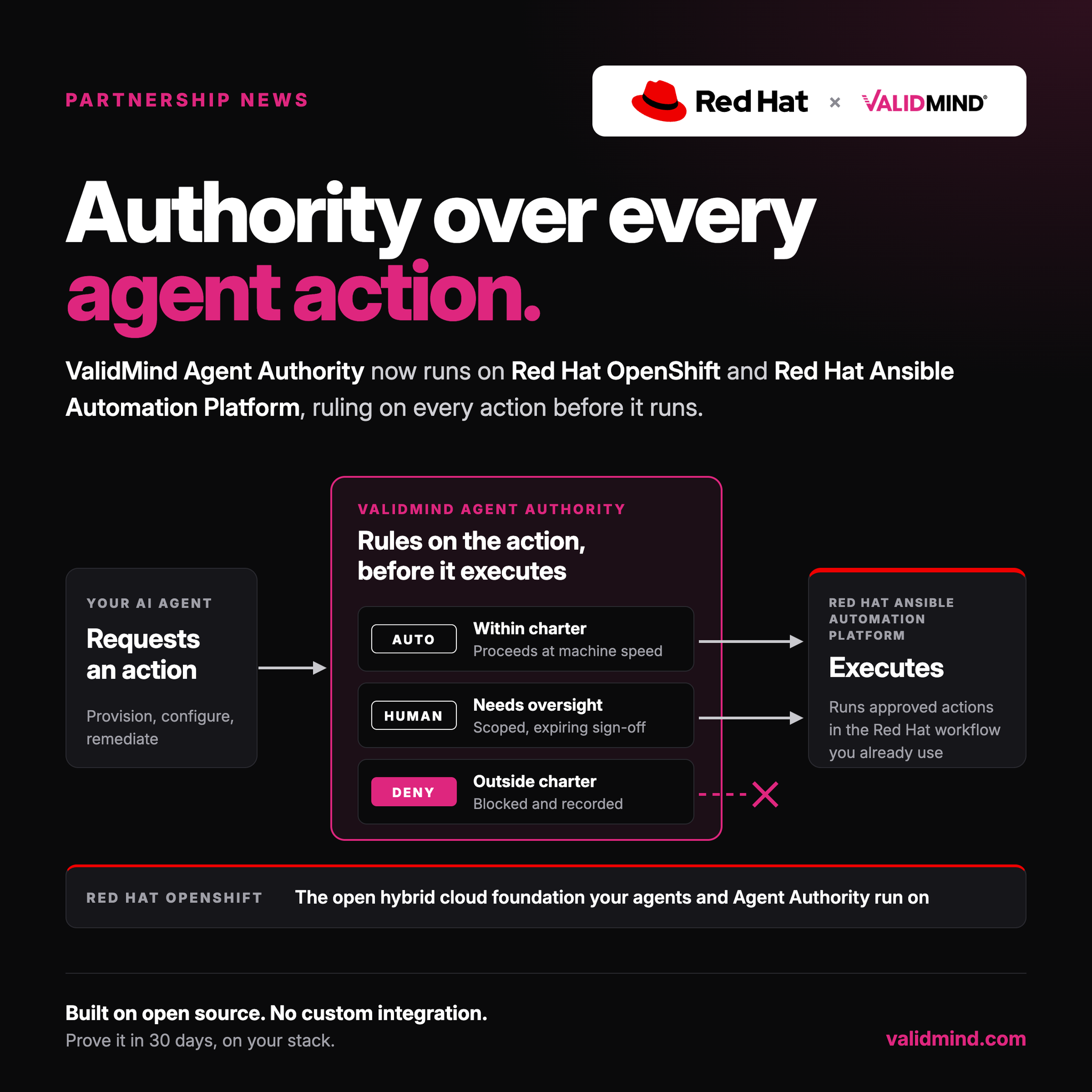
Most teams, reaching for control, build authority into the agent: permission sets in the prompt, guardrails in the model, a safety layer shipped alongside the weights. That design fails in a predictable way. The agent becomes both the executor and the arbiter of its own boundaries, and at machine speed, the arbiter loses. The only reliable fix is to take authority out of the agent entirely.
To maintain institutional control, authority must be externalized. The Silicon Org Chart provides the architecture for that separation.
- The Brain: the centralized governance layer where charters, risk tiers, and prohibited actions are defined.
- The Muscle: the agent performing the work.
- The Nervous System: a mediation protocol that connects them.
The agent never owns the ability to move money or delete files. It only has the ability to request those actions. Agents own analysis and initiation; the Brain mediates execution. Every grant is an Authority Lease, and the Lease is ephemeral: it expires when the task completes. No standing credentials.
It also makes authority graduated, which is what makes the architecture self-correcting. When the Brain sits between intent and action, the firm can dial an agent’s authority up and down based on observed behavior, the same way a manager gives a promising associate more rope and pulls a drifting one back:
- An agent whose token consumption spikes ten times its baseline is paused pending review, not shut down. Its routine tasks still run; its spending drops to zero until a human signs off.
- An agent who starts hallucinating above tolerance has its high-risk leases revoked automatically. It keeps read-only access. It loses the ability to write.
- An agent with a clean Management Transcript over ninety days earns an expanded charter. More scope, higher limits, less friction. Same logic as a performance review.
When authority lives inside the agent, none of that works. When it lives at the Brain, it becomes routine.

Fig. 2. The Silicon Org Chart. The agent requests; the Brain decides; the manager signs the record.
IV. Manage Agents Like Junior Associates
You do not debug a digital employee. You manage it.
Imagine a sharp junior associate in Accounts Payable. She has a defined scope: match invoices to purchase orders, approve payments up to $10,000, and flag exceptions. Inside that scope, she is fast and reliable. Outside it, she asks. She does not approve a $50,000 invoice because she thinks it is a good idea. She presents the situation, explains her reasoning, and waits for signature.
That is the operating model. The agent is a bounded employee: capable, credentialed, fast, and bounded by design. You do not give a new hire unfettered access to the firm based on a password. You give the agent a job description, a hierarchical charter, and a clear authority ceiling.

Fig. 3. The operating model. One accountable human. Four agents. Each with a name, a charter, a reporting line, and a file.
Most agentic failures happen between fully authorized and fully forbidden. The Three Channels make that middle space manageable.
- Green Channel: routine work inside charter. A $4,800 invoice from an approved vendor with a matching purchase order is greenlighted at machine speed.
- Yellow Channel: a tollgate decision. A $12,000 invoice from an approved vendor is above the charter ceiling. The agent prepares a decision package with reasoning and intent. The manager grants or denies a one-time lease.
- Red Channel: prohibited action. A payment to a sanctioned vendor is blocked at the protocol level. The agent stops and escalates.
The discipline is directed autonomy. Scale does not come from removing the human. It comes from narrowing the decision the human has to make.
V. The Delegation Tree
Your agent does not work alone.
Give an agent a meaningful task. Process this customer onboarding package. It will do what any capable employee does: decompose the work. It calls a KYC sub-agent to verify identity. The KYC sub-agent invokes a sanctions-screening tool. The tool calls a translation agent to normalize a name across scripts. A risk-scoring agent runs a fraud check. A documents agent validates the uploaded forms.
That is not six entities on your org chart. It is one accountable relationship (the agent reporting to its human manager) and a delegation tree five layers deep beneath it.

Fig. 4. The Delegation Tree. Most governance frameworks see only the top two layers. Everything below runs on the agent’s authority, and on the human manager’s signature.
Accountability does not fragment as the tree grows. It cascades. The human manager owns every action taken on her agent’s authority, including the ones two layers down that she never personally approved. She delegates the work, not the accountability.
Most governance frameworks inventory top-level agents and draw a line to a human. They do not see the sub-agents, third-party agents, tools, and APIs invoked on the top-level agent’s authority. The Silicon Org Chart addresses this by mapping relationship chains at machine speed. Authority is inherited correctly down the chain. Any action taken anywhere in the tree can be traced back to a single human at the top. Without that mapping, you have the illusion of governance.
Without that mapping, you have the illusion of governance.
VI. The Management Transcript: Managing Behavior by Recording Intent
You do not debug an agent. You shape its behavior by managing intent.
An agent’s accuracy tells you what it did. Its intent tells you why. At scale, the why is where management lives. It is the difference between a decision you can defend and a decision you cannot.
An API log tells you what happened. A Management Transcript tells you why. In the 2026-2027 enforcement window of DORA (the Digital Operational Resilience Act) and the EU AI Act, technical logs are not a defense. They record mechanics, not reasoning, and the regulator is asking for reasoning. That is where fiduciary duty lives. What the regulator wants is Active Supervision: a Narrative of Intent.
The primary output of the Silicon Org Chart is the Management Transcript, and every step in it is a step in managing intent:
Management Transcript: Agent request -> reasoning -> manager review -> authority lease -> action completed.
Every line captures intent. The request names what the agent wants to do. The reasoning names why. The review names the risk the manager weighed. The lease names the boundary she accepted. The action closes the loop.
This is how a firm manages a digital workforce at scale. Drift between what the agent said it was doing and what it actually did becomes a reviewable event, not a forensic reconstruction.
VII. The Executive Mandate
The Chief AI Officer builds and procures models. The COO runs people, processes, and production. As agents move from tools to workers, the management challenge becomes an operating problem, not just a technology problem.
The strategic advantage will not go to the firm with the fastest model. It will go to the firm with the most resilient management infrastructure.
Agents are operations. They belong in operations. The Silicon Org Chart is not a governance framework layered on top of the firm. It is the COO’s new operating system.
VIII. The Six Moves, in order
Architecture.
- Externalize authority and fund the management layer. Take authority out of the agent and put it in a centralized Brain that can grant and revoke at machine speed. 2.
- Separate request from action. The agent requests, the Brain decides, and the action fires only through the mediation protocol
Operating model.
- Charter the agent, kill standing credentials, and wire the Three Channels. Define scope, authority ceiling, prohibited actions, Green routine work, Yellow tollgates, and Red blocked actions.
Evidence.
- Map the Delegation Tree. Inventory the sub-agents, tools, and third-party APIs every agent invokes on its authority.
- Record the Management Transcript. Capture the reasoning, risk weighed, lease granted, and action taken for every Yellow-channel request.
Ownership.
- Name the owner, and put the workforce in the COO’s portfolio. Every agent in production needs an accountable human with a name, not a team.
IX. The Fiduciary Mandate
Innovation without a reporting structure is not leadership. It is an abdication of duty. The question is simple. When the next agent acts inside your firm, can you name its manager, read its charter, and produce its transcript? If the answer is yes, you have built the architecture. If the answer is no, you have not yet started.
The board test is mechanical: Who is the agent’s manager? What is the agent’s charter? Can you produce its transcript?
If those answers are on paper, you have a Silicon Org Chart. If any answer is improvised, you do not.
It is time to give your AI a reporting line.
Sources
- Jensen Huang quote: All-In Podcast, Jensen Huang LIVE: Nvidia’s Future, Physical AI, Rise of the Agent, Inference Explosion, AI PR Crisis, March 19, 2026; All-In Podcast LinkedIn video transcript, Jensen Huang on the future of coding: Every engineer is going to have 100 agents.
- Meta agent incident. “Meta discloses Sev-1 after internal AI agent posts unreviewed technical advice to company forum,” TechCrunch, March 18, 2026; “The AI agent that broke Meta’s change-management process,” Unite.AI, March 2026. Additional reporting on the agent’s autonomous publication, the two-hour exposure window, and the post-authentication credential blind spot: The Guardian, March 20, 2026; VentureBeat, March 2026; PointGuard AI, March 23, 2026; Safestate, March 25, 2026. The Meta Director of Safety and AI Alignment Gmail-deletion incident: TechCrunch, February 23, 2026.
- BNY Mellon. Robin Vince, remarks at BNY investor day, March 2025; “Over 100 ‘digital employees’ work at this Wall Street bank,” Axios, October 2025; “BNY unveils updated Eliza platform,” Fortune, September 2025; “BNY builds ‘AI for everyone, everywhere’ with OpenAI,” OpenAI, 2025.
- JPMorgan Chase. “Here’s JPMorgan Chase’s blueprint to become the world’s first fully AI-powered megabank,” CNBC, September 30, 2025; Jamie Dimon, Bloomberg interview, October 8, 2025.
- Allianz. “Allianz launched its first agentic AI to automate claims,” Allianz newsroom, November 2025; “Allianz partners with Anthropic to accelerate adoption of responsible AI,” Reinsurance News, January 2026.
- Cisco / Splunk. State of AI Security 2026, Cisco, February 2026; The CISO Report: From Risk to Resilience in the AI Era, Splunk / Cisco, February 2026 (n=650 global CISOs).
- Gartner. “40% of Enterprise Apps Will Feature Task-Specific AI Agents by 2026,” Gartner press release, August 2025; “Over 40% of agentic AI projects will be canceled by end of 2027,” Gartner Predicts 2026, Infrastructure & Operations.
- Agents of Chaos. Bau Lab (Northeastern), with collaborators at Harvard, MIT, Stanford, and Carnegie Mellon, 2026. agentsofchaos.baulab.info.
- Cloud Security Alliance / Token Security. Autonomous but Not Controlled: AI Agent Incidents Now Common in Enterprises, CSA, April 21, 2026; reporting via Infosecurity Magazine, April 21, 2026.
- U.S. banking regulatory exposure. Carter Pape, “Unpatched AI flaw poses risk to banking sector,” American Banker, April 21, 2026, citing 2023 Interagency Guidance on Third-Party Relationships (Federal Reserve, FDIC, OCC) and the federal banking agencies’ 36-hour computer-security incident notification rule.
- EU supervisory authority guidance. Nannini, L., Smith, A. L., Maggini, M. J., Panai, E., Feliciano, S., Tiulkanov, A., Maran, E., Gealy, J., and Bisconti, P., “AI Agents Under EU Law: A Compliance Architecture for AI Providers,” arXiv:2604.04604v1, April 2026, citing February 2026 guidance from the Spanish Data Protection Authority (AEPD) and the Dutch Data Protection Authority on agentic AI deployer accountability.
- Chief AI Officer adoption. “The State of AI: Key Insights from the 2026 Leadership Survey,” Data Privacy + Cybersecurity Insider, January 2026; Fortune/Deloitte CEO Survey, Fall 2025.