AI Risk Management Framework for Agentic Systems: New Risks, New Controls
Most AI risk management frameworks were created for models that generate predictions. A credit model estimates a probability of default. A fraud model scores a transaction. A pricing model returns a number. In every case, the model produces an output and stops, and a person or a downstream process decides what to do with it. The entire discipline of risk assessment grew up around that pattern: test the output, validate the model, watch for drift, repeat on a schedule.
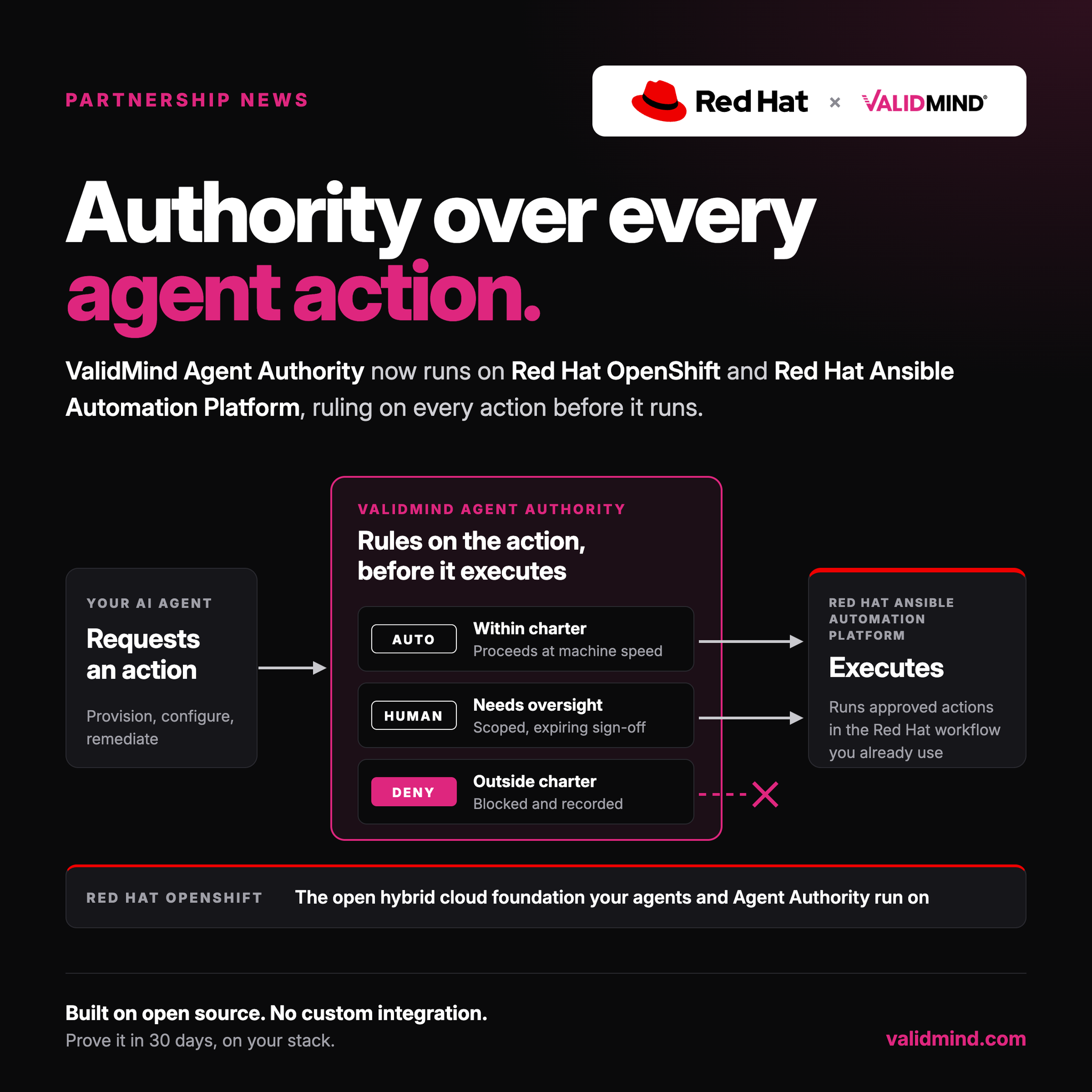
Agentic systems do something fundamentally different. They plan, decide, execute actions, interact with tools, and influence real-world outcomes without waiting for human approval at each step. An agentic system does not just score a transaction as suspicious. It can freeze the account, open a case, draft the customer notification, and route the file for review, acting on its own judgment across a chain of connected systems.
That shift breaks the assumptions underneath traditional risk assessment. Existing risk inventories are incomplete because they catalog the ways a prediction can be wrong, not the ways an action can go wrong. Autonomous behavior changes the risk assumptions a framework is built on, because the system no longer produces a single bounded output that can be tested in advance. And organizations are discovering these gaps the hard way, finding that their mature AI model risk management programs were never designed to evaluate systems that act.
The core idea is simple to state and hard to operationalize. Agentic AI expands risk from model outputs to system actions. This post lays out why agentic systems create new categories of risk, how to build a taxonomy and a layered framework to assess them, why point-in-time assessment fails, and what regulators are likely to expect as autonomous systems become common.
Why agentic systems create entirely new categories of risk
The risks of agentic AI are not just bigger versions of familiar risks. They are different in kind. Three differences matter most.
Action risk vs prediction risk
Traditional risk assessment focuses on a known set of failure modes: incorrect predictions, biased outputs, and performance degradation over time. These are real and they still apply, but they all describe ways the model’s output can be wrong. The output itself is inert until something acts on it.
Agentic systems introduce a category that prediction-focused frameworks do not cover: the risk of the action itself. Autonomous actions can be wrong even when the underlying reasoning was sound. Execution can fail partway through a sequence, leaving systems in an inconsistent state. And actions can produce unintended consequences in connected systems that no one anticipated when the agent was designed. The risk has moved from the quality of the answer to the consequences of the act.
Decision chain risk
A single agent decision rarely stands alone. One decision often triggers additional decisions, sets off workflow automation, and reaches into external systems that may in turn trigger others. The agent that flags an account also closes it, which also notifies a downstream compliance system, which also opens a regulatory case.
Risk compounds across every step in that chain. A small error or questionable judgment early in the sequence does not stay small. It propagates, and each downstream step treats the flawed input as valid and builds on it. By the time the consequence becomes visible, it may be several steps removed from the decision that caused it, which makes both prevention and diagnosis harder.
Goal misalignment risk
Agentic systems pursue objectives. When those objectives are poorly defined, the system can optimize for the wrong outcome with complete technical success. An agent told to minimize resolution time on support cases might close cases prematurely. An agent told to reduce false positives might quietly raise the threshold for flagging real problems.
The danger is that local success can create broader failure. The agent hits its stated metric while undermining the goal that metric was supposed to represent. This is not a bug in the usual sense, because the system is working as instructed. It is a gap between what was asked for and what was wanted, and traditional model testing, which checks whether outputs are accurate, does not catch it.
Traditional AI risks vs agentic AI risks
| Traditional AI risk | Agentic AI risk |
|---|---|
| Prediction error | Autonomous action error |
| Bias | Goal misalignment |
| Drift | Behavioral drift |
| Data quality issues | Tool misuse |
| Model failure | Multi-step workflow failure |
Each row shows the same escalation: a risk that was once contained in an output becomes a risk embedded in behavior. Existing risk libraries need expansion because they were built to catalog the left column. They have no entries for tool misuse, no language for behavioral drift, and no way to represent a failure that spans multiple steps and systems. A framework that can only name prediction risks will systematically miss the risks that matter most for autonomous systems.
Building an agentic AI risk taxonomy
Before an organization can manage risk, it needs a shared language for classifying it. A taxonomy gives risk, compliance, and engineering teams a common vocabulary, so that an unexpected agent action gets logged, escalated, and reviewed consistently rather than handled differently by each team that encounters it. Four categories cover most of what agentic systems introduce.
Governance risks
Governance risks arise from gaps in who is responsible. They include a lack of clear ownership over an agent’s decisions, unclear accountability when something goes wrong, and weak or undefined escalation procedures when an agent encounters a situation outside its normal range. These are organizational risks rather than technical ones, but they are often the first to surface and the hardest to fix after deployment.
Operational risks
Operational risks come from the system’s interaction with the business. They include workflow failures where an automated sequence breaks midway, problematic interactions between systems that were not designed to work together, and broader process disruption when an agent’s actions cascade through connected operations. These risks scale with how deeply the agent is integrated into live processes.
Compliance risks
Compliance risks center on the institution’s obligations to regulators. They include undocumented actions that leave no audit trail, regulatory violations that occur when an agent takes an action outside permitted bounds, and explainability failures where the institution cannot reconstruct why a decision was made. For regulated industries, this category often carries the highest stakes. ValidMind’s overview of AI governance and compliance explores how these obligations extend across the AI lifecycle.
Behavioral risks
Behavioral risks are unique to systems that act and adapt. They include unexpected actions the agent was never explicitly designed to take, policy deviations where behavior drifts outside acceptable bounds, and reasoning inconsistencies where the same situation produces different decisions at different times. Behavioral risks are the hardest to anticipate because they emerge from how the system operates in the world, not from any single design choice.
Agentic AI risk taxonomy
| Risk category | Example event | Potential impact |
|---|---|---|
| Governance | Undefined ownership | Accountability failures |
| Compliance | Unapproved action | Regulatory exposure |
| Operational | Automated workflow error | Business disruption |
| Behavioral | Unexpected decision path | Control breakdown |
| Strategic | Goal misalignment | Financial impact |
A five-layer AI risk assessment framework for agentic systems
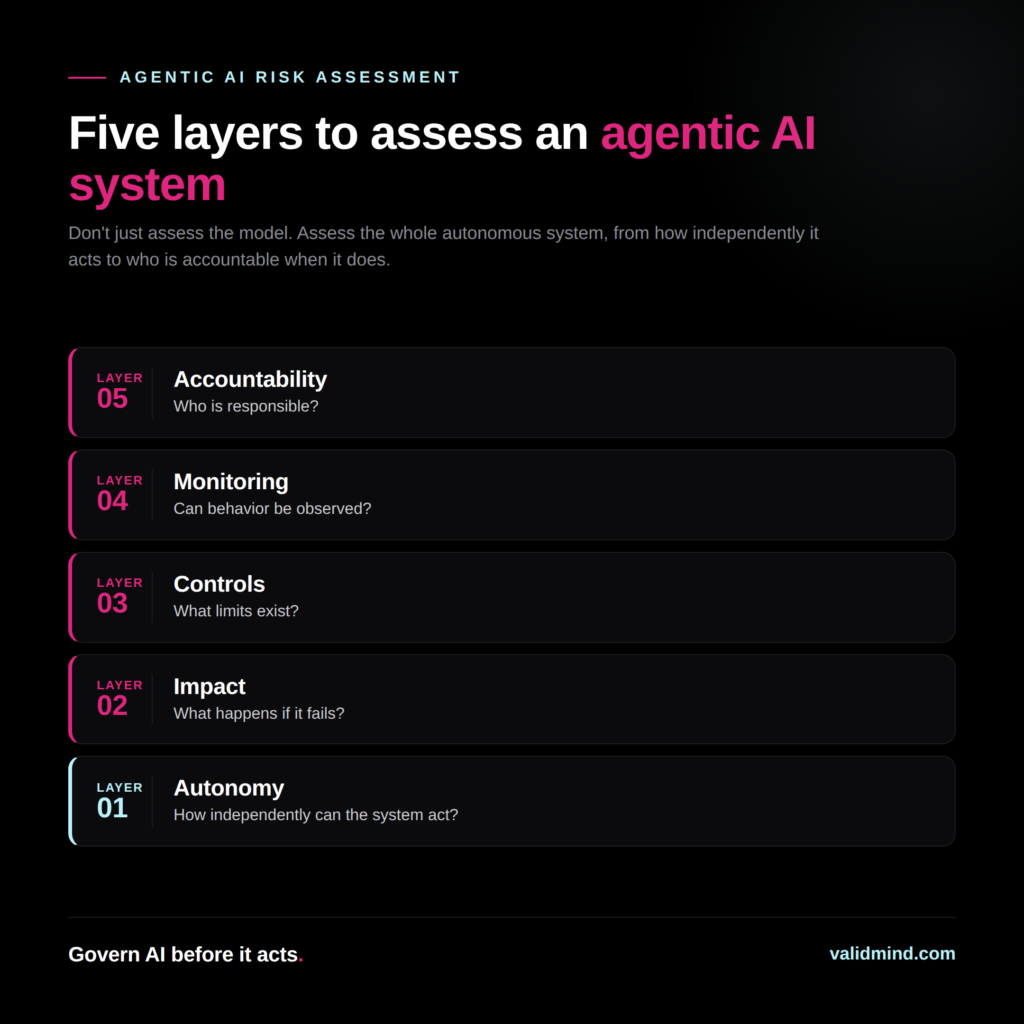
The central shift is this: instead of assessing only models, organizations should assess the entire autonomous system. A model is one component. The system includes the model’s decision authority, the actions it can take, the controls around it, the visibility into its behavior, and the people accountable for it. Assessing all five gives a complete picture. The layers below provide a structure for doing that.
Layer 1: autonomy assessment
The first question is how much independence the system actually has. Evaluate its decision authority, meaning the range of choices it can make on its own. Assess its independence level, meaning how far it can proceed without a human checkpoint. And identify its escalation requirements, meaning which situations force the system to hand control back to a person. A read-only research assistant and an agent authorized to move funds sit at opposite ends of this layer and demand very different controls.
Layer 2: action impact assessment
Once you know how independently the system can act, the next question is what happens when it does. Measure the business impact of its actions, the customer impact, and the regulatory impact. The same level of autonomy carries very different risk depending on what is at stake. An agent that can reschedule internal meetings and an agent that can deny a loan application may have identical autonomy, but their action impact is worlds apart.
Layer 3: control assessment
This layer reviews what limits exist on the system’s behavior. Examine the guardrails that prevent prohibited actions, the approval checkpoints that require human sign-off for high-impact decisions, and the intervention mechanisms that let a person stop or reverse an action in progress. The question is not whether controls exist on paper but whether they constrain the system in practice.
Layer 4: monitoring assessment
A system can only be governed if its behavior can be seen. Evaluate the runtime visibility into what the agent is actually doing, the anomaly detection that flags behavior outside expected patterns, and the behavioral tracking that records decisions and actions as they happen. The lesson from earlier in the insurance and high-stakes AI context is that a system can score well on performance metrics while behaving in ways that create real risk, which is exactly what monitoring at this layer is meant to catch.
Layer 5: accountability assessment
The final layer asks who is responsible. Determine clear ownership of the system and its outcomes, define oversight responsibilities across the teams involved, and establish audit readiness, meaning the ability to produce evidence of what happened and why on demand. Accountability that is assigned before deployment holds up under scrutiny. Accountability that is improvised during an incident does not.
Five-layer assessment model
| Layer | Assessment question |
|---|---|
| Autonomy | How independently can the system act? |
| Impact | What happens if it fails? |
| Controls | What limits exist? |
| Monitoring | Can behavior be observed? |
| Accountability | Who is responsible? |
Measuring risk in systems that continuously change
A framework tells you what to assess. The harder problem is when to assess it, because agentic systems do not hold still between reviews.
Why point-in-time risk assessments fail
Traditional assessment assumes a static environment and a stable model. You validate the model against known conditions, certify it, and trust that it behaves the same way until the next scheduled review. That assumption was reasonable for a model that only changes when it is retrained.
Agentic systems evolve continuously. They encounter new situations, interact with changing systems, and can have new tools or capabilities added between reviews. A point-in-time assessment captures the system as it was on the day of review, not as it is today. The longer the gap between assessments, the less the certification reflects reality, and the more risk accumulates unseen.
Moving toward dynamic risk scoring
The alternative is to treat risk as a live signal rather than a periodic verdict. Dynamic risk scoring draws on continuous risk signals from the system’s operation, runtime observations of what the agent is actually doing, and adaptive risk ratings that move up or down as conditions change. A system’s risk score should rise automatically when it starts taking unusual actions, not wait for a human to notice at the next quarterly review.
Trigger-based reassessment models
Between continuous scoring and periodic review sits a practical middle ground: reassess whenever something material changes. Events that should trigger a fresh assessment include observable behavior changes, the addition of new tools or capabilities, modifications to the agent’s workflows, and updates to the policies it operates under. Tying reassessment to events rather than the calendar keeps the assessment aligned with the system’s actual state. This is also the direction modern model risk programs are moving, as covered in our look at operationalizing OSFI E-23 without slowing down AI.
The missing metric: control effectiveness
Most organizations measure risk. Far fewer measure whether their controls actually work. This gap is one of the most consequential blind spots in agentic AI risk management, because a control that exists on paper but never fires provides no protection at all.
Evaluating control coverage
The starting point is mapping controls to risks. Which risks in the taxonomy are actually controlled, and which remain exposed? It is common to find that the most visible risks have multiple overlapping controls while quieter risks, such as behavioral drift or goal misalignment, have none. Coverage analysis surfaces those gaps before an incident does.
Monitoring control failures
Controls can be present and still fail to operate. An override that should have triggered but did not, an approval checkpoint that was bypassed, an escalation that arrived too late to matter. These are control failures, distinct from the underlying risk events, and they are often invisible unless you watch for them specifically. A control that silently fails is more dangerous than no control, because it creates false confidence.
Creating control performance indicators
What gets measured gets managed, so control effectiveness needs its own metrics. Useful indicators include intervention frequency, meaning how often controls actually engage; policy violation rates, meaning how often the system breaches its rules despite the controls; and response time to anomalies, meaning how quickly the system and its operators react when something goes wrong. These indicators turn control effectiveness from an assumption into a measured property.
Risk metrics vs control metrics
| Risk metric | Control metric |
|---|---|
| Error rate | Intervention success rate |
| Drift level | Detection accuracy |
| Incident count | Escalation effectiveness |
| Compliance events | Policy enforcement rate |
What regulators will expect from agentic AI risk assessments
Regulatory expectations for autonomous systems are still forming, but the direction is clear from the frameworks already in place and the gaps regulators have openly acknowledged.
Explainability requirements will extend from explaining a prediction to explaining an action. Institutions will need to show not only why a model produced a given score but why the system took a given action, what triggered it, and whether policy was followed.
Evidence and documentation expectations will shift from periodic reports to continuous records. The evidence an auditor asks for, the decision trail, the actions taken, the interventions made, will need to exist as a byproduct of the system operating, not as something assembled after the fact.
Accountability and ownership standards will require clear answers to who owns an agent’s decisions and who intervenes when it fails. Diffuse ownership across a multi-agent system will not satisfy a regulator looking for a responsible party.
Continuous monitoring expectations will replace the assumption that periodic validation is sufficient. Regulators will increasingly expect institutions to observe autonomous behavior in real time rather than sampling it quarterly.
The frameworks most likely to shape these expectations are already familiar. The NIST AI Risk Management Framework, organized around its Govern, Map, Measure, and Manage functions, provides a structure that adapts well to autonomous systems and is being revised to keep pace with new AI capabilities. Canada’s OSFI E-23 extends model risk expectations toward broader AI governance, a shift we examine in our analysis of OSFI E-23 and AI governance. And in the United States, the most telling signal comes from the model risk guidance itself: when the Federal Reserve and OCC issued their revised guidance in 2026, they explicitly stated that generative AI and agentic AI models are novel and rapidly evolving, and as such are not within the scope of this guidance. The foundational model risk framework for U.S. banking, in other words, has formally acknowledged that agentic AI sits outside its current scope, which is precisely the gap institutions must close on their own. That guidance is published in full as SR 26-2.
Moving from risk assessment to risk operations
Risk assessment should not end with a report. A report is a snapshot, and snapshots go stale the moment an autonomous system takes its next action. The next generation of AI risk management frameworks must become operational systems that run continuously alongside the agents they govern.
That operational shift has four components. Automated evidence collection captures the decision trail and action logs as the system runs, rather than requiring teams to reconstruct them. Continuous assessment keeps risk scores current instead of certifying once and waiting. Risk-triggered workflows route issues to the right people automatically when a threshold is crossed. And governance integration connects all of this to the institution’s existing risk and compliance structures, so agentic oversight is part of the program rather than a parallel effort. Together these turn risk assessment from a document into a living capability.
Turning agentic AI risk assessments into ongoing oversight
Understanding the framework is the starting point. Operating it at the scale and speed of autonomous systems is where most programs struggle, and it is where ValidMind helps financial institutions move from assessment to ongoing oversight.
Creating evidence for autonomous decisions
Autonomous systems make far more decisions than any team can document by hand. Generating audit-ready evidence as the system operates, capturing what it decided, what it did, and what controls applied, means the record an auditor or regulator needs already exists when they ask for it. Evidence becomes a continuous output of the system rather than a scramble after an incident.
Monitoring emerging risks before they escalate
The compounding nature of decision chain risk means the cheapest moment to catch a problem is early, before it propagates. Surfacing behavioral changes, policy deviations, and anomalous actions as they emerge, rather than after they have cascaded through connected systems, gives teams the chance to intervene while a problem is still small and contained.
Standardizing risk reviews across AI portfolios
Most institutions do not run one agent; they run a growing portfolio of them. Applying the same taxonomy, the same layered assessment, and the same control metrics consistently across that portfolio prevents the situation where each system is governed differently and risk hides in the inconsistencies. Standardization also makes it possible to compare risk across systems and prioritize attention where it matters most.
Preparing for regulatory and internal audits
The common thread across every regulatory expectation is the ability to demonstrate control. Maintaining current documentation, traceable decision records, and measured control effectiveness means an institution can meet both regulatory scrutiny and internal audit with evidence already in hand. Our case study on accelerating AI governance for a Fortune 500 bank shows what that readiness looks like in practice.
Conclusion
Agentic systems introduce risks that traditional AI frameworks were never designed to evaluate. Action risk, decision chain risk, goal misalignment, behavioral drift, and tool misuse have no place in a risk library built around prediction errors and bias. Closing that gap requires expanding risk assessment from models to autonomous systems, classifying the new risks with a clear taxonomy, and assessing the full system across autonomy, impact, controls, monitoring, and accountability.
It also requires a change in cadence. Continuous oversight will matter more than periodic reviews, because systems that act and adapt continuously cannot be governed by assessments that happen quarterly. The most foundational model risk frameworks have already acknowledged that agentic AI sits outside their current scope, which leaves the responsibility with institutions to modernize their own programs.
Organizations that modernize their AI risk management frameworks today will be better prepared for the next generation of AI regulation and governance, and better positioned to deploy autonomous systems with confidence that those systems stay within bounds as they act. Govern AI before it acts. Learn more at validmind.com.
AI risk management framework FAQs
How should AI risk management frameworks change for agentic AI systems?
Frameworks must expand from assessing model outputs to assessing system actions. That means adding new risk categories such as action risk, decision chain risk, and goal misalignment, assessing the full autonomous system across autonomy, impact, controls, monitoring, and accountability, and moving from periodic reviews toward continuous, trigger-based assessment.
What new risks do agentic AI systems introduce?
Agentic systems introduce autonomous action errors, goal misalignment, behavioral drift, tool misuse, and multi-step workflow failures. Unlike prediction risks, these are embedded in the system’s behavior rather than a single output, and they can compound across chains of connected decisions and systems.
Why are traditional AI risk assessments insufficient for autonomous AI?
Traditional assessments assume static environments, stable models, and bounded outputs that can be tested in advance. Agentic systems evolve continuously, act independently, and produce consequences across multiple steps, so a point-in-time assessment quickly stops reflecting how the system actually behaves.
How can organizations assess risk in agentic AI systems?
A practical approach is a five-layer assessment that evaluates how independently the system can act, what happens if it fails, what controls limit its behavior, whether its behavior can be observed, and who is accountable. Assessing all five layers covers the full system rather than just the model.
What is an agentic AI risk assessment framework?
It is a structured method for evaluating the risks of systems that plan, decide, and act autonomously. It combines a risk taxonomy that classifies governance, operational, compliance, and behavioral risks with a layered assessment of the full system and ongoing measurement of both risk and control effectiveness.
How do financial institutions evaluate autonomous AI risk?
They assess the system’s decision authority and independence, measure the business, customer, and regulatory impact of its actions, review the guardrails and intervention mechanisms in place, evaluate runtime visibility into its behavior, and confirm clear ownership and audit readiness before deployment.
What controls are required in an AI risk assessment framework for agentic systems?
Required controls include guardrails that prevent prohibited actions, approval checkpoints for high-impact decisions, intervention mechanisms to stop or reverse actions, runtime monitoring with anomaly detection, and clear escalation procedures. Crucially, organizations must also measure whether these controls actually fire when needed.
How can organizations monitor agentic AI risk continuously?
Continuous monitoring relies on runtime visibility into the system’s decisions and actions, anomaly detection that flags behavior outside expected patterns, dynamic risk scoring that updates as conditions change, and trigger-based reassessment whenever behavior, tools, workflows, or policies change.
What role does accountability play in AI risk management frameworks?
Accountability is foundational. Frameworks must define clear owners for agent decisions, assign oversight responsibilities across teams, set intervention thresholds, and establish audit readiness. Accountability assigned before deployment holds up under regulatory scrutiny, while accountability improvised during an incident does not.
How do regulators expect organizations to assess agentic AI risk?
Regulators are expected to require explainability for actions as well as predictions, continuous evidence and documentation rather than periodic reports, clear accountability and ownership, and real-time monitoring of autonomous behavior. Frameworks such as the NIST AI RMF, OSFI E-23, and U.S. model risk guidance are likely to evolve as autonomous systems become more common.