Agentic AI Governance Challenges: What Financial Institutions Must Solve
Financial institutions have spent the last decade learning how to govern predictive AI, but a new area is exposing emerging agentic AI governance challenges. Credit models, fraud scores, and pricing engines all share a common trait: they produce a prediction, a human reviews it, and an action follows. Governance programs, model risk management frameworks, and regulatory expectations were all shaped around that pattern.
Agentic AI breaks the pattern. These systems do not simply predict. They act independently, trigger workflows, call tools and APIs, and make contextual decisions that change as conditions change. An agent can open a case, route a customer, adjust a limit, or escalate an exception without a person in the loop for every step.
Traditional governance programs were built for static models with bounded outcomes. They assume you can test a model once, document it, and revalidate it periodically. Autonomous systems introduce risks that those programs were never designed to control. Behavior shifts in production. Decisions chain together. Accountability blurs across teams and across cooperating agents.
The result is a new mandate for risk, compliance, and model governance teams. The challenge is no longer governing models. It is governing autonomous behavior at scale. This article breaks down why agentic AI is harder to govern, the specific challenges financial institutions face, where existing programs fall short, and the practical shifts teams need to make to stay in control.
Why Agentic AI Is Harder to Govern Than Traditional AI
Autonomous Systems Behave Differently
A traditional model predicts. It takes an input, returns an output, and stops. Governance can focus on whether that output is accurate, fair, and stable over time.
An agentic system decides, acts, and adapts. It interprets a goal, chooses a path, takes an action in a live system, and adjusts based on what happens next. That difference matters because behavior changes dynamically. The same system can take different actions depending on the state of the world when it runs, which means oversight has to follow behavior, not just output quality.
Multi-Step Reasoning Increases Complexity
Agentic systems chain decisions together. A single request can trigger a sequence of reasoning steps, each calling tools and APIs, each triggering downstream systems that may themselves invoke other processes.
Governance can no longer stop at the quality of a final answer. It has to account for the full chain: the decisions made along the way, the actions taken in external systems, and the consequences those actions produce. A defensible governance program needs visibility into all three.
Context Changes Decision Outcomes
With a deterministic model, the same input reliably produces the same output. With an agent, the same prompt does not guarantee the same action. Context, available tools, memory, and the live state of connected systems all influence what the agent chooses to do.
That variability creates real governance risks: inconsistent behavior across similar cases, unpredictable outcomes that are hard to reproduce, and hidden policy violations that surface only under specific conditions. Point-in-time testing rarely catches these because the conditions that trigger them may not exist during validation.
Read more: Agentic AI Governance and Risk Management Strategy for Enterprises
Traditional AI vs Agentic AI Governance Challenges
| Area | Traditional AI | Agentic AI |
|---|---|---|
| Output | Prediction | Autonomous action |
| Risk | Isolated | Cascading |
| Monitoring | Model performance | Behavior plus outcomes |
| Accountability | Model owner | Multiple stakeholders |
| Governance scope | Point-in-time | Continuous |
The implication is straightforward. The control mechanisms that worked for predictive models do not transfer cleanly to autonomous systems. A control framework that monitors a single owner, evaluates a static output, and revalidates on a fixed schedule cannot keep pace with a system that acts continuously, affects multiple downstream processes, and shares accountability across teams. Financial institutions cannot simply extend their existing controls. They need controls built for autonomous behavior.
The Biggest Agentic AI Governance Challenges Financial Institutions Face
Lack of Explainability in Autonomous Decisions
When an agent takes an action, governance teams need to answer three questions: Why did the system make this decision? What triggered the action? Was policy followed? With multi-step reasoning and contextual inputs, those answers are not always available after the fact.
Regulators care about this for the same reasons they always have: accountability, fairness, and transparency. A financial institution that cannot explain why an autonomous system declined an application, flagged an account, or moved a case faces both a regulatory problem and a customer trust problem.
Weak Auditability and Decision Traceability
Traditional audits rely on reports, approvals, and validation evidence collected at known checkpoints. That model assumes decisions happen at a pace and in a form that humans can document.
Agentic AI requires a different kind of evidence. To reconstruct what happened, teams need to trace the decisions the agent made, the actions it took, the tool calls it issued, and the downstream consequences that followed. Without that trace, audits become guesswork, and proving that controls existed becomes nearly impossible.
Governance of Multi-Agent Systems
Increasingly, agents do not work alone. They collaborate, share context, and trigger one another. One agent gathers information, hands it to another that makes a recommendation, which prompts a third to take an action.
This raises a hard accountability question: who owns the outcome when multiple agents contribute to it? If a customer is harmed by a decision that emerged from three cooperating agents, governance needs a clear answer about ownership, and most programs do not have one yet.
Runtime Behavioral Drift
In traditional model risk management, drift means a measurable decline in model performance as data shifts away from training conditions. Teams monitor accuracy, stability, and population shifts to catch it.
Agentic drift is different. It shows up as behavioral change rather than a metric decline. An agent may begin taking unexpected actions, deviating from policy in subtle ways, or developing new decision patterns that were never observed during validation. These shifts can pass every accuracy check while still creating real risk.
Accountability Gaps
Autonomous systems surface organizational questions that many institutions have not resolved. Who owns agent decisions? Who approves exceptions when an agent encounters an edge case? Who intervenes when an agent fails or behaves unexpectedly in production?
When these answers are unclear, governance breaks down at exactly the moment it is needed most: during a failure or an unexpected event.
Top Governance Challenges in Agentic AI
| Challenge | Why It Happens | Risk Created |
|---|---|---|
| Explainability | Complex multi-step reasoning | Regulatory exposure |
| Auditability | Missing decision and action logs | Compliance gaps |
| Behavioral drift | Dynamic, adaptive behavior | Operational failures |
| Multi-agent coordination | Shared and chained actions | Ownership confusion |
| Accountability | Unclear responsibilities | Governance breakdown |
Why Existing Governance and Compliance Programs Struggle
SR 26-2 and Traditional MRM Were Built for Models, Not Agents
Model risk management as most institutions practice it assumes bounded behavior, testable outputs, and periodic validation. SR 26-2 and the frameworks built around it expect a model you can characterize, challenge, and sign off on at a point in time.
Agents do not fit those assumptions. They behave continuously and autonomously, which means a one-time characterization captures only a snapshot of a system that keeps changing. The framework still matters, but it needs to be extended to cover behavior in production, not just performance at validation.
Governance Reviews Are Too Slow
Quarterly or annual reviews work when a model makes a relatively stable set of decisions between checkpoints. They fail when an agent makes thousands of decisions a day, each one a potential point of risk.
By the time a quarterly review surfaces a problem, the agent may have repeated it tens of thousands of times. Autonomous systems need continuous oversight, not periodic inspection.
Existing Monitoring Is Too Narrow
Most production monitoring focuses on accuracy and performance metrics. Those signals are necessary, but they are not sufficient for autonomous systems.
Accuracy monitoring misses behavioral anomalies and downstream effects. An agent can score well on every performance metric while taking an action that violates policy or triggers an unintended consequence three systems away. Monitoring has to widen to capture behavior and outcomes, not just statistical quality.
Why Existing Governance Programs Fall Short
| Existing Governance Practice | Agentic AI Limitation |
|---|---|
| Periodic reviews | Too slow for continuous decisions |
| Static documentation | Quickly outdated |
| Model performance monitoring | Misses behavioral risk |
| Human approval for each action | Does not scale |
| Manual compliance checks | Delayed risk detection |
Governance Challenges Across the Agentic AI Lifecycle
Intake and Risk Classification
Before an agent goes anywhere near production, teams need to determine its autonomy level, its risk tier, and the sensitivity of its use case. An agent that drafts internal summaries is not the same risk as one that can move money or change a customer outcome, and intake has to capture that distinction clearly.
Validation
Validating an agent is harder than validating a model because the target is moving. Teams have to assess unpredictable decisions, adaptive behavior, and multi-step actions, often without a fixed set of expected outputs to test against. Validation has to cover ranges of behavior and guardrails rather than a single correct answer.
Deployment
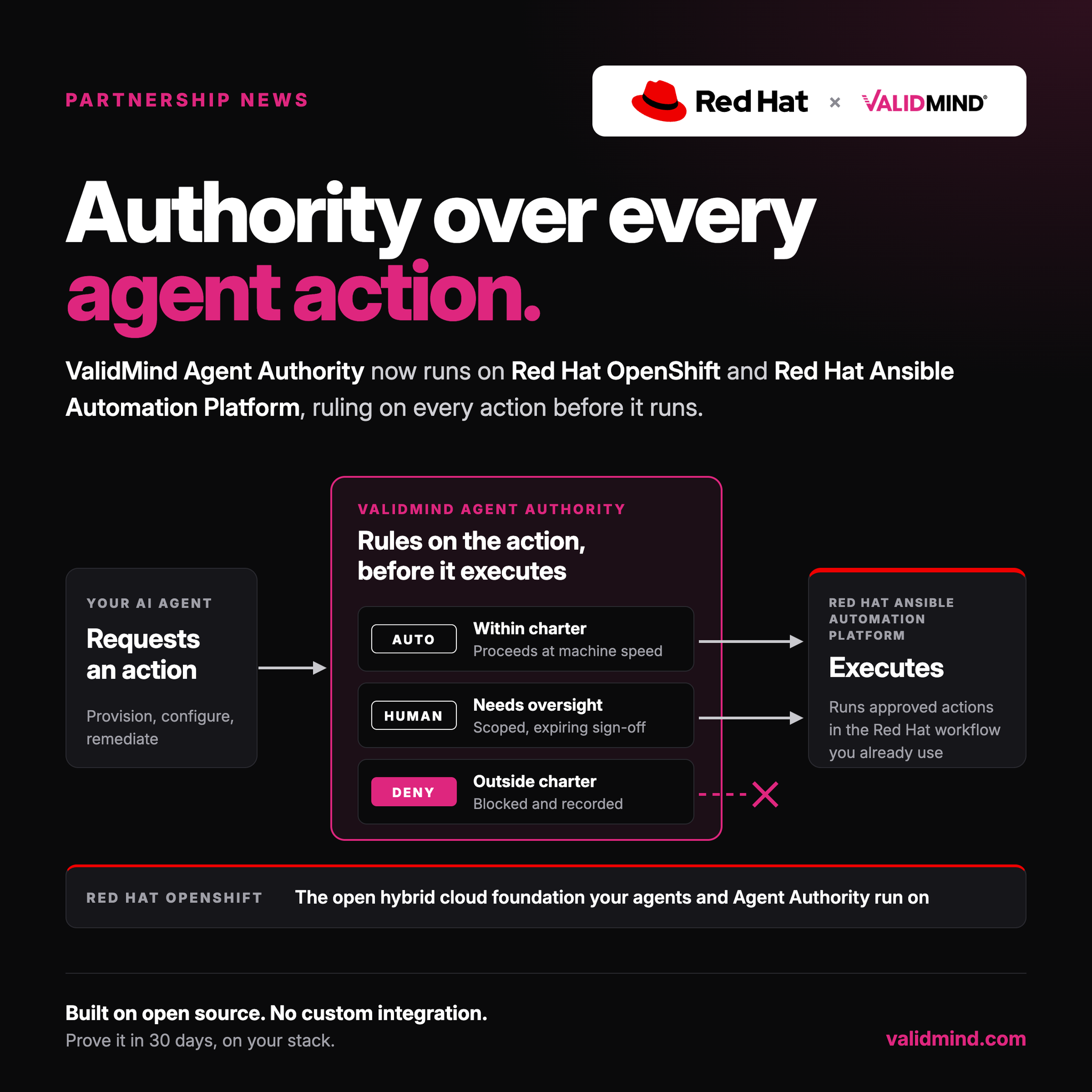
At deployment, the key questions shift from accuracy to control: What guardrails are in place? Which actions require escalation to a human? What are the hard limits the agent cannot cross? These controls need to be defined and enforced before the agent acts, not documented after.
Monitoring
Once live, the agent needs continuous tracking of its runtime behavior, anomalies, and policy violations. This is where behavioral oversight replaces performance monitoring as the primary lens.
Recertification
Periodic recertification was designed for systems that stay still between reviews. For agents that adapt continuously, a fixed recertification cycle leaves long windows where behavior can drift unchecked. Continuous assurance has to supplement, and in some cases replace, the periodic model.
Governance Challenges Across the Lifecycle
| Lifecycle Stage | Key Challenge |
|---|---|
| Intake | Classifying autonomy and risk |
| Validation | Testing unpredictable behavior |
| Deployment | Enforcing guardrails |
| Monitoring | Runtime behavioral oversight |
| Recertification | Maintaining continuous assurance |

What Financial Institutions Must Do to Prepare
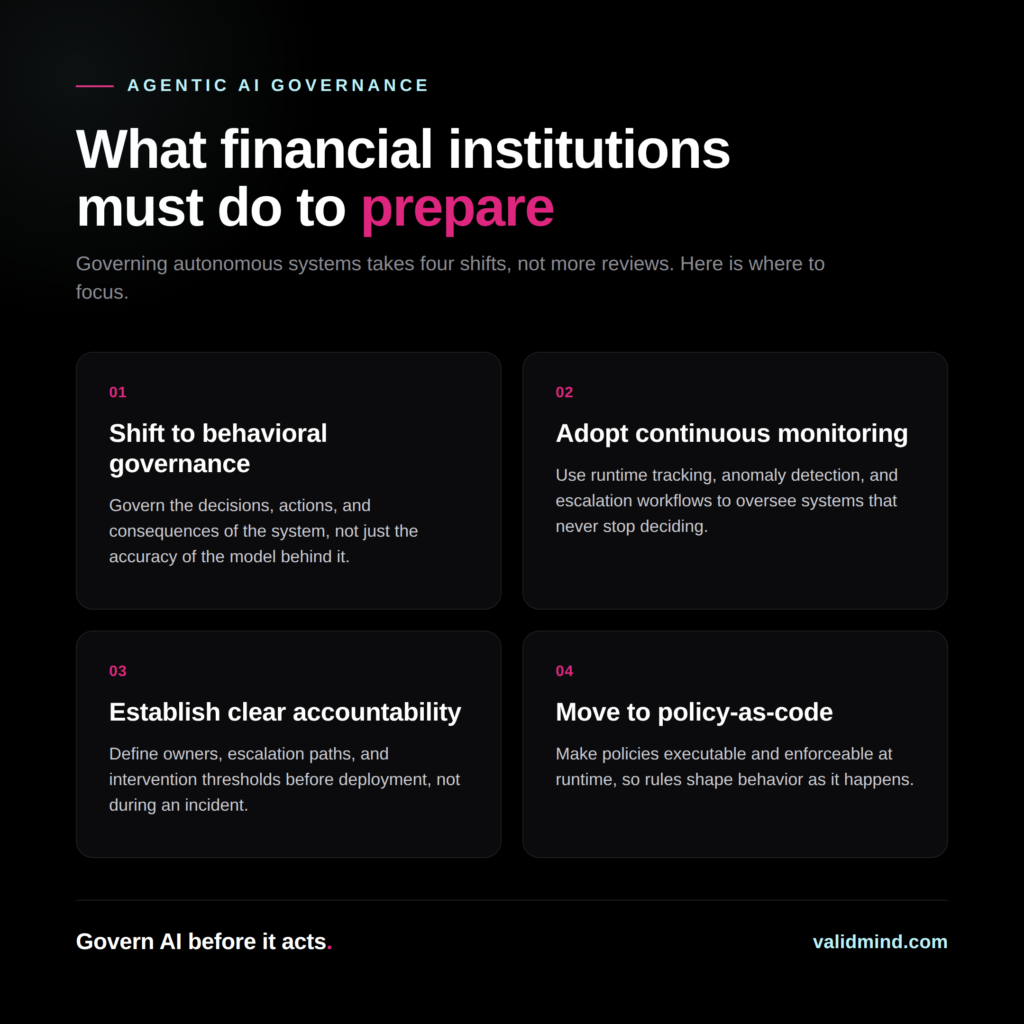
Shift from Model Governance to Behavioral Governance
The center of gravity has to move from the model artifact to the behavior it produces. That means governing decisions, actions, and consequences as first-class objects, with the same rigor institutions once reserved for model documentation. Behavioral governance asks not only whether a system is accurate, but whether it acted within policy every time it acted.
Adopt Continuous Monitoring
Continuous oversight replaces periodic inspection. In practice this means runtime tracking of agent behavior, anomaly detection that flags deviations as they happen, and escalation workflows that route problems to the right people quickly. The goal is to catch issues in hours, not in the next quarterly cycle.
Establish Clear Accountability Models
Every autonomous system needs defined owners, documented escalation paths, and explicit intervention thresholds. Before an agent goes live, the organization should be able to answer who is responsible for its decisions, who approves exceptions, and at what point a human steps in. Clarity here is what holds the rest of the program together.
Move Toward Policy-as-Code Controls
Policies written for humans to interpret cannot keep up with systems that act in milliseconds. Controls have to become executable and enforceable, expressed as policy-as-code that an agent encounters at runtime. This turns a policy from a document people consult into a constraint the system cannot bypass.
Turning Agentic AI Governance Challenges into Operational Controls
Creating Evidence for Autonomous Decisions
Manual documentation cannot keep pace with autonomous systems, so evidence has to be generated automatically as the system operates. Governance teams need decision traceability, runtime logs, and audit-ready evidence captured at the moment each decision and action occurs. The shift is from writing down what a system did to recording it as it happens, so the trail exists when an auditor or regulator asks for it.
Bringing Structure to Autonomous AI Oversight
The accountability gaps and fragmented ownership described earlier are solved with structure, not heroics. Governance teams can establish standardized review workflows, clear approval structures, and defined escalation paths for agentic systems, so that responsibility is assigned before an agent acts rather than debated after something goes wrong. Structure converts ambiguity into a process people can follow under pressure.
Monitoring Behavioral Risk, Not Just Model Performance
Because traditional monitoring misses unexpected actions, policy deviations, and runtime behavior shifts, oversight has to expand to cover behavior directly. Behavioral monitoring, continuous oversight, and anomaly detection give teams a view of what an agent is actually doing in production, not just how a metric is trending. This is the operational answer to behavioral drift: watch behavior continuously and flag departures as they occur.
Preparing for Audit and Regulatory Scrutiny
Regulatory frameworks such as SR 11-7 and OSFI E-23, along with broader AI governance requirements, ultimately ask institutions to prove the same things about autonomous systems that they prove about models. Governance teams need to demonstrate that decisions were explainable, that controls existed and were enforced, and that interventions were documented when they occurred. Building toward that standard now means an institution is ready when scrutiny arrives, rather than scrambling to reconstruct a record that was never captured.
Conclusion
Agentic AI introduces autonomy, complexity, and continuous risk that traditional governance programs were never built to handle. Predictive-era controls, periodic reviews, static documentation, and performance-only monitoring all assume a kind of stability that autonomous systems do not provide.
The path forward is a shift in mindset and in machinery. Financial institutions that want to deploy agentic AI with confidence will move toward continuous oversight, behavioral governance, and stronger accountability models. The institutions that make that shift early will be the ones able to scale autonomous systems without losing control of them, and able to prove it when regulators ask.
Agentic AI Governance FAQs
Why is agentic AI harder to govern than traditional AI systems?
Traditional AI predicts, while agentic AI decides, acts, and adapts. Because agents take autonomous actions across multiple steps and change behavior based on context, governance has to monitor behavior and consequences continuously rather than evaluating a single static output at a point in time.
What are the biggest agentic AI governance challenges in financial services?
The core challenges are explainability of autonomous decisions, weak auditability and decision traceability, governance of multi-agent systems, runtime behavioral drift, and accountability gaps around who owns and intervenes in agent decisions.
How can financial institutions audit autonomous AI decisions?
By capturing evidence at runtime. Teams need automatic decision traceability, logs of actions and tool calls, and records of downstream consequences, so the full chain of an agent’s behavior can be reconstructed for an auditor or regulator.
Why do traditional model governance programs struggle with agentic AI?
Frameworks like SR 11-7 assume bounded behavior, testable outputs, and periodic validation. Agents behave continuously and autonomously, so point-in-time characterization, quarterly reviews, and performance-only monitoring leave gaps that autonomous behavior can slip through.
What risks do multi-agent AI systems create for governance teams?
When agents collaborate, share context, and trigger one another, it becomes unclear who owns the outcome. Shared and chained actions create ownership confusion, making accountability and root-cause analysis difficult when something goes wrong.
How can financial institutions monitor agentic AI behavior in real time?
By adopting continuous monitoring built around runtime behavior tracking, anomaly detection, and escalation workflows, so deviations from expected behavior or policy are flagged as they happen rather than at the next review cycle.
What makes agentic AI difficult to validate and test?
Agents produce unpredictable decisions, adaptive behavior, and multi-step actions, often without a fixed set of expected outputs. Validation has to assess ranges of behavior and guardrails rather than checking a single correct answer.
How should financial institutions manage accountability in autonomous AI systems?
By defining clear owners, escalation paths, and intervention thresholds before deployment, so the organization knows who is responsible for agent decisions, who approves exceptions, and when a human steps in.
What governance controls are needed for agentic AI systems?
Behavioral governance, continuous monitoring, clear accountability models, and policy-as-code controls that are executable and enforceable at runtime, supported by automatic evidence generation for audits.
How can financial institutions prepare for agentic AI governance challenges?
By shifting from model governance to behavioral governance, adopting continuous oversight, establishing clear accountability models, and moving policies toward enforceable code, while building the audit evidence regulators will expect.