Agentic AI Governance and Risk Management Strategy for Enterprises
Enterprises are adopting agentic AI faster than they can govern it. Unlike the predictive models that defined the last decade of enterprise AI, agentic systems act independently, trigger multi-step actions across connected systems, and adapt their behavior in real time. That autonomy is exactly what makes them valuable, and exactly what makes them risky.
The problem is that most enterprise risk management strategies were never designed for systems that change after deployment. Static validation, periodic reviews, and manual oversight assume a model that behaves the same way on day 300 as it did on day one. Agentic AI breaks that assumption. The result is continuous risk exposure and shrinking human visibility into decisions that carry real financial, operational, and compliance consequences.
A modern agentic AI governance and risk management strategy has to shift the center of gravity from static control to continuous governance. This guide breaks down what changes with agentic systems, why traditional approaches fall short, and how enterprises can build a lifecycle-based strategy that scales oversight without slowing down adoption.
Understanding Agentic AI and Its Risk Implications
What Is Agentic AI in the Enterprise Context
Agentic AI refers to systems that can make autonomous decisions, execute multi-step actions to achieve a goal, and adapt dynamically to new inputs without a human approving each step. Where a traditional model returns a prediction or a score, an agent takes action on that output and often chains several actions together.
In practice, enterprises are already running agentic systems in high-stakes environments:
- Autonomous trading systems that execute orders based on evolving market signals
- Decision-making copilots that take actions inside workflows rather than just suggesting them
- Automated underwriting engines that assess, price, and approve without manual intervention
Each of these delivers speed and scale. Each also moves decision-making authority away from people and into systems that operate continuously and adapt on their own.
Why Agentic AI Introduces New Risk Dimensions
1. Autonomous Decision Risk
When an agent makes decisions without explicit human approval, the organization inherits the consequences of every assumption baked into that agent. Incorrect assumptions, edge cases the model never encountered, or subtle shifts in input data can produce unintended outcomes at machine speed and machine scale.
2. Cascading Action Risk
A single agentic decision rarely stops at one action. One decision triggers downstream actions, which trigger others. When something goes wrong upstream, the error doesn’t stay contained; it amplifies across connected systems before anyone notices.
3. Lack of Explainability
Agentic behavior is harder to trace than a single model output. Reconstructing why a decision was made, which inputs influenced it, and what chain of reasoning led to a particular action becomes significantly more difficult, which is a serious problem when auditors, regulators, or risk teams come asking.
Types of Risks in Agentic AI Systems
| Risk Type | Description | Enterprise Impact | Detection Difficulty |
|---|---|---|---|
| Autonomous Decision Risk | AI acts without human input | High financial/compliance risk | High |
| Drift Risk | Model behavior changes over time | Performance degradation | Medium |
| Cascading Risk | A chain of actions is triggered | System-wide failures | High |
| Data Dependency Risk | Input data changes impact output | Bias and inconsistency | Medium |
| Compliance Risk | Regulatory violations | Legal penalties | High |
The critical insight here is that these risks are interconnected. Drift feeds autonomous decision risk; a single bad decision cascades into system-wide failures; data dependency issues surface as compliance violations. Treating each risk in isolation leaves the connective tissue ungoverned, which is precisely where agentic failures originate.
Read our whitepaper: Governing Agentic AI in Financial Services
Why Traditional AI Risk Management Strategies Fail
Traditional model risk management (MRM) frameworks were built for a different kind of model: static, predictable, and validated on a periodic schedule. Those assumptions hold reasonably well for a credit scorecard reviewed once a year. They collapse the moment a system continues to learn, act, and evolve after it goes live.
Static Validation Cannot Handle Dynamic Behavior
Conventional validation happens once, before deployment. You test the model, document it, approve it, and move on. But agentic AI keeps evolving after deployment, which means the system you validated is not the system running in production six months later. Without continuous validation, the approval becomes a snapshot of a moment that has already passed.
Lack of Real-Time Monitoring Capabilities
Most enterprise monitoring is reactive and periodic. Someone pulls a report, reviews metrics, and flags issues after the fact. Agentic systems demand real-time tracking and behavioral analysis, because by the time a quarterly review catches a problem, the agent may have executed thousands of decisions on a faulty premise.
Fragmented Risk Visibility Across Systems
Enterprises typically run separate tools for validation, monitoring, and reporting, each owned by different teams. The result is no unified view of risk. When risk data is scattered across disconnected systems, no one can answer the most important question: what is our total exposure across every agent in production right now?
| Aspect | Traditional AI Risk Management | Agentic AI Requirements |
|---|---|---|
| Validation | One-time | Continuous |
| Monitoring | Periodic | Real-time |
| Governance | Policy-based | System-driven |
| Risk Visibility | Fragmented | Centralized |
| Response | Manual | Automated |
The throughline is unmistakable: enterprises have to move from one-time, fragmented, manual oversight toward continuous, centralized, system-driven risk governance.
Core Components of an Agentic AI Risk Management Strategy
An effective strategy has to account for the three things that make agentic AI different: autonomy, scale, and continuous risk. The components below work together as a system, not as standalone controls.
Continuous Risk Assessment Frameworks
Key capabilities: dynamic risk scoring, continuous evaluation, and adaptive thresholds that adjust as conditions change.
Why it matters: risk in an agentic system is not a fixed property you measure once. It moves with the model’s behavior, its inputs, and its environment. A framework that scores risk continuously (rather than annually) keeps oversight aligned with how the system actually behaves.
Real-Time Monitoring and Drift Detection
Monitoring dimensions: performance metrics, behavioral anomalies, and data drift.
Key outputs: alerts when thresholds are breached, dashboards that surface emerging issues, and automated revalidation triggers that flag when a model has drifted far enough to require review.
Real-time monitoring is what converts governance from a backward-looking audit into a live safeguard.
Human-in-the-Loop Governance Models
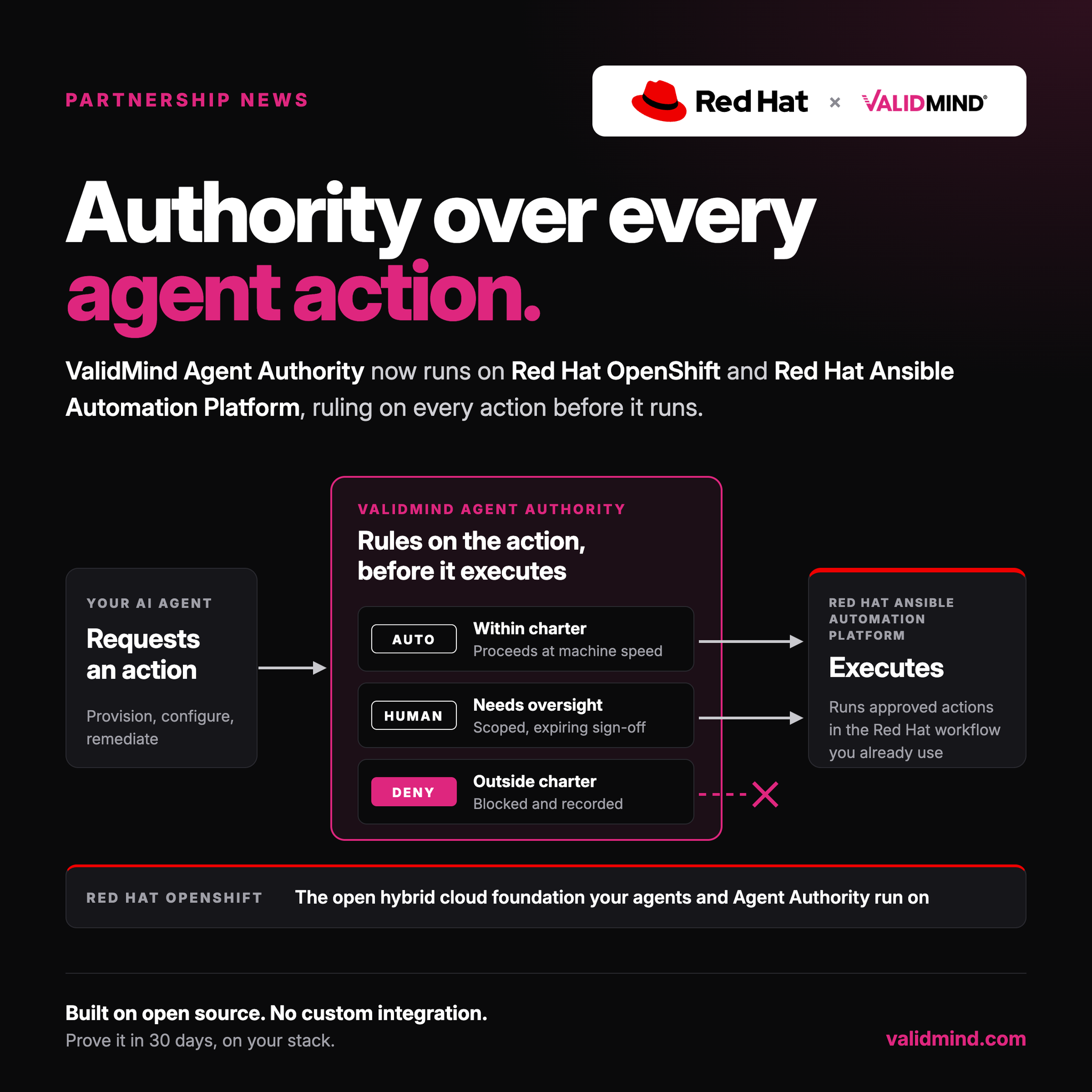
Control mechanisms: approval workflows for high-stakes actions, override systems that let humans intervene, and escalation paths that route decisions to the right reviewer.
When human intervention is needed: high-risk decisions, detected anomalies, and compliance-triggering events. The goal isn’t to put a human in front of every action. That would defeat the purpose of automation. The goal is to ensure humans stay in control of the decisions that matter most.
Risk Thresholds and Escalation Workflows
Threshold design: define acceptable risk levels and map them directly to business impact, so a threshold breach means something concrete to the people who own the consequences.
Escalation layers: automated alerts for minor deviations, human review for material ones, and (where warranted) the ability to pause or shut down a system before damage compounds.
Integrating Risk Management Across the AI Lifecycle
Agentic risk doesn’t live at a single point. It accumulates across every lifecycle stage, which means governance has to be embedded end to end rather than bolted on at validation.
| Stage | Risk Type | Governance Action | Tools Required |
|---|---|---|---|
| Development | Data bias, model design risk | Risk classification | Validation tools |
| Validation | Performance, explainability | Testing and approval | Validation workflows |
| Deployment | Transition risk | Monitoring setup | Deployment controls |
| Monitoring | Drift, anomalies | Continuous tracking | Monitoring systems |
| Revalidation | Performance degradation | Re-assessment | Governance tools |
Pre-Deployment Risk Identification
Before anything goes live, define the model’s purpose, classify its risk level, and assess the data inputs it depends on. This is where you decide how much oversight a given agent warrants. For example, a low-stakes internal copilot and an autonomous underwriting engine should not be governed identically.
Validation and Approval Controls
Validation brings together testing frameworks, complete documentation, and approval workflows. For agentic systems, validation also has to account for behavior under conditions the model will encounter after deployment, and not just the conditions present in training.
Post-Deployment Monitoring and Revalidation
This is where continuous tracking and automated revalidation triggers do their work. The biggest risk gap in nearly every enterprise sits here: well-governed deployment followed by thin, periodic oversight. Closing that gap and making monitoring and revalidation as rigorous as initial validation is the single highest-leverage move in an agentic AI strategy.
Enterprise Challenges in Governing Agentic AI
Lack of Centralized Model Visibility
Without a unified inventory, enterprises can’t reliably answer how many models and agents they’re running, who owns them, or what each one is doing. You cannot govern what you cannot see.
Scaling Risk Oversight Across Systems
Governance that works for a handful of models breaks under hundreds of them, spread across multiple teams with different practices. Oversight has to scale through automation and standardization, not headcount.
Regulatory and Compliance Complexity
Regulations are evolving quickly, and audit expectations are rising alongside them. Enterprises need governance that produces defensible, audit-ready evidence by default, rather than scrambling to reconstruct it when a regulator asks.
The Shift Toward Platform-Driven Risk Management
Manual processes stitched together across fragmented tools simply cannot keep pace with agentic AI. The direction of travel across the enterprise is toward platform-driven governance that unifies oversight in one place.
Centralized Risk Visibility
A single dashboard that delivers enterprise-wide insight into every model and agent, replacing the patchwork of disconnected tools with one source of truth.
Automated Governance Workflows
Validation workflows and approval tracking that run as repeatable, automated processes, so governance keeps pace with the speed of deployment rather than becoming the bottleneck.
Continuous Monitoring Systems
Real-time insight and drift detection built into the platform, so risk is surfaced as it emerges rather than discovered after the fact.
How ValidMind Supports Agentic AI Risk Management
End-to-End Lifecycle Coverage
ValidMind governs models across the full lifecycle, from development through deployment and ongoing monitoring, so risk is managed continuously rather than at isolated checkpoints.
Integrated Validation and Monitoring
Continuous validation and performance tracking work together in one environment, closing the post-deployment gap where agentic risk concentrates.
Audit-Ready Documentation
Structured reporting and compliance-aligned documentation are generated as a byproduct of the governance process, giving risk teams defensible evidence without manual reconstruction.
Enterprise-Grade Risk Oversight
Centralized visibility and standardized governance workflows let enterprises scale oversight across hundreds of models and many teams without sacrificing rigor.
Conclusion
Agentic AI introduces risk that is continuous, complex, and interconnected. The autonomy that makes these systems valuable is the same property that makes traditional, static risk models insufficient. Validation that happens once, monitoring that happens periodically, and oversight that lives in fragmented tools cannot keep up with systems that act and evolve on their own.
The enterprises that govern agentic AI successfully will be the ones that adopt lifecycle-based governance, continuous monitoring, and platform-driven execution as a single, coherent strategy. The shift is fundamental: AI risk management has to evolve from control to continuous orchestration.
Frequently Asked Questions
What is an agentic AI governance and risk management strategy for enterprises? It’s a coordinated approach to overseeing AI systems that act autonomously, combining continuous risk assessment, real-time monitoring, human-in-the-loop controls, and lifecycle-wide governance. Unlike traditional MRM, it assumes the system will change after deployment and is designed to manage risk continuously rather than at fixed checkpoints.
How do enterprises design governance strategies for agentic AI systems? They start by classifying each system’s risk level and mapping it to business impact, then embed governance across every lifecycle stage, from pre-deployment risk identification through continuous post-deployment monitoring. The most effective designs unify these controls on a single platform rather than spreading them across disconnected tools.
What risks are unique to agentic AI in enterprise environments? The defining risks are autonomous decision risk (action without human approval), cascading action risk (one decision triggering many downstream actions), and reduced explainability. These compound with drift, data dependency, and compliance risks, and because they’re interconnected, isolated controls tend to leave the most dangerous gaps unaddressed.
How can enterprises manage autonomous decision-making risks in agentic AI? By defining clear risk thresholds tied to business impact, building approval and override mechanisms for high-stakes decisions, and establishing escalation paths that route material risks to human reviewers. Real-time monitoring ensures these controls trigger before a flawed decision cascades.
What are the key components of an agentic AI governance strategy? Continuous risk assessment frameworks, real-time monitoring with drift detection, human-in-the-loop governance models, and well-defined risk thresholds with escalation workflows. These function as an integrated system rather than as standalone safeguards.
How does agentic AI impact enterprise risk management frameworks? It forces a shift from one-time validation to continuous validation, from periodic to real-time monitoring, from policy-based to system-driven governance, and from fragmented to centralized risk visibility. Frameworks built for static models have to be redesigned around dynamic, evolving behavior.
What role does continuous monitoring play in agentic AI risk management? It’s the safeguard that catches drift, behavioral anomalies, and emerging risk as they happen rather than after the fact. Continuous monitoring also generates the alerts and automated revalidation triggers that keep oversight aligned with how the system is actually behaving in production.
How can organizations implement human-in-the-loop controls in agentic AI systems? Through approval workflows for high-risk actions, override systems that let humans intervene, and escalation paths triggered by anomalies or compliance events. The aim is to keep humans in control of consequential decisions without forcing manual review of every routine action.
What governance challenges do enterprises face when scaling agentic AI systems? The most common are a lack of centralized model visibility, the difficulty of extending oversight across hundreds of models and multiple teams, and rising regulatory and audit complexity. Scaling oversight requires automation and standardization rather than simply adding people.
How do enterprises ensure compliance and audit readiness in agentic AI governance? By generating structured, compliance-aligned documentation as a natural output of the governance process and maintaining centralized, continuous records of model behavior and decisions. This produces defensible evidence on demand rather than requiring teams to reconstruct it during an audit.