The Agentic AI Kill Switch Problem: Why Authority Must Be Revocable
I have been asking a version of the same question in executive sessions lately: when your AI agent is live in production, where does its authority actually live? If that agent begins operating outside policy, can you revoke its ability to act immediately? I do not mean by spinning up a war room, redeploying code, or rotating credentials across multiple systems. I mean deterministically, cleanly, and without destabilizing the rest of your environment. That is the kill switch problem in agentic AI.
Most organizations assume they have an answer, but when you dig deeper, what they are actually describing is an escalation path (a plan for what to do after things go wrong) rather than a control architecture. The distinction becomes critical as agents move from experimentation into operational workflows. A traditional model that produces a flawed prediction creates downstream governance work, but an agent that can initiate transactions or update records creates operational exposure in real time. The failure mode has shifted from model error to control failure.
Governance as the Nervous System of Agentic AI
At this point, the question is no longer about intelligence. It is about authority. If agents are going to function as digital workers, governance must function as their management layer. For years, AI governance programs centered on documentation and post-deployment oversight. That was workable when models were static and advisory. It does not hold when systems are active participants in business processes.
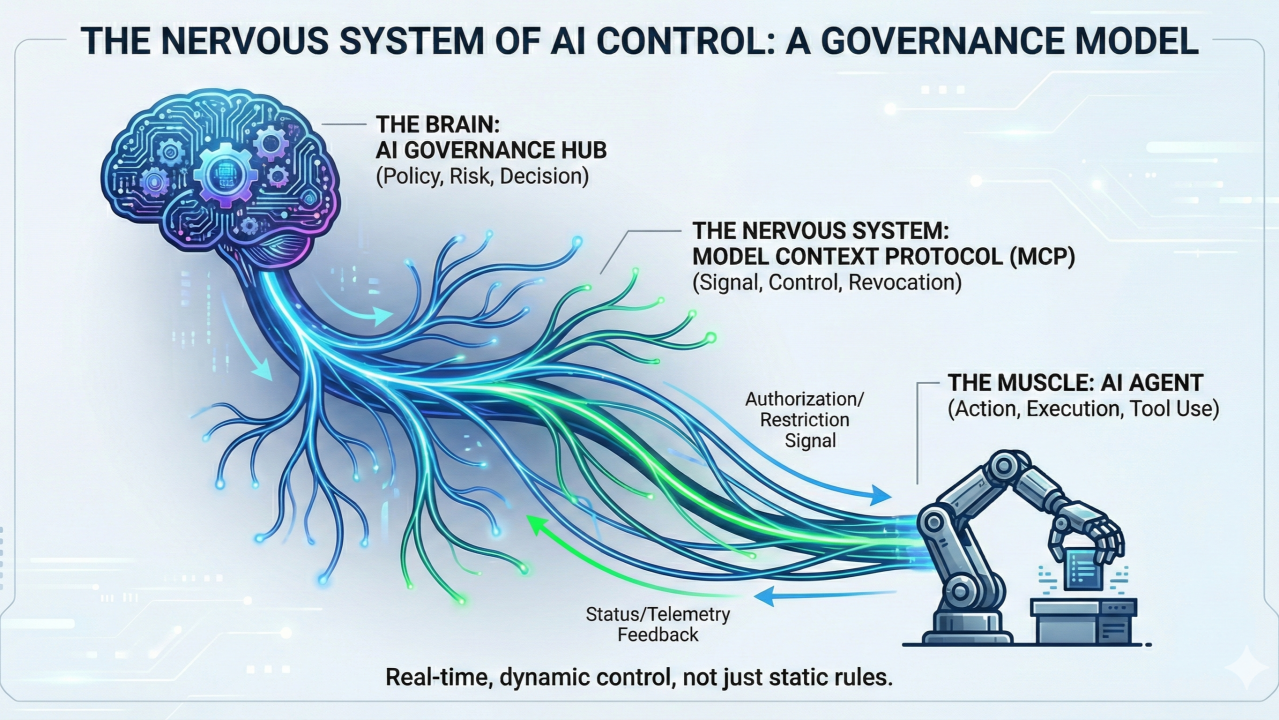
The missing piece in most architectures is the bridge between policy and action. I think of the AI Governance Hub as the brain, the centralized place where risk tiers, transaction limits, and licenses to operate are defined. The Agent is the muscle. But without a nervous system to connect them, the brain has no way to tell the muscle to stop.
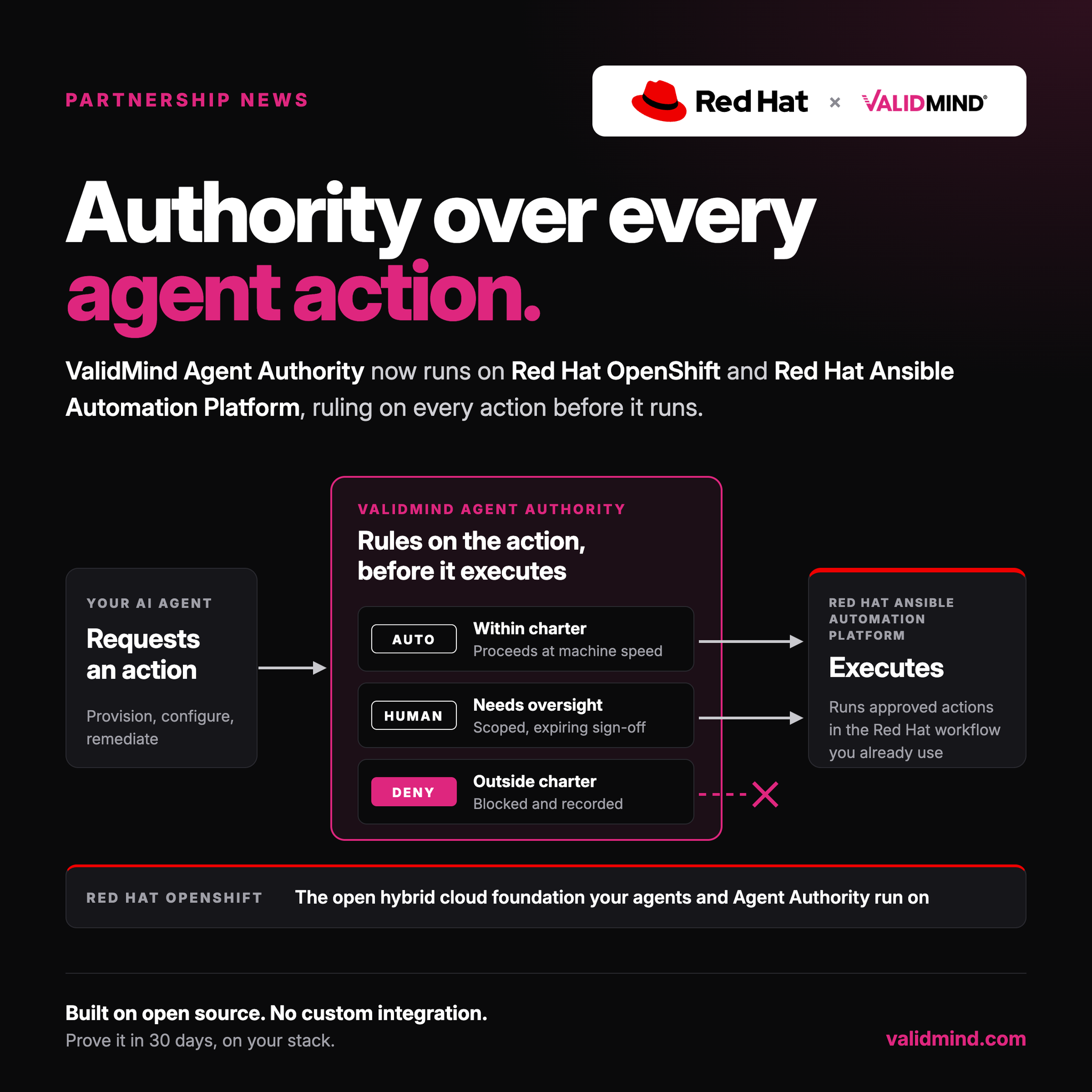
This is where the Model Context Protocol becomes strategically relevant. It acts as that nervous system by connecting the agent to the governance hub in real time. Instead of the agent simply possessing authority, it must request it through the control layer, which calls home to the hub to validate the action against current policy. This transforms governance from a passive audit into active, runtime enforcement.
The Operational Risk of Empowered Mistakes
The deeper risk is not that agents will make mistakes. Mistakes are inevitable in complex systems. The real risk is that agents will make mistakes while still fully empowered to act. In many current architectures, authority is embedded directly inside the agent. Permissions are hardcoded, tool access is assumed, and credentials are persistent. When drift appears, the response is blunt: shut down the service or block the endpoint. That is containment, not control.
True control requires that authority be externalized and evaluated at the moment of action rather than assumed at design time. By using a protocol like MCP as the bridge to a central governance hub, you separate what an agent can reason about from what it is authorized to do. Consider a retail banking agent as a practical example. It may be capable of retrieving balances, summarizing transactions, and initiating wire transfers. In a conventional design, if the agent holds access to the wire transfer API, it can move funds until someone manually cuts the power.
However, in an architecture where authority is mediated externally, the agent does not actually own the ability to move money. It only has the ability to request a transfer. The control layer routes that request to the governance hub, which checks the brain to see if the agent’s license is active, if the transaction is within approved limits, or if the customer’s risk profile has been flagged. If the hub says no, the protocol denies the call. The agent remains active for low-risk tasks like answering balance questions, but its power to move money is withdrawn instantly.

Moving Beyond Binary Control
Mature governance is rarely all or nothing. In a real enterprise, you do not always fire an employee for one error; you restrict their scope. The connection between a control layer and a governance hub makes this graduated authority possible. If anomaly indicators rise, the hub can tell the infrastructure to dynamically lower transaction thresholds or force a human-in-the-loop for the next hour. This is what it means for authority to be truly revocable.
The kill switch problem is not about having a button; it is about whether your architecture supports granular, real-time control over what agents are allowed to do. If authority remains embedded inside the agent, exposure scales with autonomy. If authority is externalized and enforced through a dedicated bridge, autonomy becomes governable. Agents will continue to scale across enterprises, but the real differentiator will not be who deploys them first, but who builds the control architecture required to operate them responsibly. You do not scale by trusting the AI; you scale by trusting the infrastructure that keeps it in check.