Model Risk Management Lifecycle: From Validation to Monitoring
For much of its history, the model risk management lifecycle has had a clear focal point: validation before deployment. A model was built, an independent team tested it, a committee approved it, and it went live. The hard work happened up front, and once a model cleared review the risk was largely considered handled. That made sense in a world of slow-moving statistical models that behaved much the same in year three as they did on launch day.
AI has changed the shape of the problem. Modern models introduce continuous risk and evolving behavior. They retrain, the data feeding them shifts, and the patterns they learned can quietly stop matching the world they operate in. Risk does not stop at deployment. In many cases it begins there. The implication is simple but far-reaching: model risk management must be lifecycle-driven, not a one-time gate.
This guide walks through the full model risk management lifecycle, stage by stage, from initial development and validation to deployment, continuous monitoring, and ongoing governance. It also looks at where the lifecycle tends to break down in practice, and what a continuous, platform-based approach changes.
Why Model Risk Management Must Be Lifecycle-Driven
Limitations of One-Time Validation
The traditional model risk management approach follows a tidy sequence: validate, approve, deploy. It treats validation as the moment risk is resolved. The trouble is that the sequence assumes a static model and a static world. Neither holds for AI. Models change as they retrain, the data they consume evolves, and a validation that was accurate at sign-off can drift out of date within a single quarter. A one-time check cannot catch a risk that emerges six months after approval, because by then the reviewer has long since moved on.
Risk Evolves Across the Model Lifecycle
Model risk is dynamic and continuous. It does not sit still at a fixed level once a model is approved. It shifts across every stage of the lifecycle, rising when input data changes, when usage patterns move, or when the environment the model was trained on no longer reflects reality. A lifecycle view accepts this and builds controls at each stage rather than concentrating them all at one checkpoint. The rest of this guide follows the lifecycle in order.
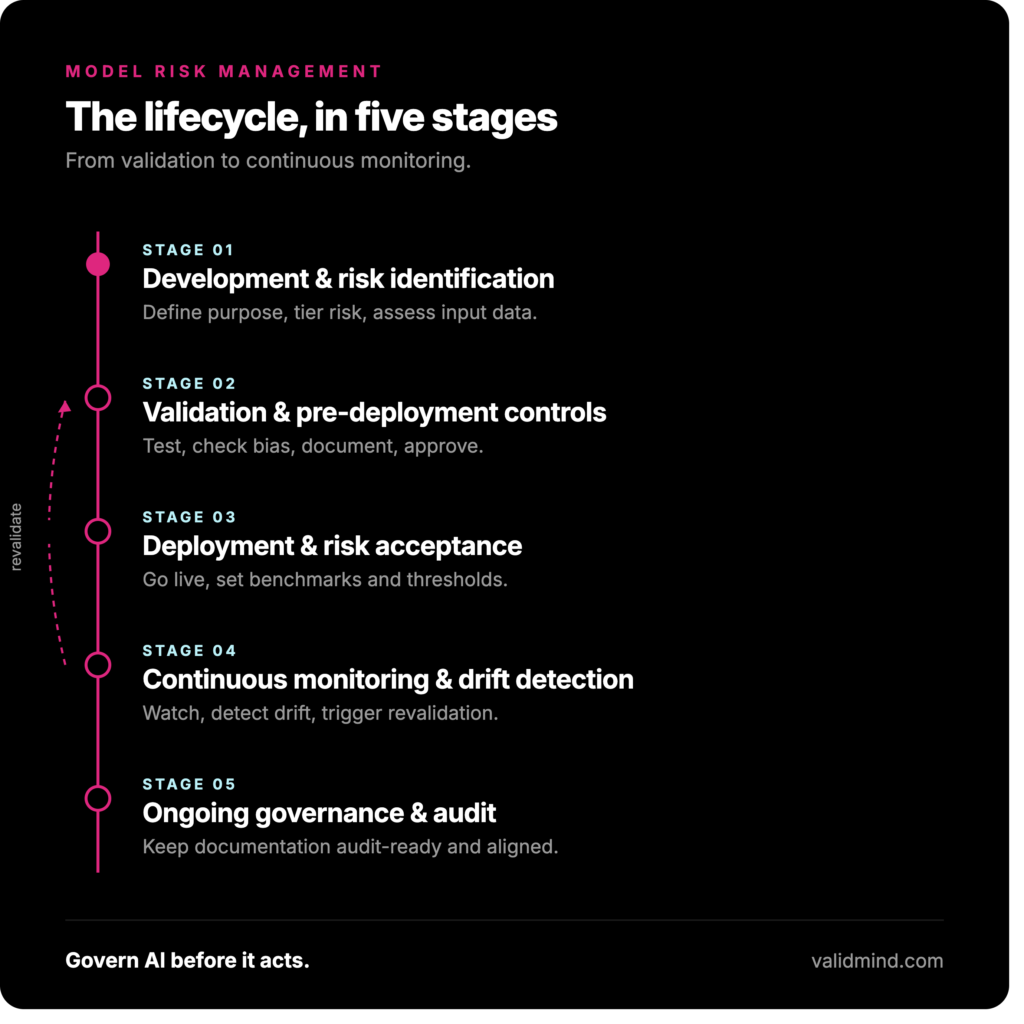
Stage 1: Model Development and Initial Risk Identification
Defining Model Purpose and Risk Classification
Risk management starts before a single line of model code is validated. It starts with intent. Clearly defining the business use case sets the boundaries for what the model should and should not do, and risk tiering establishes how much scrutiny it needs. A model that prices a multi-million-dollar credit portfolio carries different stakes than one that ranks internal support tickets, and classifying that early lets teams focus effort where it matters most.
Data Quality and Input Risk Assessment
The model is only as sound as the data behind it, so the first technical risk assessment focuses on inputs. Teams examine data bias that could skew outcomes against particular groups, missing data that weakens the model in edge cases, and the potential for data drift once the model is in production. Catching these issues at the development stage is far cheaper than discovering them after a model has been making decisions for months.
Stage 2: Model Validation and Pre-Deployment Controls
Validation Workflows and Testing Standards
Validation is where the model meets independent scrutiny. Strong validation workflows test performance against held-out data, apply stress testing to see how the model behaves under extreme conditions, and use scenario analysis to probe how it responds to situations it may rarely have seen in training. The goal is not just to confirm the model works, but to map where and how it fails.
Explainability and Bias Validation
Performance alone is not enough in regulated settings. Validation also checks that a model meets interpretability requirements, so its decisions can be explained to a regulator, an auditor, or a customer. Fairness checks test for bias across protected groups and ensure the model does not encode discrimination that the business cannot defend. These checks are increasingly a baseline expectation rather than an advanced practice.
Documentation and Approval Processes
Validation produces evidence, and that evidence has to be captured. Structured validation reports document what was tested, what was found, and what was concluded, while approval workflows route that evidence to the right reviewers and record their sign-off. Done well, documentation is not paperwork bolted on at the end. It is the trail that makes every later stage of the lifecycle auditable.
For a closer look at making this evidence trail manageable rather than burdensome, see how ValidMind gives teams complete control over model documentation.
Stage 3: Model Deployment and Risk Acceptance
Transitioning from Validation to Production
Moving from approval to deployment is a handover, and handovers are where risk leaks. The model that was validated in a controlled environment now has to perform on live data, inside production systems, often owned by a different team than the one that built it. Common challenges include subtle differences between the validation and production environments, gaps in how the model is integrated, and assumptions that held in testing but not in the real pipeline. Treating deployment as a formal risk-acceptance step, rather than a quiet technical event, keeps these gaps visible.
Defining Monitoring and Risk Thresholds
Deployment is also the moment to decide what good and bad will look like in production. Teams set performance benchmarks that define acceptable behavior and alert thresholds that mark the point at which a model needs attention. Defining these up front, before anything goes wrong, turns monitoring from a vague intention into a concrete control with clear trigger points.
Stage 4: Continuous Model Monitoring and Drift Detection
Why Monitoring Is the Most Critical Stage
If there is one stage where the lifecycle view earns its keep, it is monitoring. The majority of model failures occur after deployment, not before, because that is when the model meets the messy, shifting reality it will live in. These post-deployment risks are often hidden, accumulating gradually until a threshold is crossed and the impact becomes visible in outcomes. Monitoring is what turns those hidden risks into ones the organization can see and act on.
Detecting Model Drift and Performance Degradation
Two forms of drift matter most. Data drift occurs when the inputs a model sees in production diverge from the data it was trained on. Concept drift occurs when the underlying relationship between inputs and outcomes changes, so even stable inputs no longer map to the right answers. Both degrade performance quietly, and both are far easier to manage when monitoring is watching for them continuously rather than waiting for the next scheduled review.
Triggering Revalidation and Risk Escalation
Detection only matters if it leads to action. Mature monitoring fires automated alerts when a model crosses a defined threshold and routes those alerts into revalidation workflows, so a degrading model is re-examined and, if needed, retrained or retired. Escalation paths ensure the right risk owners are notified rather than an alert disappearing into an inbox. This is the feedback loop that keeps the lifecycle continuous instead of linear.
The cost of getting this wrong is real. For a concrete example of what happens when model accuracy fails in a high-stakes setting, see ValidMind’s analysis of high stakes in insurance AI.
Stage 5: Ongoing Governance, Audit, and Compliance
Maintaining Audit-Ready Documentation
Governance is the connective tissue that holds the lifecycle together over time. At its center is audit-ready documentation: a complete, traceable record of how each model was developed, validated, deployed, and monitored. Maintaining a clear validation history means that when a regulator or internal auditor asks why a model was approved or how an issue was handled, the answer is on hand rather than reconstructed under pressure.
Regulatory Alignment and Reporting
Compliance expectations for models continue to rise across jurisdictions, and governance is where an institution demonstrates that it meets them. Aligning the lifecycle to recognized reporting frameworks lets teams produce the evidence supervisors expect without reinventing it each time. The aim is to make regulatory reporting a natural output of well-governed work rather than a separate, manual scramble.
For a deeper look at aligning model risk management to a major framework, see ValidMind’s perspective on NIST and strategic compliance.
Where the Model Risk Management Lifecycle Breaks Down
The lifecycle above is straightforward in theory. In practice, most organizations struggle to run it cleanly, and the failures tend to cluster in three places.
Fragmented Tools Across Lifecycle Stages
Many teams use one tool for validation, another for monitoring, and another for documentation. Each may work well on its own, but the seams between them are where information falls through. Evidence captured in one system is invisible to another, and the lifecycle that should be continuous becomes a series of disconnected handoffs.
Lack of Centralized Model Inventory
Without a single inventory, no one has a reliable answer to a basic question: how many models are in production, who owns them, and which carry the most risk. That lack of visibility across models is itself a serious risk, because exposure that no one can see cannot be managed.
Manual Processes and Workflow Gaps
When the lifecycle runs on spreadsheets and email, tracking becomes inconsistent and steps get skipped. Manual processes do not scale as the number of models grows, and the workflow gaps they create are exactly the places where a model slips through without proper review or monitoring.
The Shift Toward Continuous Model Risk Management
From Periodic to Continuous Validation
The clearest response to these failures is a move from periodic to continuous validation. Instead of validating once and revisiting on an annual cycle, lifecycle-based validation treats validation as an ongoing activity that spans development, deployment, and monitoring. The model is checked against current reality, not a snapshot taken at approval.
Integrating Monitoring with Governance
Continuous MRM also closes the loop between monitoring and governance. When monitoring feeds directly into governance, a drift alert is not just a technical signal. It becomes a governed event with a documented response, an owner, and an audit trail. Monitoring and governance stop being separate disciplines and start reinforcing each other.
Real-Time Risk Visibility Across Models
Bringing it together produces real-time risk visibility at the enterprise level. Leaders can see the risk posture of every model in one place, track exposure as it changes, and report on it with confidence. Enterprise-level tracking turns model risk from a collection of isolated assessments into a coherent, current picture.
How AI Governance Platforms Enable Lifecycle-Based MRM
Running a continuous lifecycle by hand is impractical at scale, which is why AI governance platforms have become central to modern model risk management. Four capabilities matter most.
Centralized Model Inventory and Visibility
A single inventory gives the organization a complete, current view of every model and its risk profile, replacing scattered spreadsheets with one source of truth.
Automated Validation Workflows
Standardized, automated workflows assign roles, route evidence, and enforce policy consistently, so validation scales with the number of models instead of breaking under it.
Continuous Monitoring Systems
Built-in monitoring watches models in production, detects drift, and triggers alerts and revalidation, keeping the back half of the lifecycle as rigorous as the front.
Audit-Ready Documentation
Structured documentation is generated as part of the work, producing traceable, audit-ready artifacts without a separate reporting effort.
Explore how these capabilities come together in ValidMind’s AI model risk management and AI governance platform.
How ValidMind Supports the Full Model Risk Management Lifecycle
ValidMind is built to run the entire lifecycle in one place, so model risk teams can move from fragmented, manual work to continuous, governed oversight.
End-to-End Lifecycle Coverage
From initial risk identification through development, validation, deployment, monitoring, and retirement, ValidMind covers every stage in a single system rather than a patchwork of tools.
Integrated Validation and Monitoring
Validation and monitoring share the same platform and the same record, so a model’s pre-deployment evidence and its live performance live side by side, and revalidation flows directly from what monitoring detects.
Standardized Governance Workflows
Consistent, automated workflows assign roles, track activity, and enforce policy across every model and team, making governance repeatable rather than dependent on individuals.
Enterprise-Grade Risk Oversight
Centralized inventory and real-time visibility give leadership a portfolio-level view of model risk, with the documentation and reporting to back it up.
To see how this maps to regulatory expectations, see ValidMind on the OSFI E-23 regulation, and for a practical starting point, the complete AI governance training overview.
Conclusion
Model risk is lifecycle-driven, and treating it any other way leaves the largest risks unmanaged. Validation before deployment still matters, but it is the opening stage of a longer story, not the end of it. Monitoring is the most critical stage precisely because that is where most failures appear, and continuous governance is what keeps the whole lifecycle honest over time.
The future of model risk management is continuous, integrated, and scalable, and platforms are what make that future executable. The organizations that treat the lifecycle as one connected system, rather than a sequence of disconnected checkpoints, will be the ones that can scale AI with confidence and stand behind every model they put into production.
Model Risk Management Lifecycle FAQs
What are the stages of the model risk management lifecycle?
The lifecycle typically spans five stages: development and initial risk identification, validation and pre-deployment controls, deployment and risk acceptance, continuous monitoring and drift detection, and ongoing governance, audit, and compliance. Each stage carries its own controls, and risk is managed across all of them rather than at a single checkpoint.
How does model validation fit into the MRM lifecycle?
Validation is the pre-deployment stage where a model meets independent scrutiny through performance testing, stress testing, scenario analysis, explainability checks, and bias validation. It produces the documented evidence and approval that allow a model to go live, but it is the start of the lifecycle’s controls, not the end of them.
Why is continuous monitoring important in model risk management?
Most model failures occur after deployment, when a model meets shifting real-world data. Continuous monitoring surfaces these hidden risks by watching performance in production, detecting drift, and triggering alerts and revalidation, so problems are caught early rather than discovered in an audit or a bad outcome.
What happens after a model is deployed in risk management workflows?
Deployment is treated as a formal risk-acceptance step. Teams set performance benchmarks and alert thresholds, then move into continuous monitoring. From there, drift detection, automated alerts, revalidation, and ongoing governance keep the model under control for as long as it stays in production.
How do organizations detect model drift during the lifecycle?
They monitor for two kinds of drift. Data drift is when production inputs diverge from training data, and concept drift is when the relationship between inputs and outcomes changes. Continuous monitoring systems track both and fire alerts when a model crosses a defined threshold, prompting revalidation.
What tools support the model risk management lifecycle?
Lifecycle MRM is increasingly run on AI governance platforms that combine a centralized model inventory, automated validation workflows, continuous monitoring, and audit-ready documentation in one system. This replaces the common pattern of separate, disconnected tools for validation, monitoring, and documentation.
How is risk reassessed after model deployment?
Through monitoring-driven revalidation. When monitoring detects drift or performance degradation past a threshold, automated alerts route the model into a revalidation workflow where it is re-examined and, if needed, retrained or retired. Escalation paths ensure the right risk owners are involved.
What role does documentation play in the MRM lifecycle?
Documentation is the traceable record that makes the lifecycle auditable. Capturing validation history, monitoring activity, and approvals as the work happens means an institution can show a regulator or auditor exactly why a model was approved and how issues were handled, without reconstructing the trail later.
How do enterprises manage risk across multiple AI models?
With a centralized model inventory and real-time, enterprise-level visibility. Tracking every model, its owner, and its risk profile in one place lets leaders aggregate exposure across the portfolio and report on it, turning scattered assessments into a single coherent view.
What are common failures in the model risk management lifecycle?
The most common failures are fragmented tools that break continuity between stages, the lack of a centralized model inventory that leaves teams blind to enterprise-wide exposure, and manual processes built on spreadsheets that do not scale and create workflow gaps where models slip through without proper review or monitoring.