How to use Agent Authority to Enable AI
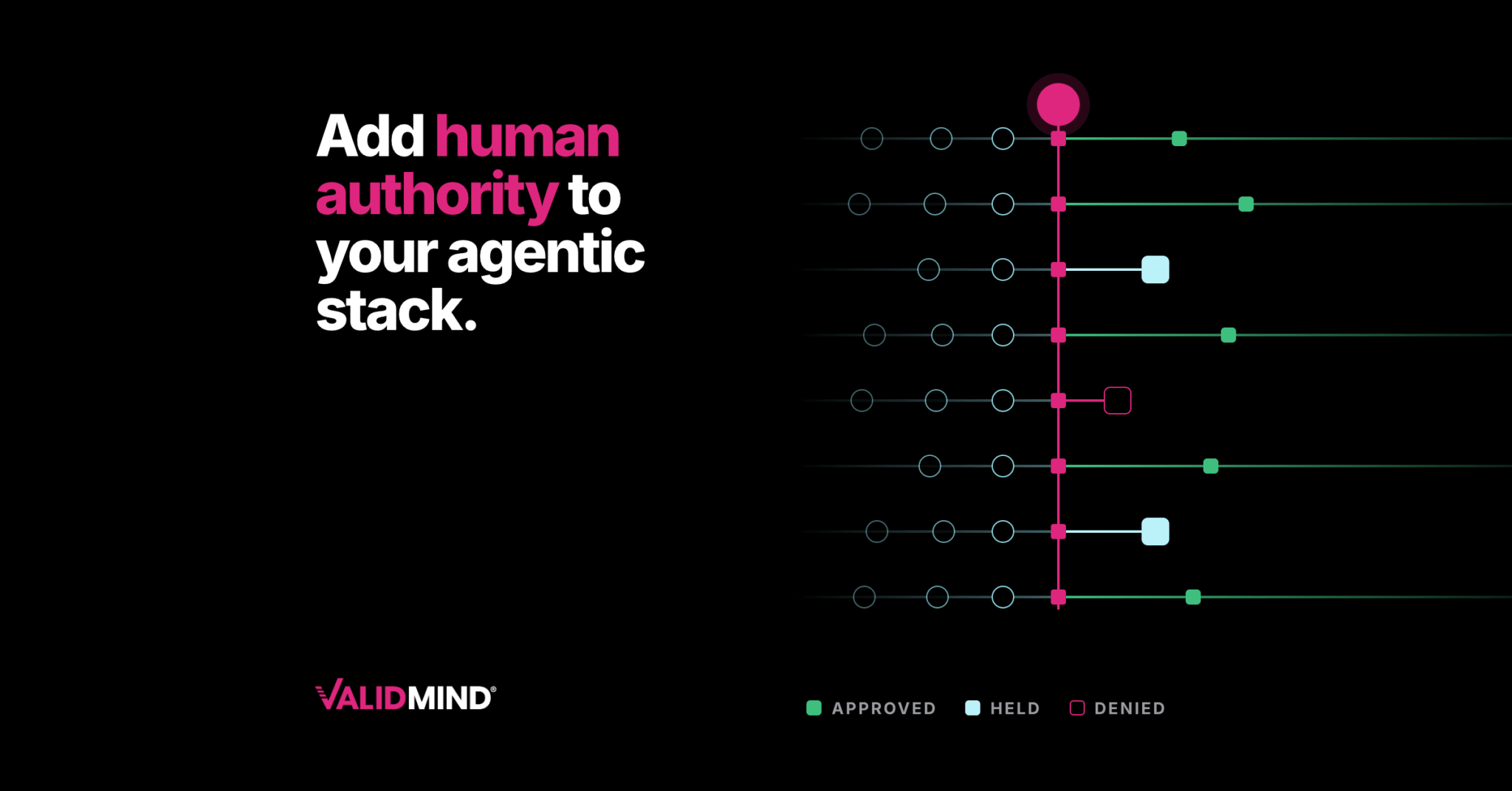
AI agent governance now has to cover what agents do, not just how they’re built. Here’s how Agent Authority adds that control to the stack you already run, in line with rules like the GDPR, the EU AI Act and DORA.
Agent Authority lets you put AI agents to work in every department by governing each action before it runs.
Four steps take an agent from idea to trusted: pick the work, connect it to the stack you already run, give it a tested charter, and let the transcript drive accountability and learning.
01Pick the work
02Connect your stack
03Write and test the charter
04Learn from the transcript
01
Pick the work
Agent Authority governs AI agents in every department of the business.
Start with work where the action matters: it moves money, reaches customers or changes production. That is where authority pays for itself.
MarketingSend an offer to 40,000 customers
SalesOffer a 30% discount
FraudFreeze a customer account
HRFilter job applicants’ resumes
SecurityPatch production servers
CodingMigrate a production database
AssistantsEmail a file outside the company
Customer serviceIssue a $450 refund
PaymentsRelease a $4,568 wire
02
Connect your stack
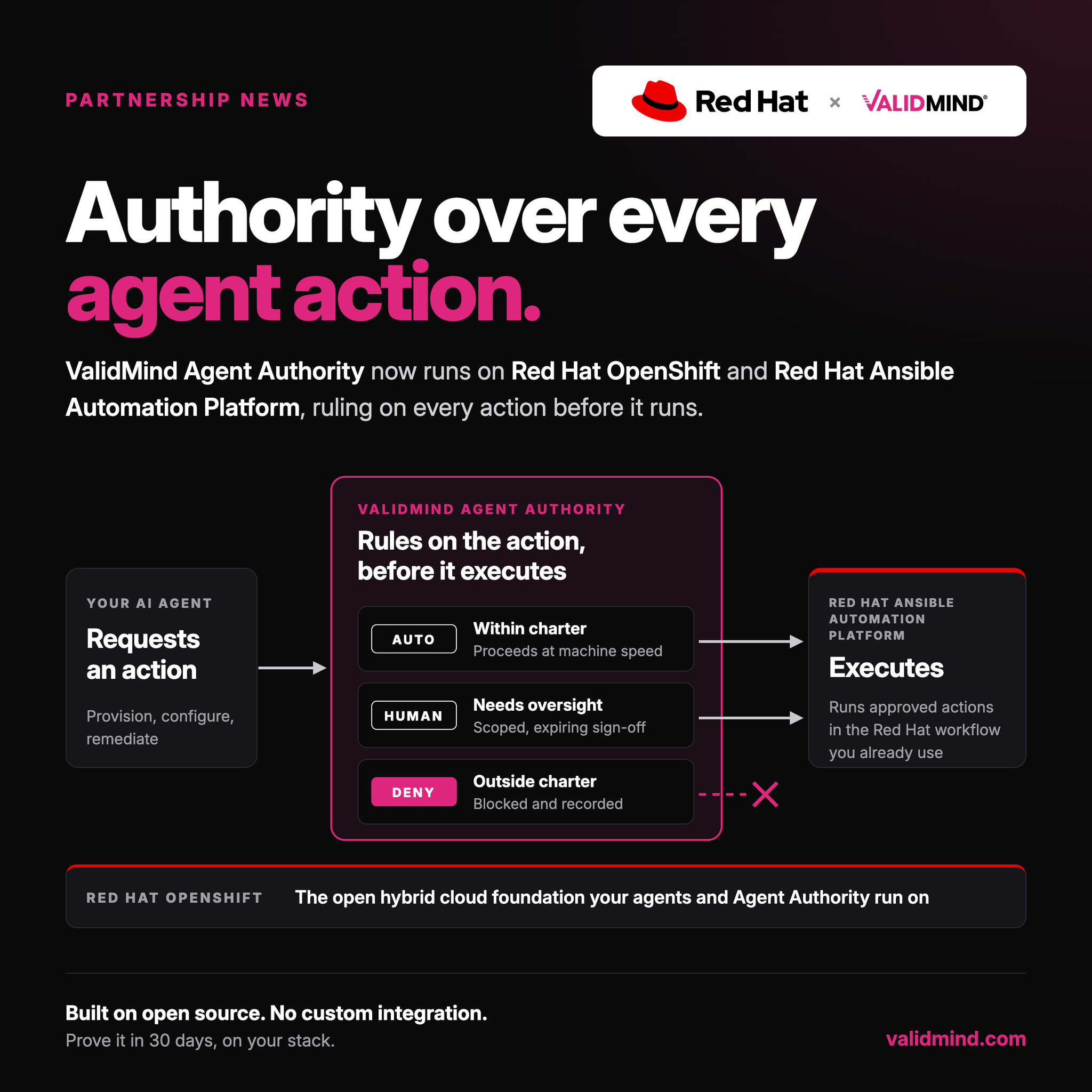
Agent Authority sits between your agents and your systems, so every action is checked before it reaches them.
Your agents
Agent harnesses
Orchestration workflows
Bought and built agents
Agent Authority
Checks the charter
Reads each proposed action and the agent’s recent steps, then rules.
ApprovedHeldDenied
Your systems
MCP servers and tools
APIs and databases
Payments, CRM, production
MCP serversInline between the agent and its tools. Every call passes the charter first.
Agent harnessesThe harness asks before it runs a tool, and runs it only if allowed.
Orchestration workflowsThe workflow pauses mid-run until the next action clears.
Example · a marketing agent built on Claude
Before
Claude agentMarketing
Email platformMCP server
Every send goes straight to the email platform. Nothing checks it first.
After
Claude agentMarketing
Agent AuthorityChecks the charter
Email platformMCP server
The connector points at Agent Authority, which holds the link to the email platform. Same agent, same tools, and every send is checked first.
Building in code with the Claude Agent SDK? A hook before each tool call asks Agent Authority for a ruling. The tool runs only if approved.
No agent rewrite. Rulings flow out to your GRC and observability tools.
03
Write and test the charter
Every agent works under a charter that inherits your firm’s compliance rules and is tested before it governs a live action.
Compliance owns the rules every agent must follow. Each agent’s manager adds the rules for its job, and can tighten the firm’s rules but never loosen them.
Firm-wide rules · owned by compliance
Inherited by every agent charter
HR · filter resumes
- Alone
- Advance candidates who meet every requirement
- Ask
- Before rejecting anyone GDPR Art. 22
- Never
- Use age, gender or employment gaps as a reason
Payments · release a wire
- Alone
- Up to $10,000 to payees on file 90+ days
- Ask
- New payee or changed bank account
- Never
- Pay before sanctions screening clears Sanctions
Coding · migrate a database
- Alone
- Staging, or production with a tested rollback
- Ask
- Any change that drops a table DORA
- Never
- Delete data without a verified backup
WriteThe manager states purpose, limits and what to escalate.
TestReplay sample and past actions to see how the charter would rule.
ValidateAn independent reviewer checks the rules against policy and risk appetite.
SignThe manager signs a versioned charter. The agent can’t edit it.
EnforceEvery live action is ruled on against that version.
04
Learn from the transcript
The transcript records every ruling, which makes each agent accountable and makes agents and managers better over time.
Transcript · refund-agent-1Customer service
- Requested
- Refund $450, second refund on this account in 30 days
- Charter
- v3 · a second refund in 30 days goes to the manager
- Manager
- J. Patel, billing operations
- Reason
- “Duplicate charge confirmed. Approve.”
HeldApproved by J. Patel · outcome: no dispute
Accountability
Every action names the person it rests on.Audit, risk and regulators see who approved what, under which charter version.Loop one · the agent
The agent learns from its rulings.The manager’s reasons become context, so fewer actions need a person next time.Loop two · the manager
The manager learns what to grant.Patterns show where to loosen the charter and where agents keep testing a limit.The transcript gives each manager one view of how well every agent’s charter fits, and what to change.
Your agents · last 30 days
J. Patel, billing operations
Sent to you
9 a dayTarget 15 or fewerDecided without you
96%Target 90% or moreYour approvals later disputed
3Of 412 decidedAgentTo you a dayCharter fitWhat to change
refund-agent-16Too tight9 in 10 holds approved unchanged. Approve second refunds under $200 when the duplicate is confirmed.
refund-agent-22Right fitOnly unusual refunds reach you. No change.
dispute-agent1Too looseSampling found 2 credits issued outside the charter. Send credits over $100 to you.
Illustrative example. Names and figures are not customer data.
Charter changes go back through step 03: write, test, validate, sign.
Govern more, so you can grant more.