Top AI Governance Trends Shaping Model Risk Management in 2026
AI adoption is accelerating across the enterprise, and nowhere is the pace more visible than in regulated industries where every model carries real exposure. As organizations move more decisions onto machine learning systems, the nature of model risk is changing. It is no longer something you assess once and file away. It is continuous, it shifts as data and behavior change, and it is harder to detect with the periodic, point-in-time methods many teams still rely on.
That shift is reshaping how leaders think about AI governance. The old model treated governance as a static framework, a set of policies that sat alongside the work. The emerging model treats it as a dynamic system, woven into the model lifecycle and capable of responding in close to real time. The most important point is this: the trends below are not driven by theory. They are driven by the practical execution challenges that risk, data science, and compliance teams hit every day as AI scales.
Here are the AI governance trends shaping model risk management in 2026, and what they mean for the teams responsible for keeping AI safe, compliant, and worthy of trust.
Why AI Governance Is Becoming Model Risk-Centric
Governance is moving closer to the model itself. Instead of orbiting the work as a layer of documentation and sign-off, it is becoming inseparable from how models behave and perform in production.
From Policy-Based Governance to Risk-Based Governance
Earlier approaches were policy-driven. Teams defined controls, mapped them to requirements, and checked whether a model cleared the bar at a given moment. That approach still matters, but it is no longer the center of gravity. Governance decisions are increasingly risk-driven, which means they hinge on what a model is actually doing rather than what a policy says it should do. The focus has shifted toward model behavior and live performance, and toward making decisions based on evidence drawn from both.
Increasing Regulatory Pressure on Model Risk
Regulators are reinforcing this direction. Across jurisdictions, supervisors increasingly expect explainability, independent validation, and complete documentation as a baseline rather than a nice-to-have. The expectation is that an institution can show, on demand, why a model was approved, how it was tested, and how it is being watched once it is live. That raises the bar for every team that owns a model, and it pulls governance squarely into model risk territory.
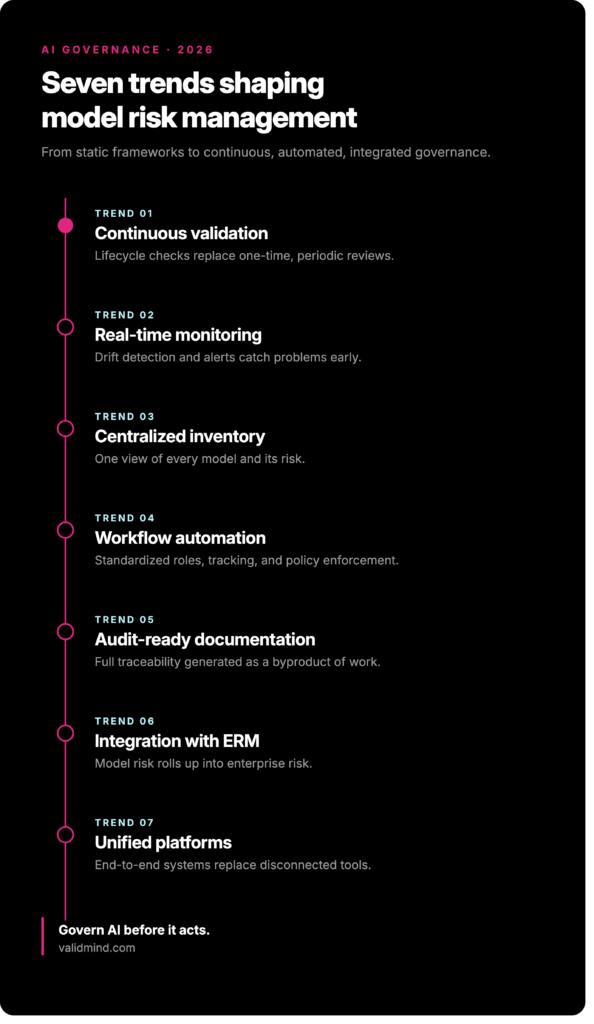
Trend 1: Continuous Model Validation Replacing Periodic Reviews
Why One-Time Validation Is No Longer Sufficient
Models are not static. They evolve as they retrain, the data feeding them changes, and the world they operate in moves on. A validation that was accurate at deployment can quietly go stale within months. Because risk accumulates continuously, a single annual or quarterly review leaves long windows where a model can drift out of bounds with no one watching. Continuous validation closes those gaps.
Shift Toward Lifecycle-Based Validation
The answer is to validate across the lifecycle rather than at a single checkpoint. That means meaningful validation activity at development, again at deployment, and continuously through monitoring once the model is live. Each stage answers a different question, and together they give risk teams a current view instead of a snapshot that ages the moment it is filed.
This lifecycle view is already shaping how supervisors frame their guidance. For a closer look at how it applies under one major framework, see operationalizing E-23 and how teams scale governance without slowing AI down.
Trend 2: Real-Time Monitoring and Drift Detection Becoming Standard
Rise of Monitoring-Driven Governance
If validation now spans the lifecycle, monitoring is what makes the back half of that lifecycle real. Governance no longer ends at deployment. It continues for as long as the model is in production, which creates a clear need for real-time insight into how each model is performing against expectations. Monitoring-driven governance treats the live model as the primary source of truth.
Detecting Performance Degradation Early
The practical payoff is early detection. Modern monitoring watches for drift in data and performance, fires automated alerts when a model crosses a threshold, and can trigger revalidation before a small degradation turns into a costly failure. Catching problems early is far cheaper, and far safer, than discovering them in an audit or, worse, in a customer outcome.
Trend 3: Centralized Model Inventory and Risk Visibility
Need for Enterprise-Wide Model Tracking
As AI spreads, most enterprises end up with many teams building many models. Without a single, authoritative inventory, no one can answer basic questions: how many models are in production, who owns them, and which ones carry the most risk. That lack of visibility is itself a source of risk, because you cannot govern what you cannot see.
Risk Aggregation Across AI Systems
A centralized inventory does more than count models. It enables a consolidated view of risk across every AI system, so leadership can understand exposure at the portfolio level and report on it with confidence. Risk aggregation turns a scattered collection of point assessments into a coherent picture the board and regulators can actually use.
Trend 4: Governance Workflow Automation
Moving Away from Manual Processes
Much of model governance still runs on spreadsheets and disconnected systems. Evidence lives in email threads, approvals happen in side channels, and reconstructing what happened later is slow and error-prone. As the number of models grows, manual processes simply do not scale.
Standardizing Validation and Approval Workflows
Automation brings structure to the work. Standardized workflows assign clear roles, track validation activity as it happens, and enforce policies consistently across every model and team. The result is faster cycle times and a process that is repeatable rather than dependent on who happens to be doing the work.
Documentation is a natural place to start, since it touches every stage of the lifecycle. See how complete control over model documentation removes a major manual bottleneck.
Trend 5: Audit-Ready Documentation as a Core Requirement
Increasing Demand for Traceability
Documentation has moved from a final deliverable to a continuous requirement. Regulators increasingly expect full audit trails and validation evidence that can be produced on request, showing not just the conclusion but the path that led to it. Traceability is now part of the standard, not an extra.
Structured Documentation Over Manual Reporting
Meeting that expectation manually is unsustainable. The trend is toward automated, structured documentation that generates standardized artifacts as a byproduct of the work itself. When evidence is captured automatically and consistently, audit readiness stops being a fire drill and becomes a steady state.
Trend 6: Integration of AI Governance with Enterprise Risk Systems
Connecting Governance with ERM Systems
Model risk does not live in a vacuum. It is one input into the broader enterprise risk picture, and leaders are increasingly connecting the two. Linking model risk directly into enterprise risk management systems lets organizations see how AI exposure rolls up alongside credit, operational, and other risk categories.
Unified Risk Reporting Across the Organization
That integration produces unified reporting and, just as important, aligned teams. When governance and risk functions work from the same data and the same definitions, model risk becomes a first-class part of enterprise reporting rather than a parallel track that has to be reconciled after the fact.
Trend 7: Rise of AI Governance Platforms Over Point Solutions
Limitations of Disconnected Tools
Many teams have assembled governance from separate tools: one for validation, another for monitoring, another for documentation. Each may be capable on its own, but the seams between them create gaps, duplicate effort, and a fragmented record. Stitching point solutions together rarely produces coherent governance.
Need for End-to-End Governance Systems
The clear direction is toward end-to-end platforms that cover the full lifecycle in one place. Unified workflows, a shared inventory, and connected validation, monitoring, and documentation give teams a single source of truth and remove the integration tax of managing many disconnected tools. Consolidation is becoming the default, not the exception.
What These Trends Mean for Model Risk Teams
Shift in Responsibilities
Taken together, these trends redefine the model risk role. The job is moving from validation-only, where a team signs off and steps back, to lifecycle oversight, where the same team stays engaged from development through retirement. The mandate is broader, more continuous, and more visible to leadership.
Increasing Need for Cross-Functional Collaboration
That broader mandate cannot be met by one function alone. Modern governance depends on tight collaboration between risk, data science, and compliance, each bringing a piece of the picture. The teams that do this well treat governance as a shared discipline rather than a handoff between silos.
How ValidMind Enables Modern AI Governance Trends
ValidMind brings these trends together in a single platform built for model risk management at enterprise scale, so governance teams can move from reactive, manual work to continuous, automated oversight.
Continuous Validation and Monitoring
ValidMind supports validation across the full lifecycle and continuous monitoring once models are live, with drift detection and alerting that surface issues early rather than at the next scheduled review.
Centralized Model Inventory
A single, enterprise-wide inventory gives leadership a complete view of every model, its owner, and its risk profile, turning scattered assessments into portfolio-level visibility.
Automated Governance Workflows
Standardized, automated workflows assign roles, track validation, and enforce policy consistently, so governance scales with the number of models instead of breaking under it.
Audit-Ready Documentation
Structured documentation is generated as part of the work, producing standardized, audit-ready artifacts and full traceability without the manual reporting scramble.
Conclusion
AI governance is evolving fast, and the direction is clear. Rising model complexity and tightening regulatory pressure are pushing organizations away from static, periodic, manual approaches and toward governance that is continuous, automated, and integrated with enterprise risk. The seven trends above are different views of that same shift.
For model risk teams, the opportunity is real. The teams that adopt lifecycle validation, real-time monitoring, centralized inventory, and connected platforms will not just keep pace with regulators. They will give their organizations the confidence to scale AI faster, knowing the right controls are in place. That is what good governance makes possible.
To go deeper on the regulatory backdrop driving these trends, explore ValidMind’s perspective on the urgency of robust AI governance.
AI Governance Trends FAQs
What are the latest AI governance trends in model risk management?
The defining trends in 2026 are continuous model validation replacing periodic reviews, real-time monitoring and drift detection, centralized model inventory, governance workflow automation, audit-ready documentation, integration with enterprise risk systems, and a move toward end-to-end governance platforms. Each reflects a broader shift from static, policy-based governance to dynamic, risk-based governance tied directly to model behavior.
Why is continuous validation becoming a key trend in AI governance?
Models change as they retrain and as their data shifts, so a one-time validation goes stale quickly. Continuous validation across development, deployment, and monitoring gives risk teams a current view of model performance instead of a snapshot that ages the moment it is filed, closing the windows where a model can drift out of bounds unnoticed.
How are AI governance trends changing model monitoring practices?
Governance no longer ends at deployment. Monitoring-driven governance treats the live model as the primary source of truth, with real-time insight into performance, automated alerts when thresholds are crossed, and revalidation triggers that catch degradation early rather than at the next scheduled review.
What role does drift detection play in modern AI governance?
Drift detection is central to monitoring-driven governance. It watches for changes in data and model performance and fires automated alerts when a model crosses a defined threshold, allowing teams to revalidate before a small degradation turns into a costly failure or a compliance issue.
Why is centralized model inventory important for AI governance?
When many teams build many models, a single authoritative inventory is the only way to know how many models are in production, who owns them, and which carry the most risk. It enables risk aggregation across AI systems and gives leadership a portfolio-level view of exposure they can report on with confidence.
How are enterprises adapting governance frameworks for AI models?
Enterprises are moving from policy-based frameworks to risk-based ones that focus on live model behavior and performance. They are extending validation across the lifecycle, adding continuous monitoring, automating workflows, and integrating model risk into broader enterprise risk management rather than treating it as a separate track.
What is driving the shift toward automated governance workflows?
Manual processes built on spreadsheets and disconnected systems do not scale as the number of models grows. Automation standardizes validation and approval workflows, assigns clear roles, tracks activity as it happens, and enforces policy consistently, producing faster cycle times and a repeatable process.
How do AI governance trends impact regulatory compliance?
Regulators increasingly expect explainability, independent validation, full audit trails, and documentation available on demand. Trends like continuous validation, structured documentation, and audit-ready evidence make it possible to meet those expectations as a steady state rather than scrambling ahead of each examination.
Why are organizations moving toward integrated AI governance platforms?
Assembling governance from separate validation, monitoring, and documentation tools creates gaps, duplicate effort, and a fragmented record. End-to-end platforms cover the full lifecycle in one place with unified workflows and a shared inventory, giving teams a single source of truth and removing the integration tax of disconnected tools.
How are model risk teams evolving with new governance trends?
The role is shifting from validation-only sign-off to continuous lifecycle oversight, with broader responsibility and greater visibility to leadership. Meeting that mandate depends on closer collaboration between risk, data science, and compliance, treating governance as a shared discipline rather than a handoff between silos.