Agentic AI Governance and Compliance for Financial Institutions
Financial institutions are moving fast on artificial intelligence, and the systems they are deploying risk outpacing agentic AI governance and compliance requirements. Autonomous AI agents, multi-step decision systems, and GenAI-powered workflows are now showing up in underwriting, fraud detection, and customer operations. These systems do not just score and predict. They reason, decide, and act.
That shift matters for governance. Traditional AI governance was built around bounded models with predictable outputs, where a validator could test a fixed set of inputs and trust the behavior to stay consistent. Agentic AI breaks that assumption. It brings dynamic decisions, real system autonomy, and far less human oversight at each step.
The core challenge is straightforward: compliance frameworks were designed for static models, not autonomous AI systems capable of independent action.
This guide explains what changes when AI starts acting on its own, where traditional AI governance falls short, the compliance risks that follow, and how financial institutions can build a governance model that keeps autonomous systems both effective and accountable.
What Agentic AI Means in Financial Services
Understanding Agentic AI Systems
Agentic AI describes systems that can pursue goals with limited direction. Rather than returning a single output for a single input, an agent can break a task into steps and work through them. In practice, these systems can:
• Reason independently across a problem
• Make contextual decisions as conditions change
• Execute multi-step actions toward a goal
• Interact with other systems and tools autonomously
In financial services, that capability is already taking shape in real use cases:
• Underwriting assistants that gather data, weigh factors, and recommend or take next steps
• AML investigation agents that triage alerts and assemble case files
• Fraud detection workflows that adapt to new patterns in real time
• Compliance copilots that draft, check, and route regulatory tasks
Why Agentic AI Changes Governance and Compliance Requirements
The difference between traditional AI and agentic AI comes down to one word. Traditional AI predicts outcomes. Agentic AI takes actions.
Once a system can act, governance has to answer a new set of questions. Who is accountable when an agent makes a call? How is each decision audited after the fact? What controls keep autonomous behavior inside policy? These questions sit at the center of agentic AI governance, and they cannot be answered with model-only thinking.
Traditional AI vs Agentic AI Compliance Challenges
| Area | Traditional AI | Agentic AI |
| Output | Recommendation | Action |
| Governance | Model-focused | Behavior-focused |
| Oversight | Periodic | Continuous |
| Compliance Risk | Moderate | High |
| Auditability | Easier | More complex |
The pattern is clear across every row. Agentic AI raises the stakes and the complexity at the same time. A financial institution cannot lift its existing compliance approach and apply it unchanged to systems that act on their own. The controls, the monitoring, and the evidence all need to evolve to match behavior rather than just output.
Why Traditional AI Governance and Compliance Frameworks Fall Short
Compliance Assumes Predictable AI Behavior
Most existing AI governance frameworks were built around predictability. They assume fixed inputs, stable outputs, and deterministic systems that behave the same way every time. Validation under that model is a point-in-time exercise: test the model, document the results, and move on.
Agentic AI behaves dynamically. The same starting point can lead to different action paths depending on context, available tools, and intermediate decisions. A framework that assumes stable behavior cannot keep pace with a system designed to adapt.
Weak Visibility into Autonomous Decisions
When AI takes multi-step action, visibility becomes the first thing to break. Teams often struggle to understand why a given decision happened, trace the full path of actions an agent took, and monitor how its behavior shifts over time. Without that visibility, governance is working blind, and so are the auditors who come later.
Regulatory Requirements Are Becoming More Demanding
Regulatory expectations are rising in parallel. Supervisors increasingly want to see explainability, clear accountability, ongoing monitoring, and durable governance evidence rather than one-time attestations. Established guidance already points in this direction:
• SR 26-2, the foundational US guidance on model risk management
• OSFI E-23, Canada’s model risk guideline with a broad view of model lifecycle governance
• The NIST AI Risk Management Framework, which emphasizes continuous, function-based risk management
These regimes were not written specifically for autonomous agents, but their principles extend naturally to them. For a closer look at how this plays out in practice, see our perspectives on OSFI E-23 and AI governance and NIST model risk management as strategic compliance.
Compliance Gaps in Agentic AI Systems
| Compliance Area | Traditional Approach | Agentic AI Gap |
| Validation | One-time testing | Needs continuous review |
| Monitoring | Performance metrics | Behavioral oversight |
| Documentation | Periodic reports | Real-time traceability |
| Accountability | Single owner | Multi-team governance |
| Controls | Manual | Automated |
Each gap points to the same conclusion. The good news is that closing these gaps is achievable with the right operating model. The challenge is less about inventing new principles and more about scaling governance without slowing AI down, so the controls keep up with the speed at which agents actually work.
Key Compliance Risks of Agentic AI in Financial Institutions
Regulatory Compliance Risk
When an agent acts without clear records, regulatory exposure grows quickly. The common failure modes include undocumented decisions, actions that breach policy, and an inability to explain after the fact why the system did what it did. Each one weakens the institution’s standing in an examination.
Model Risk and Decision Integrity
Autonomous action raises the cost of being wrong. Inaccurate decisions now translate directly into inaccurate actions. Hidden bias can propagate across a multi-step workflow, and unexpected outcomes can emerge from the interaction of steps that each looked reasonable in isolation.
Operational and Workflow Risk
Because agents are wired into live systems, mistakes do not stay contained. An autonomous system may trigger unintended actions, create downstream disruptions in connected processes, and escalate a small operational failure into a larger one before a human notices.
Audit and Documentation Challenges
Auditors depend on a clear, complete trail. Agentic systems can frustrate that with incomplete logs, unclear ownership of specific decisions, and evidence fragmented across multiple systems and tools. When the trail is hard to reconstruct, the audit becomes harder for everyone.
Major Compliance Risks in Agentic AI
| Risk Category | Example | Impact |
| Regulatory Risk | Compliance breach | Fines |
| Operational Risk | Failed workflow | Disruption |
| Governance Risk | Lack of oversight | Poor decisions |
| Reputation Risk | Unfair outcomes | Trust loss |
| Audit Risk | Missing evidence | Compliance failure |
In autonomous systems these risks rarely stay separate. A single missing log is an audit gap, but it can also hide an unfair outcome, which becomes a reputation problem and then a regulatory one. The interconnection is exactly why oversight has to be continuous rather than occasional, a theme we explore in the urgency of robust AI governance.
Core Components of Agentic AI Governance and Compliance
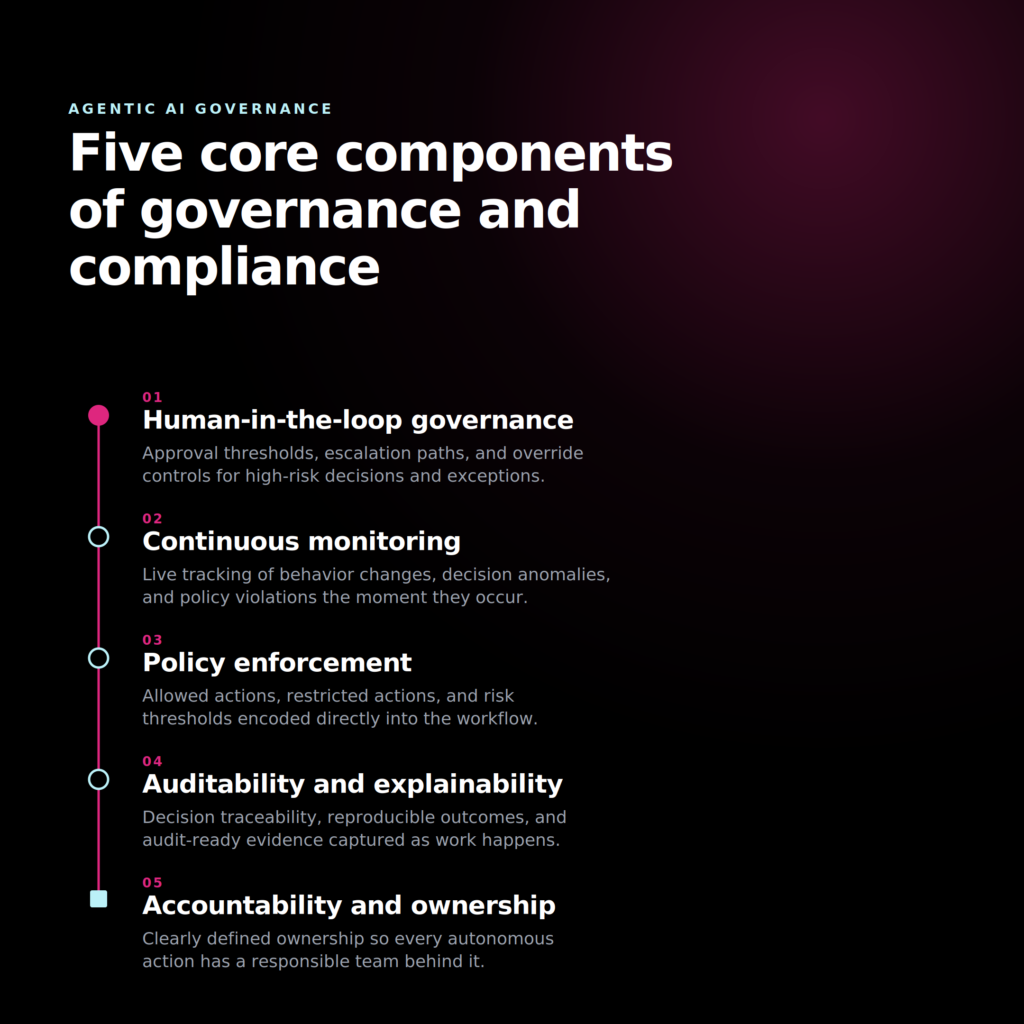
Human-in-the-Loop Governance
Autonomy does not mean removing people. It means placing them where they add the most value. Strong human-in-the-loop governance gives teams clear approval mechanisms, defined escalation pathways, and reliable override controls. Human intervention should be required where it matters most:
• High-risk decisions with material customer or financial impact
• Exceptions that fall outside expected patterns
• Policy breaches that an agent should never resolve on its own
Continuous Monitoring and Compliance Tracking
Monitoring shifts from periodic check-ins to a constant signal. For agentic systems it should track behavior changes over time, decision anomalies that deviate from norms, and policy violations the moment they occur. Continuous compliance monitoring is what turns oversight from a backward-looking report into a live control.
Policy Enforcement and Governance Controls
Agents need clear boundaries written in terms they can act on. Financial institutions should define which actions are allowed, which actions are restricted, and what risk thresholds trigger a stop or an escalation. Encoding policy directly into the workflow keeps enforcement consistent instead of relying on after-the-fact correction.
Auditability and Explainability
Every autonomous decision should leave a record that holds up under scrutiny. That means decision traceability across each step, reproducible outcomes that can be re-examined, and audit-ready evidence captured as work happens. Strong control over model documentation is what makes this practical at scale.
Governance Controls for Agentic AI Compliance
| Governance Area | Required Control |
| Decision Oversight | Approval thresholds |
| Compliance | Automated policy checks |
| Monitoring | Continuous alerts |
| Auditability | Decision logs |
| Accountability | Defined ownership |
Building a Compliance-Ready Governance Model for Agentic AI
Establish Risk-Based Governance
Not every agent carries the same risk, and governance should reflect that. Start by classifying systems by risk level, then match the depth of controls and oversight to each tier. A low-risk internal assistant and a customer-facing decision agent should not be governed identically.
Integrate Governance Across the Lifecycle
Governance works best when it is built in rather than bolted on. That means embedding controls across the full lifecycle:
• Development, where intended behavior and boundaries are defined
• Validation, where behavior is tested against those boundaries
• Deployment, where controls and approvals go live
• Monitoring, where behavior is tracked continuously in production
Align Governance with Regulatory Expectations
Mapping controls to recognized frameworks keeps governance defensible and saves rework later. SR 11-7, OSFI E-23, and the NIST AI RMF each offer principles that translate well to agentic systems, from validation discipline to lifecycle oversight to continuous risk management. Aligning early turns regulatory readiness into a byproduct of good practice rather than a separate project.
Move from Static Policies to Continuous Oversight
Static governance assumes the system behaves the same tomorrow as it did at sign-off. Autonomous systems do not honor that assumption. As agents adapt to new data and conditions, governance has to observe and respond in kind. The shift from static policy documents to continuous oversight is the single most important change financial institutions can make as they scale agentic AI.
How ValidMind Supports AI Governance and Compliance
ValidMind helps financial institutions govern AI across its full lifecycle, and that same foundation extends to agentic systems. The ValidMind AI governance platform is built for the controls, evidence, and oversight that regulated institutions need.
Lifecycle-Based Governance Workflows
ValidMind structures governance around the model lifecycle, so controls and approvals are connected from development through monitoring rather than scattered across disconnected steps.
Centralized Documentation and Auditability
Documentation and evidence live in one place, which makes decisions traceable and audits far less painful. This connects directly to model risk management, where consistent records are the backbone of defensible governance.
Continuous Monitoring and Validation
Rather than treating validation as a one-time gate, ValidMind supports ongoing review and monitoring, which is exactly what behavior-focused governance of autonomous systems requires.
Compliance-Ready Governance for Financial Institutions
Because the platform is built for regulated environments, governance evidence aligns with the expectations supervisors bring to model risk. For a real-world view, see how we helped accelerate AI governance for a Fortune 500 bank.
Conclusion
Agentic AI changes what compliance has to account for. When systems act rather than just predict, governance has to follow the behavior, not only the model. Traditional, point-in-time approaches were not built for that, and trying to stretch them over autonomous systems leaves real gaps.
Financial institutions that get ahead of this will share a few traits. They build continuous oversight into the workflow, they keep decisions explainable, and they maintain auditability as a matter of course. Above all, they make the shift in mindset that defines this moment: governance moves from model-focused to behavior-focused.
That evolution is not a burden. It is the foundation that lets institutions adopt agentic AI with confidence, knowing their systems are both capable and accountable.
AI Governance and Compliance FAQs
How can banks govern autonomous AI systems without increasing compliance risk?
By matching governance to behavior rather than output. Banks classify agents by risk level, embed controls across the lifecycle, and use continuous monitoring so that oversight scales with autonomy. Done well, stronger governance actually lowers compliance risk because every decision is documented, traceable, and bounded by enforced policy.
What happens when agentic AI makes decisions that violate compliance policies?
With proper controls, a policy violation should trigger an automated check that stops or escalates the action before it causes harm, and the event is logged for review. The goal is to catch breaches in real time through policy enforcement and escalation pathways rather than discovering them after the fact in an audit.
Why do traditional compliance frameworks struggle with agentic AI systems?
Traditional frameworks assume fixed inputs, stable outputs, and point-in-time validation. Agentic AI behaves dynamically and takes multi-step action, so the same starting point can produce different paths. Frameworks built for predictable models cannot keep pace with systems designed to adapt and act on their own.
How can financial institutions audit decisions made by autonomous AI agents?
By capturing audit-ready evidence as work happens. That means decision traceability across each step, reproducible outcomes, and centralized logs with clear ownership. When the full action path is recorded in one place, auditors can reconstruct why a decision occurred instead of piecing it together from fragmented systems.
What governance controls should financial institutions put in place for agentic AI?
Core controls include approval thresholds for high-risk decisions, automated policy checks, continuous monitoring with real-time alerts, complete decision logs, and clearly defined ownership for accountability. Together these cover oversight, compliance, monitoring, auditability, and responsibility.
How do banks monitor autonomous AI behavior in real time?
Through continuous compliance monitoring that tracks behavior changes, flags decision anomalies, and surfaces policy violations the moment they occur. Unlike periodic performance checks, real-time monitoring treats oversight as a live control rather than a backward-looking report.
What are the biggest compliance risks of using agentic AI in financial services?
The major categories are regulatory risk from undocumented or non-compliant actions, operational risk from unintended downstream effects, governance risk from weak oversight, reputation risk from unfair outcomes, and audit risk from missing evidence. In autonomous systems these risks tend to compound rather than stay isolated.
How can financial institutions maintain human oversight in agentic AI systems?
By designing human-in-the-loop governance with clear approval mechanisms, escalation pathways, and override controls. People are positioned where they add the most value, including high-risk decisions, exceptions, and any policy breach an agent should never resolve on its own.
What makes agentic AI harder to govern than traditional machine learning models?
Traditional models predict, while agents act, often across multiple steps and connected systems. That autonomy reduces visibility, multiplies the ways things can go wrong, and demands behavior-focused, continuous governance instead of one-time, model-focused validation.
How can financial institutions prepare for regulatory scrutiny around agentic AI?
By aligning controls to established frameworks such as SR 11-7, OSFI E-23, and the NIST AI RMF, embedding governance across the lifecycle, and maintaining continuous oversight with durable, audit-ready evidence. Preparing early makes regulatory readiness a byproduct of strong everyday practice.