ValidMind Agent Authority
The authority layer for the agentic economy.
The more authority you can prove, the more power you can safely hand an AI agent. ValidMind Agent Authority sits in the call path of every agent and decides whether each action is allowed on any runtime, independent of the model and the platform.

The problem: Capability has outrun control.
Agents can now act. They move money, write to production, and delete records on their own. What no enterprise has decided is who they answer to. The power came from the runtime. The authority was never built.
What they have: Power
Agents act at machine speed, on their own initiative.
They call tools, spawn sub-agents, invoke third-party APIs, and commit the firm to outcomes thousands of times a day, faster than any human can review.
What's missing: Authority
No one decided what each agent is allowed to do.
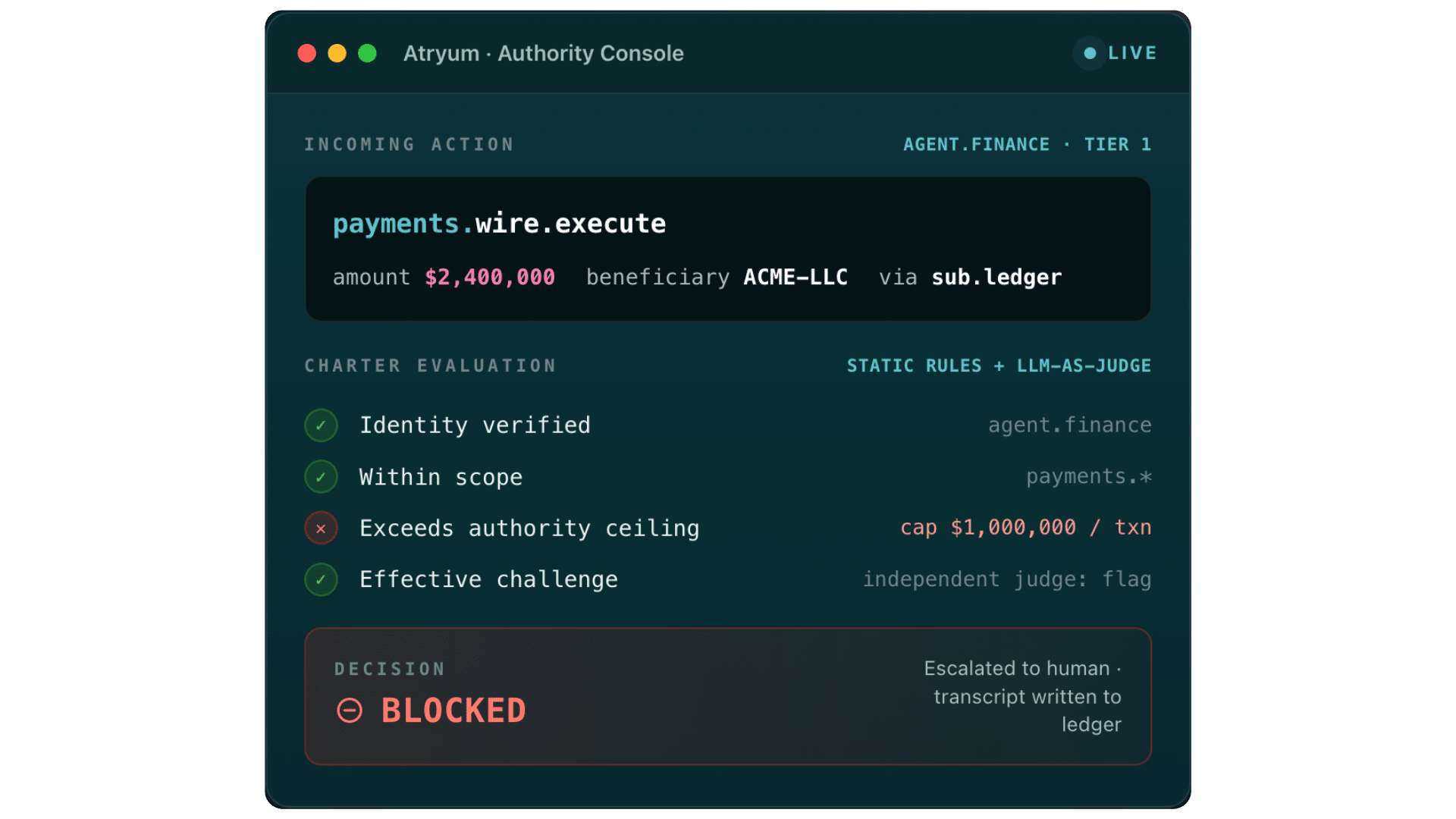
Your IAM proves who the agent is. Your guardrails screen content. But nothing rules on whether the business action itself is permitted, and stops it before it fires.
3 of 4
enterprises are adopting agentic AI, but only a minority of projects reach production.
Forrester, 2026
49%
of security leaders name agentic AI a top concern; risk is the defining constraint.
Forrester, 2026
40%+
of agentic AI projects will be canceled by the end of 2027 due to inadequate risk controls.
Gartner, 2025
The Solution: ValidMind Agent Authority
The org chart your AI workforce never had, enforced at the point of action, not just policy on paper.
Give every AI agent a manager, a charter, a reporting line, and a record of what it did.
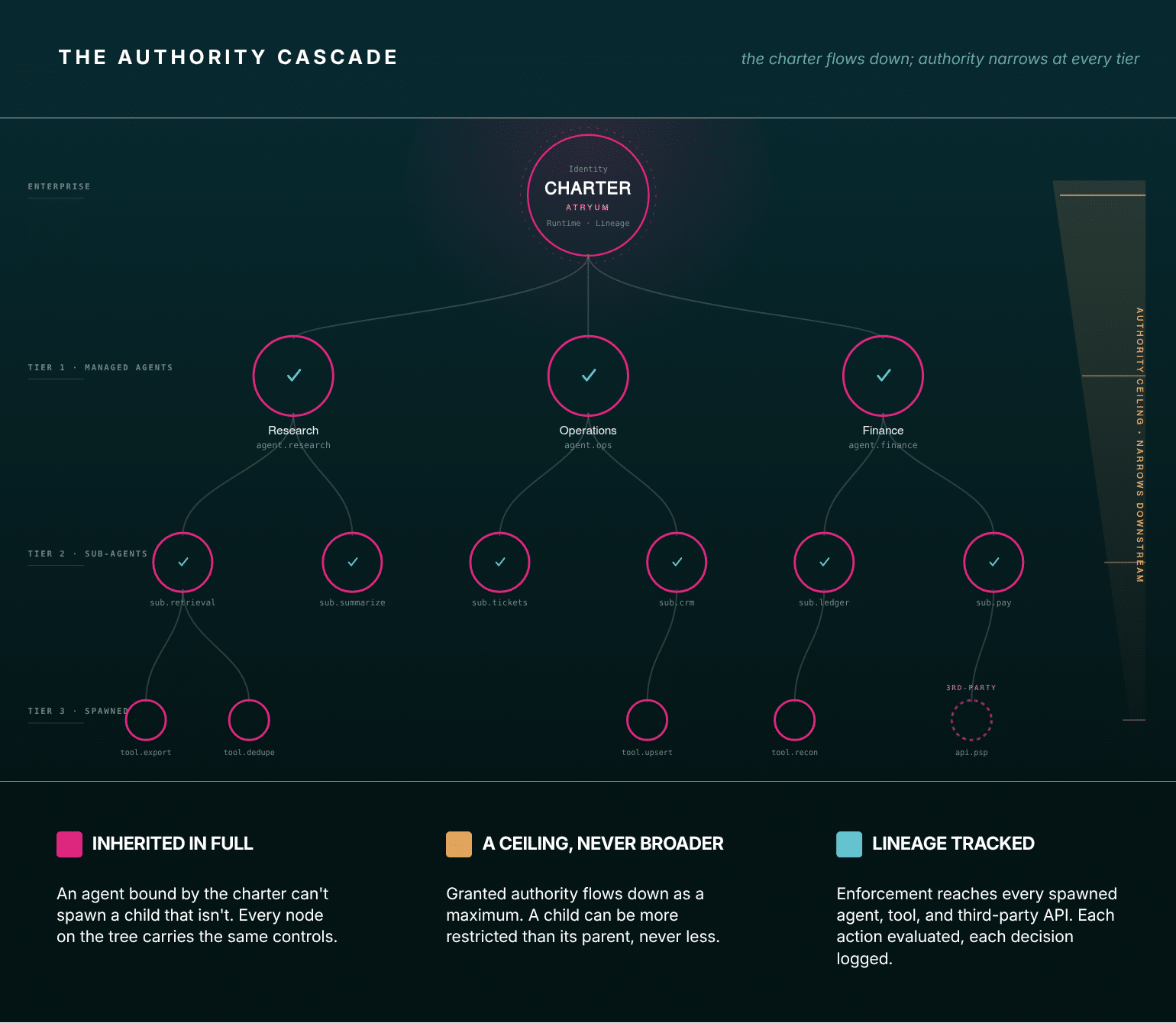
Every agent gets what every employee has: a governed identity and a charter that says what it may do. Agent Authority enforces it on every action, and the charter cascades down the tree of sub-agents and tools, narrowing at each tier.
01. Intercept
Every agent tool call is caught in the call path, before it executes.
02. Evaluate
Checked against policy. Routine work clears at machine speed; higher-stakes actions get a closer look.
03. Decide
Allow, pause, or deny. Pauses route to the right person, the agent’s reasoning attached.
04. Record
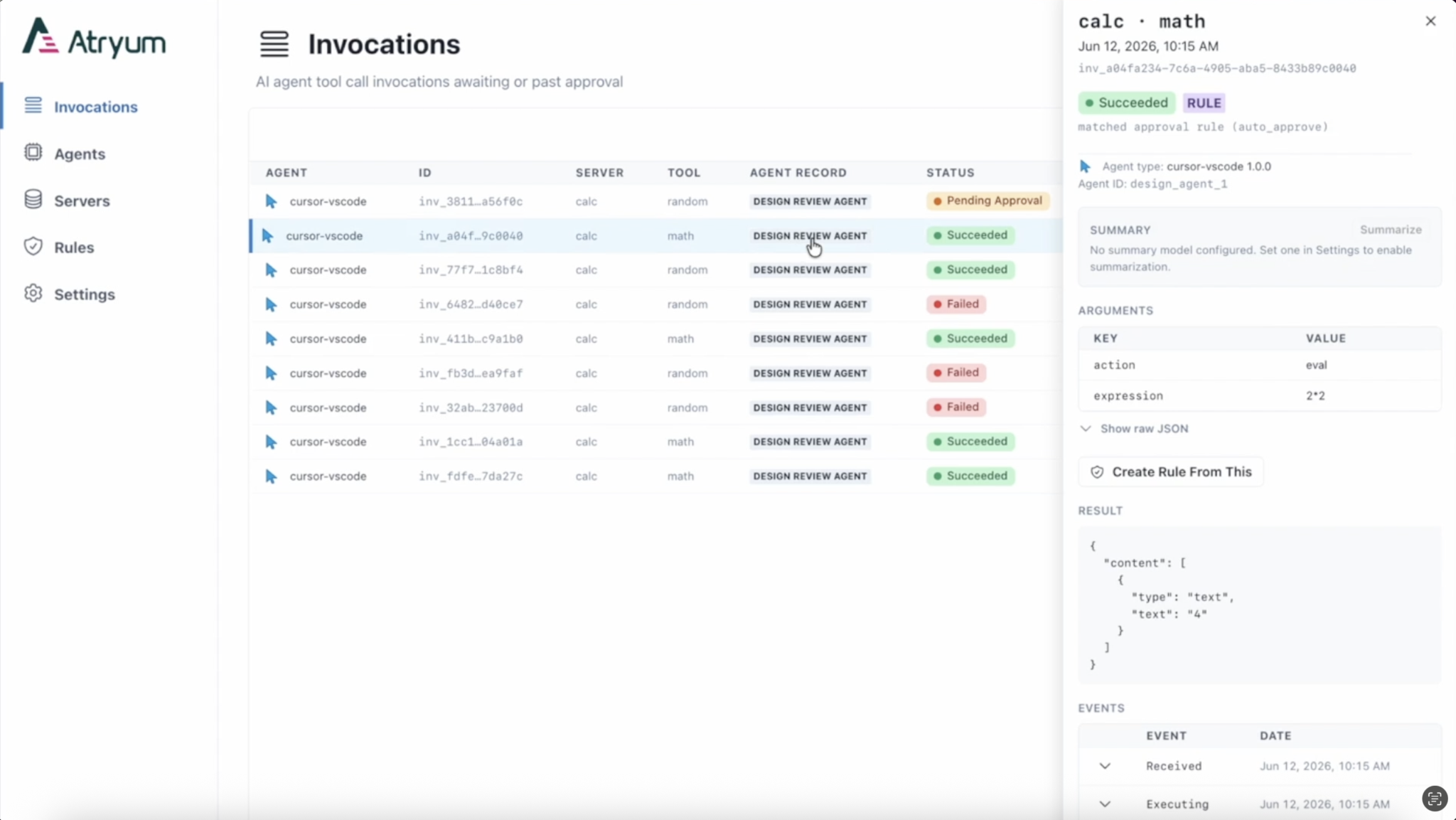
Request, verdict, and who approved it, written to an audit trail you own.
Built on Atryum. Open by design.
Agent Authority is built on Atryum, our open source agent control layer, giving you the transparency of open infrastructure with the assurance of enterprise readiness.

No black box. Inspect the control layer your agents run on.
No lock-in. Build on an open foundation, run it your way.
Open core, Apache 2.0. Audit it, extend it, own it.
Faster stakeholder trust. Show risk and audit teams how controls really work.
Enterprise assurance on top. Support, security, and governance, production-ready.

Why ValidMind? Externalized authority over the action.
Everyone claims "independent." The wedge that no one else clears is a binding gate that sits outside the agent and rules on the business action itself. Three legs — every other vendor fails at least one.

1. Outside the agent
In-agent SDKs run the check inside the agent. The team can skip or misconfigure it. Agent Authority lives outside what it governs.

2. Binding in the call path
Observability watches and flags, but the action still fires. Agent Authority stops it before it happens.

3. Over the action
Other layers check content, identity, and safety. None decide whether the business action should happen. Agent Authority does.
Only ValidMind clears all three: an outside, binding authority over the action, in the call path — independent of the model that reasons and the platform that runs it. That independence is what makes effective challenge real, the same principle SR 11-7 established for model risk and SR 26-2 now demands for agentic AI.
Production-grade, not slideware.
A decade of G-SIB heritage
Built by the team that ran model governance inside the world's largest banks — under strict regulations, not theory.
Demonstrable today
Watch Atryum intercept, evaluate, and decide on a real tool call live. The open-source core ships at GA — inspect the enforcement yourself.
We've seen how this breaks
We built Agent Authority after watching automated decisions fail in the real world. We've built the controls that would have caught them.
Give your AI a reporting line.
See ValidMind Agent Authority rule on a live agent action and what it takes to put your agentic workforce into production with authority you can prove to a board.