Policy-as-Code in AI Governance Tools for Autonomous Agents
AI governance tools are no longer optional infrastructure; they are the critical execution layer standing between autonomous AI agents and the compliance, risk, and accountability failures that follow when governance can’t keep pace.
Enterprises are deploying more than predictive models as they increasingly develop and deploy AI agents. Autonomous and agentic AI systems now make independent decisions, execute multi-step workflows, and interact across internal and external systems with limited human oversight. A credit decisioning agent can pull customer data, query a fraud model, evaluate policy thresholds, and issue a recommendation in milliseconds. A compliance copilot can parse a new regulation, map it to internal controls, and generate a remediation plan before a human ever opens the email.
That speed is the value. It is also the governance problem.
Traditional governance approaches were built for a slower, more deterministic world. They rely on written policies stored in document repositories, manual reviews conducted at quarterly checkpoints, and periodic audits that surface issues weeks or months after the fact. When the unit of decision is a human signing off on a model release every six months, that cadence works. When the unit of decision is an agent executing a thousand calls per minute across half a dozen systems, it does not.
The result is a widening gap: governance policies exist on paper, but they are not enforced consistently in real time. That gap is where governance drift takes hold, where compliance gaps emerge, and where accountability dissolves the moment something goes wrong. Regulators, boards, and customers do not accept “we had a policy” as a defense. They want evidence the policy was enforced.
This is the shift Policy-as-Code is built for. Policy-as-Code transforms governance from static documentation into executable, enforceable systems embedded directly within AI governance tools. It treats governance not as a binder on a shelf, but as code that runs alongside the AI it governs: versioned, tested, deployed, and audited with the same rigor as the models themselves.
This article unpacks how Policy-as-Code works inside modern AI governance platforms, why it is the only viable control model for autonomous agents, and how enterprises can move from governance strategy to a real execution layer without slowing down the AI programs that depend on it.
Understanding Policy-as-Code in AI Governance
Definition of Policy-as-Code in Enterprise AI Context
Policy-as-Code is the practice of translating governance policies into machine-executable logic, incorporating risk thresholds, compliance requirements, model approval criteria, decision boundaries, and escalation rules. Instead of a 40-page model risk policy that humans interpret on a case-by-case basis, the policy is encoded as rules that AI governance software can evaluate automatically against every model, every decision, and every workflow stage.
The shift it enables is fundamental: governance moves from advisory to enforceable. A policy document advises that high-risk models require independent validation; a Policy-as-Code rule prevents a high-risk model from advancing to production without the validation artifact attached, signed, and timestamped. The first relies on human discipline. The second cannot be skipped.
For enterprise AI governance tools, this means three things: rules are codified once and applied consistently everywhere, enforcement is automatic rather than dependent on individual reviewers, and every decision the system makes or blocks is captured as evidence.
Key Elements of Policy-as-Code
Rule Encoding
Governance policies are translated into logical conditions and decision rules that a governance engine can evaluate. A policy stating that “all credit risk models must achieve a minimum AUC of 0.75 on holdout data before production deployment” becomes a rule the system checks automatically when a model transitions stages. Approval thresholds, validation requirements, fairness constraints, drift tolerances, and compliance conditions all get encoded the same way, each as a discrete, testable rule.
Execution Layer
Encoded rules are useless if they only live in a policy database. Policy-as-Code embeds them into the governance tools and workflow systems where AI is actually built and deployed. When a developer pushes a new model version, the rules execute. When an agent attempts an action that crosses a defined boundary, the rules execute. Enforcement becomes automatic and consistent across teams, business units, and geographies.
Versioning and Traceability
Policies change. Regulations evolve, board risk appetite shifts, and internal controls get tightened after incidents. Policy-as-Code treats every rule as a versioned artifact that is tracked over time, with clear provenance, mapping each governance decision back to the exact policy version in force when it was made. That traceability is what turns audits from archaeological digs into queries.
Policy Documentation vs Policy Execution
Before implementing Policy-as-Code, it is worth being precise about what it replaces. Most enterprises do not lack policies; they lack the means to execute them. The table below isolates the dimensions where the two approaches diverge.
Table: Policy Documentation vs Policy-as-Code
| Dimension | Policy Documentation | Policy-as-Code |
|---|---|---|
| Format | Text-based documents | Machine-readable rules |
| Enforcement | Manual | Automated |
| Consistency | Variable | Standardized |
| Auditability | Limited | High |
| Scalability | Low | High |
| Response Time | Delayed | Real-time |
The takeaway is straightforward: documentation alone cannot govern autonomous systems. Once AI begins making decisions faster than humans can review them, execution is the only governance layer that matters.
Why Autonomous AI Agents Require Policy-as-Code
Continuous Decision-Making Requires Continuous Governance
Autonomous agents do not wait for a quarterly governance review. They make decisions continuously, often without explicit human triggers, and frequently across systems that were never designed to talk to each other. The implication for governance is straightforward: the controls have to operate at the same speed as the decisions they are meant to govern. A control that fires a week later is not a control; it is a postmortem.
Increased Complexity of Agent Behavior
Multi-Step Decision Flows
Agentic AI rarely makes a single decision in isolation. A typical workflow involves a chain of dependent operations retrieving data, calling a model, evaluating output against a threshold, calling another model, taking an action, logging the result. Governance has to attach to every step in that chain, not just the entry or exit point, because failure can occur anywhere along it.
Cross-System Interactions
Agents interact with internal APIs, third-party data sources, customer-facing applications, and other agents. Each integration is a surface where policy must be enforced: data access rules, action permissions, output constraints. AI governance systems that only oversee the model itself, while ignoring the runtime environment around it, leave the most consequential interactions unmanaged.
Adaptive Behavior
Modern AI does not stand still. Models evolve through retraining, prompt updates, retrieval-augmented configurations, and tool integrations. Behavior at deployment is not behavior six weeks later. Policies that assume a static model will be wrong about a dynamic one, and the governance layer has to adapt as fast as the system it is governing.
Risk Amplification in Autonomous Systems
The complexity of agentic systems leads to materially amplified risks compared to traditional AI. The same characteristics that make agents valuable (like autonomy, scope, speed) are exactly what magnifies the consequences when something goes wrong.
Table: Risk Amplification in Autonomous AI
| Risk Type | Traditional AI | Agentic AI |
|---|---|---|
| Decision Scope | Limited | Broad |
| Error Impact | Isolated | Cascading |
| Monitoring Needs | Periodic | Continuous |
| Human Oversight | High | Reduced |
| Risk Propagation | Low | High |
The pattern is consistent across every dimension: more autonomy demands more automation in governance, not less. The urgency for robust AI governance scales directly with the autonomy organizations grant their AI systems.
Limitations of Traditional AI Governance Approaches
Static Policy Frameworks
Most AI governance frameworks in production today were authored once, ratified by a committee, and then frozen. They cannot adapt to the way modern AI behavior evolves between releases, and certainly not to the way an agent’s behavior can shift mid-week as new data arrives, prompts are tuned, or integrated tools change.
Lack of Enforcement Mechanisms
Conventional governance defines what should happen. It rarely controls what happens. A policy stating that models must be validated before promotion does not, on its own, prevent promotion of an unvalidated model. It relies on humans to refuse to click the button. Across thousands of models and dozens of teams, that reliance fails predictably.
Fragmented Governance Across Tools
Validation lives in one platform, monitoring in another, reporting in a third, and policy documentation in a SharePoint folder. Each system has its own data model and its own definition of “approved.” The result is inconsistent governance, gaps between handoffs, and an aggregate picture that no one can see in full. This is precisely the problem seamless integrations across the AI governance lifecycle are designed to solve.
Delayed Risk Detection
When governance is reactive, issues are identified after impact. A drift breach is discovered in next month’s review. A fairness regression surfaces in a customer complaint. A compliance gap emerges during an external audit. None of those discovery paths give the organization time to act before harm occurs. There is no proactive governance layer, only proactive cleanup.
How AI Governance Tools Enable Policy-as-Code
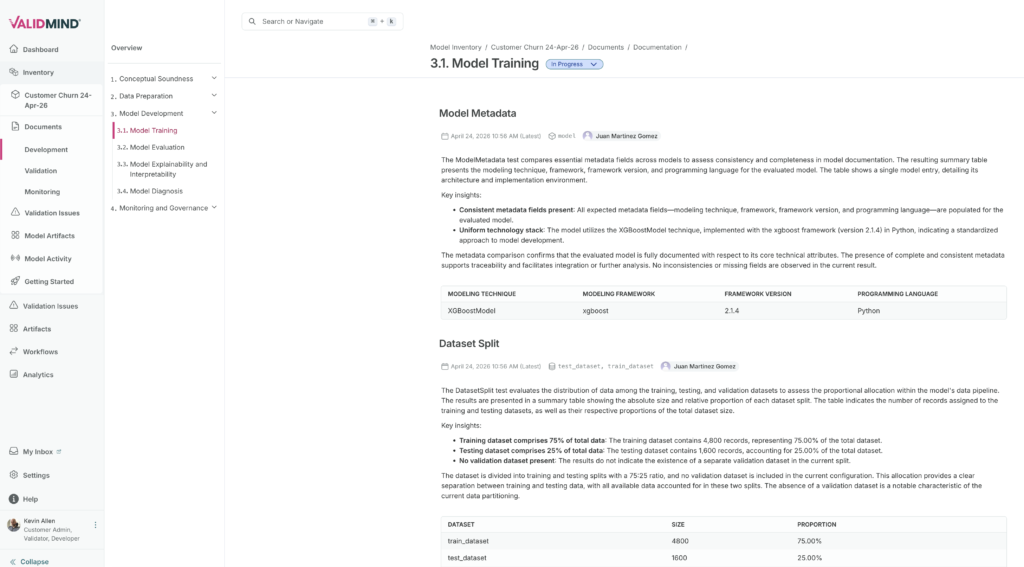
Modern AI governance platforms operationalize Policy-as-Code through four interlocking capabilities. Together, they convert governance from a documentation function into a production system.
Governance Rule Engines
Rule Definition
A rule engine is the component where policy actually becomes executable. Risk owners and compliance teams define conditions, thresholds, and constraints in a structured form, with minimum performance metrics, required validation artifacts, sign-off requirements, fairness ceilings, and exposure limits. Each rule is testable, versionable, and traceable to its source policy.
Rule Execution
Once defined, rules execute across models, workflows, and decisions automatically. They do not depend on a reviewer remembering to check a box. The rule engine becomes the enforcement layer that makes governance policy automation possible at enterprise scale.
Workflow Automation
Validation Workflows
Validation is one of the most consistent sources of governance drift, because it depends on the discipline of multiple teams across long timelines. AI governance automation standardizes validation as a workflow. Testing, documentation, independent review, and approval all happen in a defined sequence, with the system enforcing prerequisites at each stage.
Monitoring Workflows
Continuous tracking of model performance, drift, fairness, and operational metrics flows into the same workflow engine. Automated alerts trigger when monitored values cross policy thresholds, and the alerts themselves can be wired to remediation workflows (not just an email to a distribution list).
Decision Boundary Enforcement
Defining Boundaries
For agentic AI, perhaps the most consequential capability is the ability to define what an agent can decide and execute. Boundaries are codified explicitly, detailing which data sources an agent can access, which actions it is permitted to take, what dollar thresholds require human approval, what categories of decision require an audit log entry.
Enforcing Boundaries
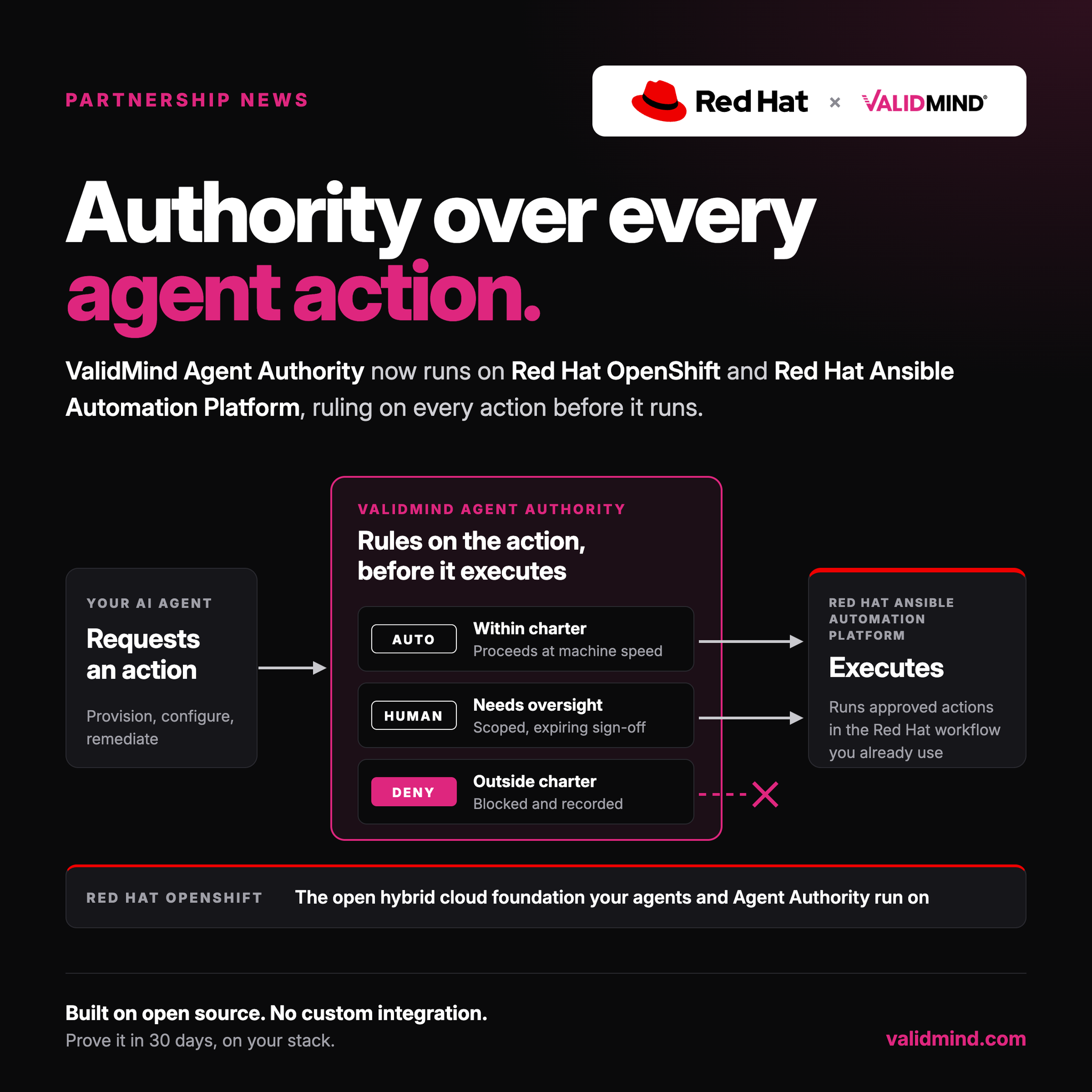
Boundaries are only meaningful if they are enforced. AI governance tools restrict unauthorized actions at the runtime layer and trigger escalation when an agent attempts to operate outside its allowed envelope. This is the operational core of autonomous AI control systems, not the model’s training, but rather the live constraints the agent runs inside.
Real-Time Monitoring Integration
Performance monitoring and anomaly detection feed back into the governance layer continuously, so the system can trigger governance actions like pause, escalate, retrain, ore rollback, in response to real-world behavior rather than scheduled review cycles.
Table: Capabilities of AI Governance Tools for Policy-as-Code
| Capability | Description | Business Impact |
|---|---|---|
| Rule Engine | Executes governance policies | Consistent enforcement |
| Workflow Automation | Standardizes processes | Efficiency |
| Monitoring Integration | Tracks real-time behavior | Risk reduction |
| Audit Logging | Captures decisions | Compliance readiness |
| Policy Versioning | Tracks policy changes | Transparency |
These capabilities collectively transform AI governance tools from passive monitoring dashboards into active execution systems. That distinction is what makes governance survivable at the speed and scale of agentic AI.
Core Capabilities Required for Policy-as-Code Implementation
Policy Versioning and Lifecycle Management
Effective AI policy versioning treats governance rules the same way engineering treats application code: every change is tracked, every release is tagged, and every deployed version is mapped to the period in which it was active. When a new regulation takes effect like a model risk update, a regional fairness rule, or an updated capital requirement, policies can be updated, tested, and promoted through environments with full traceability rather than ad-hoc memo updates that some teams adopt and others miss.
Automated Compliance Validation
Compliance validation is one of the highest-volume activities in any AI program, and one of the most error-prone when handled manually. Automating it inside the governance platform, which includes checking required documentation, evidence completeness, control coverage, and regulatory mapping, reduces manual review effort while raising the floor on consistency. This is the heart of compliance workflow orchestration in regulated environments.
Continuous Monitoring and Alerts
Detection of anomalies and policy violations has to be continuous, not periodic. Continuous monitoring integrated with the governance rule engine allows the platform to trigger corrective actions: quarantine a model, block a deployment, notify a control owner. This ideally happens the moment a violation is detected.

Audit Trail and Traceability
A complete audit trail for AI decisions is the deliverable that ties everything together. Every decision the governance system makes, every policy it enforces, every override a human grants, every action an agent takes is captured, time-stamped, and queryable. When auditors, regulators, or internal stakeholders ask what happened and why, the answer is a query, not a forensic project.
Enterprise Use Cases of Policy-as-Code in AI Governance Tools
Financial Services Risk Controls
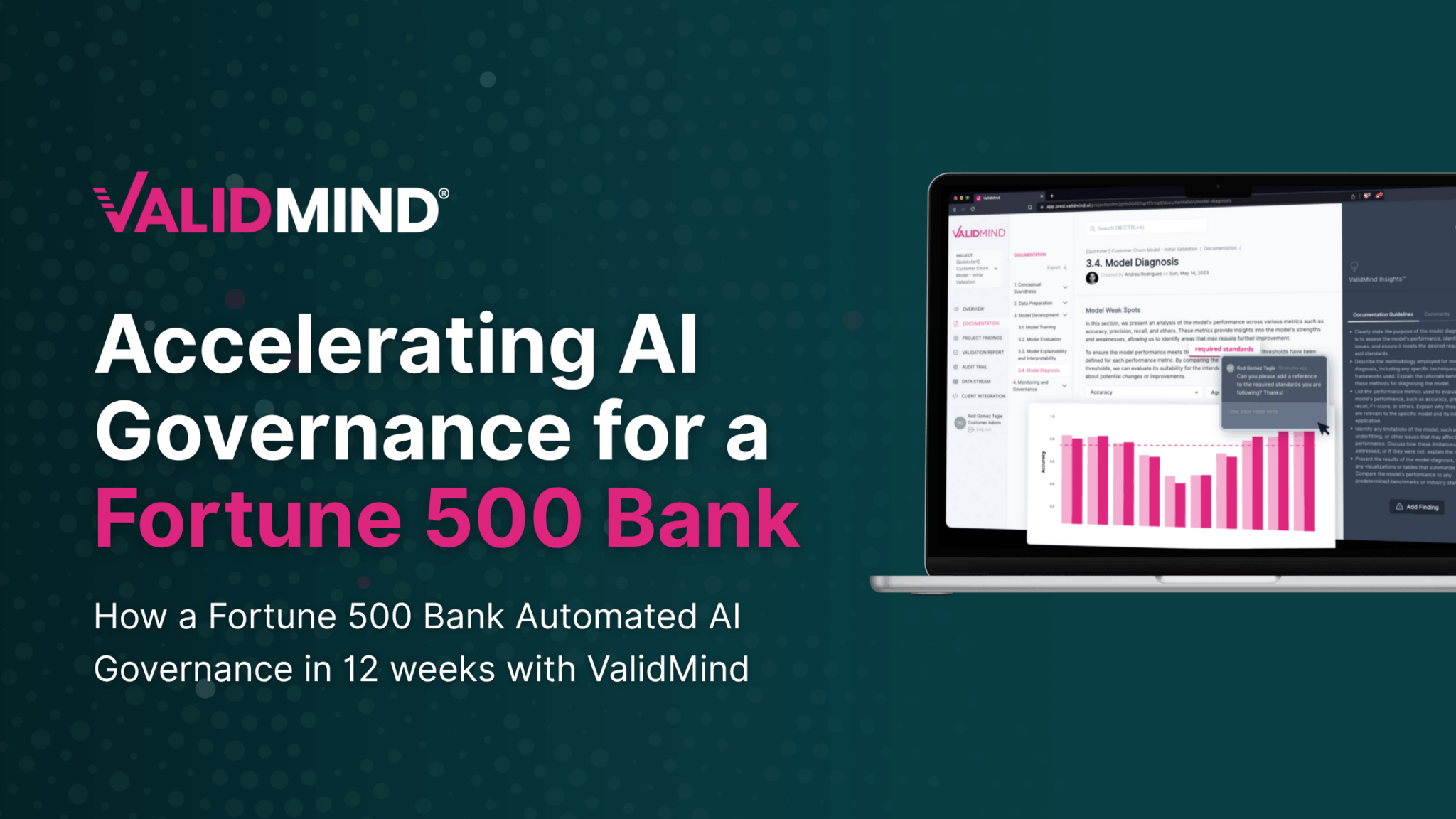
Banks and insurers operate under some of the most stringent AI risk regimes in the world: SR 26-2, the EU AI Act, SS 1/23, OSFI E-23, state-level insurance regulations, and a growing list of supervisory expectations on agentic systems. Policy-as-Code enforces credit decisioning rules, fraud detection thresholds, and regulatory compliance checks consistently across the model inventory. The work we have done with a Fortune 500 bank to accelerate AI governance and with a leading insurer to build confidence in their AI governance shows what this looks like in practice.
Autonomous Decision Systems
AI copilots, recommendation engines, and agentic workflows in operational systems require explicit decision boundaries and enforced controls. Policy-as-Code defines what the system can do unattended versus what requires human-in-the-loop, and enforces those limits at runtime.
Compliance Automation
Regulatory reporting and audit readiness benefit directly from machine-executable governance. Logs, evidence, and policy mappings are generated as a byproduct of normal operations rather than assembled as a special project before each audit cycle. This is the difference between governance that scales without slowing down AI and governance that becomes a tax on every release.
Table: Use Cases and Governance Needs
| Use Case | Governance Requirement | Policy-as-Code Role |
|---|---|---|
| Lending Models | Risk validation | Enforce approval rules |
| Fraud Detection | Real-time monitoring | Trigger alerts |
| AI Assistants | Decision control | Define boundaries |
| Compliance Reporting | Auditability | Generate logs |
In each case, Policy-as-Code maps governance requirements directly to execution. The control is not a slide in a deck, it’s a rule in a system that fires every time the condition is met.
Challenges in Implementing Policy-as-Code
Translating Policies into Executable Logic
The hardest part of Policy-as-Code is rarely the technology. Rather, the translation poses a formidable challenge. Converting legal language, regulatory text, and internal risk policies into structured rules requires close collaboration between legal, risk, compliance, and engineering teams. Ambiguity that is acceptable in a written policy (“models should be reasonably validated”) has to be made precise to be enforceable, and that precision often surfaces disagreements that were comfortably hidden in the prose.
Integration with Existing Systems
Policy-as-Code only delivers on its promise when it is connected to the rest of the enterprise: risk systems, data platforms, identity systems, ticketing, and the AI development tooling itself. Standalone governance tools that cannot reach into the runtime environment leave too many interactions ungoverned. Integration discipline is what separates AI governance implementation that works from one that produces a parallel universe of unenforced rules.
Organizational Adoption Challenges
Automation displaces familiar review patterns, and that displacement creates resistance. Teams that previously relied on judgment-based reviews can feel that codified rules are too rigid, while teams that operated without much oversight can feel newly constrained. Successful adoption requires training, governance maturity, and a clear narrative that automated controls are not a replacement for human judgment. They are a way to free human judgment for the cases that actually need it.
From Governance Strategy to Execution Layer
Bridging the Strategy-Execution Gap
Most enterprises have a governance strategy. Far fewer have a governance execution layer. Policies define intent; tools enforce execution. The gap between the two is where risk lives, and closing it is the central job of modern AI governance platforms.
Embedding Governance into AI Lifecycle
Governance has to attach at every stage of the AI lifecycle, including development, validation, deployment, and monitoring. When governance is embedded across the lifecycle, it ceases to feel like a gate and starts to function like infrastructure: present, reliable, and largely invisible until it is needed. This lifecycle integration is also the foundation of effective AI model risk management, because risk controls that only exist at deployment cannot govern what happens during development or after release.
Table: Strategy vs Execution Gap
| Layer | Strategy Defines | Execution Requires |
|---|---|---|
| Governance | Policies | Rule engines |
| Risk | Thresholds | Monitoring systems |
| Compliance | Requirements | Audit logs |
| Operations | Processes | Workflows |
Without an execution layer, governance remains theoretical, and theoretical governance does not survive contact with autonomous AI.
How ValidMind Enables Policy-as-Code in AI Governance Tools
ValidMind is purpose-built to be the execution layer for enterprise AI governance. Four capabilities anchor the platform.
Structured Governance Workflows
ValidMind standardizes validation, review, and approval workflows so that every model and every agent moves through the same defined path. The path is enforced by the platform, not by reviewer discipline, which means consistency holds even as the inventory scales into the thousands.
Lifecycle Integration
Governance attaches across all stages, from development and validation through deployment and ongoing monitoring. A model entering ValidMind is governed continuously, not just at promotion gates. Teams get the benefits of automation without losing visibility, and risk owners get a single, current picture rather than a stale snapshot.
Audit-Ready Documentation
Documentation, evidence, and policy mappings are generated as part of normal workflow execution. When auditors or regulators arrive, the artifacts already exist: versioned, traceable, and tied to the policies in effect at the time of each decision. Customers consistently report that this is the single largest reduction in audit preparation effort they see after deploying ValidMind.

Centralized Oversight
ValidMind provides unified visibility across the model and agent inventory, with enterprise-grade controls for access, segmentation, and reporting. For organizations new to operationalizing governance at this depth, our complete training overview walks through how teams ramp on the platform and apply Policy-as-Code patterns to their own model risk environment.
Frequently Asked Questions
What are AI governance tools? AI governance tools are enterprise software platforms that operationalize the policies, controls, and oversight required to manage AI models and agentic systems across their lifecycle. They typically include rule engines, workflow automation, monitoring integration, audit logging, and policy versioning.
What is Policy-as-Code in AI governance? Policy-as-Code is the practice of translating governance policies into machine-executable rules that are enforced automatically by AI governance software. It shifts governance from advisory documentation to enforceable execution, with versioned, auditable rules that fire in real time.
Why do autonomous AI agents need different governance than traditional models? Autonomous agents make continuous, multi-step decisions across systems with reduced human oversight. Traditional periodic review cannot keep pace, and errors propagate faster and farther. Continuous, automated enforcement through Policy-as-Code is the only governance model that operates at the same speed as the agents it controls.
How does Policy-as-Code support regulatory compliance? Policy-as-Code generates a complete, queryable audit trail of every decision the governance system makes: which policy version was in force, which rules fired, and who approved exceptions. This evidence is what regulators increasingly expect, and it is generated automatically rather than reconstructed before each audit.
What is the difference between AI governance software and an AI governance platform? The terms are often used interchangeably, but a platform implies broader scope, including integrated rule engine, workflows, monitoring, documentation, and oversight in one system. Enterprise AI governance tools at the platform level are designed to be the execution layer across the AI lifecycle.
Conclusion
Autonomous AI systems require continuous governance and enforceable controls, not periodic reviews of static documents. Policy-as-Code is the mechanism that delivers it, translating policies into executable rules, embedding them into the workflows where AI is built and deployed, and producing the audit evidence that regulators and boards now demand by default. AI governance tools become the execution layer that bridges policy and practice.
The strategic shift is the one to internalize: governance in the age of agentic AI is about executing them. Enterprises that make that shift will scale AI confidently. Those that do not will keep writing policies that their own systems cannot enforce.
If you are evaluating how to operationalize AI governance at the depth that agentic systems require, explore the ValidMind AI governance platform or see how it integrates with the rest of your AI model risk management stack. Request your demo today.
AI Governance Tools FAQs
What are AI governance tools?
AI governance tools are enterprise software platforms that operationalize the policies, controls, and oversight required to manage AI models and agentic systems across their lifecycle. They typically include rule engines, workflow automation, monitoring integration, audit logging, and policy versioning.
What is Policy-as-Code in AI governance?
Policy-as-Code is the practice of translating governance policies into machine-executable rules that are enforced automatically by AI governance software. It shifts governance from advisory documentation to enforceable execution, with versioned, auditable rules that fire in real time.
Why do autonomous AI agents need different governance than traditional models?
Autonomous agents make continuous, multi-step decisions across systems with reduced human oversight. Traditional periodic review cannot keep pace, and errors propagate faster and farther. Continuous, automated enforcement through Policy-as-Code is the only governance model that operates at the same speed as the agents it controls.
How does Policy-as-Code support regulatory compliance?
Policy-as-Code generates a complete, queryable audit trail of every decision the governance system makes: which policy version was in force, which rules fired, and who approved exceptions. This evidence is what regulators increasingly expect, and it is generated automatically rather than reconstructed before each audit.
What is the difference between AI governance software and an AI governance platform?
The terms are often used interchangeably, but a platform implies broader scope, including integrated rule engine, workflows, monitoring, documentation, and oversight in one system. Enterprise AI governance tools at the platform level are designed to be the execution layer across the AI lifecycle.