Types of AI Governance Models: Centralized vs Federated vs Hybrid
AI governance models determine whether your organization’s artificial intelligence scales with confidence or collapses under the weight of regulatory scrutiny, fragmented ownership, and audit failures.
As AI adoption spreads across business units, the governance structures built for single-team models and static risk environments are buckling. The result: fragmented ownership, inconsistent validation, and mounting audit complexity. Understanding AI governance models, and choosing the right one for your organization, is no longer a theoretical exercise. It’s a critical organizational design decision that determines whether governance is an enabler or a bottleneck.
This guide breaks down the three primary AI governance models–centralized, federated, and hybrid–including how they work in practice, where they break down, and how enterprise teams can select and operationalize the right model at scale.
AI Governance Models Are Organizational Designs, Not Just Policies
Most discussions of AI governance focus on frameworks: the rules, regulations, and documentation requirements that organizations must meet. But frameworks alone don’t determine governance outcomes. The organizational model, who owns what and how decisions flow, is what makes or breaks compliance in practice.
Governance Model vs Governance Framework vs Governance Tooling
These three concepts are often conflated, but they operate at entirely different levels:
- Framework = the rules, standards, and regulatory requirements an organization must meet (e.g., SR 26-2, EU AI Act)
- Governance model = the operating structure that defines who owns decisions, who validates models, and how accountability is distributed
- Governance tooling = the execution layer: the platforms, workflows, and automation that make governance operational
Most governance failures aren’t caused by inadequate frameworks; they’re caused by organizational misalignment. The same policy applied through a centralized model versus a federated one produces entirely different outcomes.
Why Operating Models Define Governance Success
The urgency is clear: more than 88% of organizations now use AI in at least one business function. Yet, as of 2024, only 39% of Fortune 100 companies disclosed any form of board oversight of AI. The AI operating model and governance ownership structure you choose will shape validation timelines, audit readiness, and the ability to adapt to new regulatory demands.
Centralized AI Governance: Control-First Architecture
In a centralized AI governance model, a single governance authority, typically a Model Risk Management (MRM) function or central validation team, owns the entire governance lifecycle for all AI and machine learning models across the organization.
Structural Design
- All model validation requests route through one central team
- Monitoring and risk decisions are controlled centrally
- Business units submit models; governance team approves or escalates
- Documentation standards, validation templates, and reporting formats are uniform across the org
How Validation and Monitoring Work
- All models routed through central validation
- Monitoring decisions controlled centrally
Strengths Under Regulatory Pressure
For organizations operating under strict regulatory oversight (banks, insurers, healthcare organizations), centralized governance offers a compelling advantage: consistency. Every model goes through the same validation process. Every decision has a traceable owner. Audit artifacts are uniform and complete.
- Strong audit traceability with consistent validation artifacts
- Easier regulatory alignment across SR 26-2, EU AI Act, and similar frameworks
- Single source of truth for model inventory and documentation
Where It Breaks at Scale
The control advantages of centralized governance come with a real organizational cost. As AI model volumes grow, central validation teams become bottlenecks. Deployment timelines slip. Business units–particularly those in high-velocity environments like credit decisioning or fraud detection–find governance at odds with their speed requirements.
- Validation backlogs slow model deployment cycles by weeks or months
- Central teams lack domain-specific context for nuanced risk decisions
- Governance becomes a blocker rather than an enabler of AI development
Real-World Impact: Industry research shows it typically takes 6–18 months to get a single AI use case approved for production. In centralized structures, this bottleneck compounds with scale.
Federated AI Governance: Distributed Ownership Model
A federated governance structure embeds governance responsibilities within individual business units. Each team owns its own model validation, monitoring, and risk decisions, within a broad set of enterprise guidelines. This is the AI governance model of choice for large, multi-division organizations where domain expertise and speed matter most.
Structural Design
- Governance ownership sits within business units or product teams
- Each team manages its own validation, monitoring, and documentation
- Central enterprise team sets high-level policy but does not control execution
- Risk decisions are made by people closest to the model’s domain context
How Governance Becomes Context-Aware
The primary advantage of federated governance is contextual intelligence. A fraud model at a payments company has entirely different risk dimensions than a recommendation engine in retail. When governance decisions sit with the teams closest to those models, validation is more nuanced and deployment is faster.
- Domain-specific risk decisions by teams with deep model context
- Faster experimentation cycles and model iteration
- Reduced dependency on a central bottleneck
Hidden Risks
Federated governance creates significant execution risk if not carefully managed. Without a coordination layer, governance standards diverge across teams. Model documentation becomes inconsistent. And when regulators request enterprise-wide evidence of governance, organizations face a painful documentation gap.
- Inconsistent validation standards across business units
- Lack of global visibility into model inventory and risk exposure
- Fragmented documentation that fails audit readiness requirements
- Risk of governance decisions made without enterprise-wide context
Why Audit Readiness Becomes Difficult
- No centralized evidence
- Inconsistent governance artifacts
Key Insight: Federated governance works well when teams are mature, standards are clear, and a coordination mechanism ensures consistency. Without those conditions, it creates the illusion of governance without the substance.
Hybrid AI Governance: Coordinated Control at Scale
Hybrid governance architecture combines centralized policy-setting with distributed execution. A central team establishes standards, validation templates, and risk thresholds; business units apply those standards locally with the freedom to adapt to their domain context. It’s the AI governance model increasingly adopted by enterprises that need to scale AI responsibly across complex organizational structures.
Structural Design
- Central governance team owns standards, policies, and validation templates
- Business units execute locally using shared frameworks and tooling
- Governance coordination layer provides enterprise-wide visibility
- Escalation paths exist for high-risk or novel model types
Governance Coordination Layer
- Central team defines:
- Standards
- Validation templates
- Teams execute locally
Why Hybrid Models Are Emerging as Standard
Large organizations with mature AI programs report operating with some form of hybrid governance architecture. The reason is structural: neither pure centralization nor pure federation can handle the complexity of modern enterprise AI portfolios.
Hybrid governance balances:
- Innovation speed – teams can move quickly within established guardrails
- Regulatory control – central standards ensure enterprise-wide compliance posture
- Audit readiness – standardized workflows produce consistent evidence regardless of which team executes
The Real Challenge: Coordination Complexity
Hybrid governance doesn’t simplify governance; it replaces one problem (bottlenecks or inconsistency) with another: coordination complexity. Without the right governance workflow orchestration and tooling, hybrid models can generate the worst of both worlds: slow central processes AND inconsistent local execution.
AI Governance Model Comparison
Use the table below to compare the three AI governance models across key operational dimensions:
| Dimension | Centralized | Federated | Hybrid |
| Ownership | Central MRM/Validation team | Business unit teams | Shared: central standards + local execution |
| Validation Speed | Slower — bottleneck risk | Faster — local decisions | Balanced with coordination layer |
| Audit Readiness | High — consistent artifacts | Variable — depends on teams | High when platforms enforce standards |
| Innovation Agility | Lower | Higher | High with guardrails |
| Best For | Regulated industries, early AI maturity | Large enterprises with mature BUs | Scaling enterprises with mixed AI maturity |
Governance Breakdown Points Across Models (Deep Insight Section)
Understanding where different AI governance models work is important. Understanding where they break down is critical. Here are the four most common failure patterns in enterprise AI governance, regardless of model type.
- Model Inventory Fragmentation
Without a unified model inventory, governance teams don’t know what they’re governing. Models spread across business units, cloud environments, and toolsets become invisible to oversight functions. Many enterprise AI teams lack a complete inventory of deployed models, making enterprise AI operating model governance nearly impossible.
- Validation Ownership Confusion
When governance ownership is unclear, especially in federated or transitioning hybrid environments, validation becomes duplicated in some places and skipped entirely in others. The result is inconsistent risk coverage and gaps that surface at the worst possible time: during audits or regulatory examinations.
- Monitoring Gaps Post-Deployment
Model lifecycle governance doesn’t end at approval. But in many organizations, governance activity effectively stops after a model is deployed. Monitoring responsibilities are unclear, drift goes undetected, and model risk exposure grows invisibly. AI governance monitoring needs to be built into the operating model, not treated as an optional add-on.
- Documentation and Audit Failures
Missing or inconsistent documentation is one of the most frequent findings in AI-related regulatory examinations. When governance processes are manual or distributed across disconnected tools, producing complete audit evidence becomes a high-effort, error-prone process. Cross-functional governance fails not because teams don’t care, but because documentation systems aren’t built for it.
Why Governance Models Fail Without an Execution Layer
This is the most important distinction in enterprise AI governance: choosing a governance model defines your organizational structure. But executing that model requires systems, workflows, and automation that most organizations underinvest in.
Manual Governance Cannot Scale
Spreadsheets, disconnected tools, and manual documentation workflows create governance that is labor-intensive, error-prone, and impossible to audit at scale. As AI portfolios grow, and as models become more complex with GenAI and LLM-based systems, manual approaches create compounding risk.
- Spreadsheet-based model inventories lack version control and visibility
- Manual validation documentation takes weeks and introduces human error
- Disconnected tools prevent cross-team governance coordination
The Need for Governance Orchestration
Governance orchestration is the practice of using standardized workflows, automated documentation, and lifecycle tracking to operationalize governance across teams and model types. It’s what transforms a governance model from a policy document into a functioning system.
Learn more about operationalizing governance at scale: Scaling AI Governance Without Slowing Down AI
The Role of AI Governance Platforms in Supporting Operating Models
Selecting a governance model is a strategic decision. Making it operational requires the right AI governance platform. The best platforms are model-agnostic and flexible enough to support centralized, federated, and hybrid operating structures.
Enabling Centralized Governance
- Unified model inventory with centralized visibility across all teams and environments
- Standardized validation workflows that reduce manual effort and ensure consistency
- Centralized audit trails and documentation repositories
Enabling Federated Teams
- Localized execution environments that allow teams to work within their own contexts
- Standardized templates that ensure consistency without micromanagement
- Role-based access and governance workflows tailored to team structure
Powering Hybrid Governance
- Coordination layer that provides central visibility into distributed governance activity
- Shared workflow orchestration with team-level flexibility
- Enterprise-wide reporting with team-specific execution detail
How ValidMind Enables Enterprise AI Governance Models
ValidMind is purpose-built for the operational realities of enterprise AI governance. Whether your organization operates a centralized MRM function, a federated business unit structure, or a hybrid model, ValidMind provides the execution layer that makes governance work at scale.
Model Inventory and Visibility Across Teams
ValidMind provides a centralized model inventory that gives governance leaders complete visibility across all models, regardless of where they’re developed or deployed. Business units can manage their own model registries while enterprise teams maintain oversight, a core requirement for any hybrid governance architecture.
Standardized Validation Workflows
ValidMind’s AI governance platform automates validation documentation through pre-built tests, configurable templates, and structured review workflows. This eliminates the manual documentation burden that makes centralized governance a bottleneck and federated governance inconsistent.
Continuous Monitoring Across Lifecycle
ValidMind extends governance beyond the approval gate. Continuous AI governance monitoring tracks model performance post-deployment, flags drift and emerging risk, and feeds findings back into the governance workflow, closing the loop on model lifecycle governance.
Audit-Ready Documentation and Traceability
Every validation decision, documentation update, and governance action is logged with complete traceability. When regulators request evidence, ValidMind produces structured, complete audit packages without manual assembly, a critical advantage for both centralized and federated governance teams.
Supporting Both Centralized and Federated Teams
ValidMind’s flexible architecture adapts to your governance model rather than forcing a single operating pattern. Central teams can define standards, templates, and escalation paths. Business units can execute locally with the tools and workflows that fit their context.
Selecting the Right AI Governance Model (Decision Layer)
There is no universally correct AI governance model. The right structure depends on your organization’s regulatory exposure, AI maturity, size, and the speed-versus-control trade-off you’re willing to accept. Use these four factors as a decision lens.
Factor 1: Organizational Complexity
Organizations with a single business unit and a contained AI portfolio can often operate effectively with centralized governance. Organizations with multiple divisions, diverse model types, and cross-functional AI teams typically require federated or hybrid models that don’t force all decisions through a single gateway.
Factor 2: Regulatory Exposure
Highly regulated industries(banking, insurance, healthcare) require governance structures that can produce consistent, auditable evidence at scale. Centralized or hybrid models with strong enterprise AI operating model standards are better suited to these environments. The EU AI Act and regulations like SR 26-2 implicitly expect governance accountability that only structured operating models can deliver.
Factor 3: AI Maturity Level
Early-stage organizations building their first governance program often benefit from centralized structures that establish baseline consistency. More mature organizations, where multiple teams have developed governance competency, can safely distribute responsibility through federated or hybrid structures.
Factor 4: Speed vs Control Trade-Off
Central control maximizes consistency but creates bottlenecks. Federated models maximize speed but risk inconsistency. Hybrid governance architecture attempts to capture both — but requires coordination investment to realize that promise.
AI Governance Model Decision Framework
| Factor | Lean Centralized | Lean Federated | Go Hybrid |
| Regulatory Exposure | High (banking, insurance, healthcare) | Lower or sector-specific | Mixed or evolving |
| Organizational Size | Mid-size, single vertical | Large, multi-BU | Enterprise, cross-functional AI |
| AI Maturity | Early — building consistency | Advanced BU-level maturity | Mixed maturity across teams |
| Primary Priority | Compliance & control | Speed & experimentation | Scale with accountability |
The Evolution of AI Governance Models (Forward-Looking)
Enterprise AI governance models are not static structures. They’re evolving alongside AI capabilities, regulatory requirements, and organizational maturity. Understanding where governance is heading is as important as choosing where to start.
- Shift to hybrid as default: As organizations scale AI programs, the limitations of pure centralization and pure federation become increasingly visible. Hybrid governance is becoming the enterprise standard because it’s the only model that doesn’t force a binary choice between speed and control.
- Rise of GenAI governance: Generative AI and large language models introduce governance challenges that existing frameworks weren’t designed for. New model types require new validation approaches, new risk criteria, and new monitoring logic, all of which need to be absorbed into evolving governance structures.
- Shift from periodic to continuous governance: Static, point-in-time governance is giving way to continuous lifecycle governance. Models don’t become less risky after approval; they need ongoing monitoring, periodic revalidation, and real-time risk tracking.
- Platform-driven execution: The organizations that govern AI most effectively are those that treat governance software as a strategic asset rather than a compliance checkbox. AI governance platforms that can adapt to different operating models will define governance maturity in the next five years.
Conclusion
Choosing the right AI governance model is one of the most consequential decisions an enterprise can make as it scales AI. The model you choose will determine who owns decisions, how fast models move from development to deployment, and whether your organization can demonstrate accountability when regulators ask for it.
Centralized governance offers control at the cost of speed. Federated governance offers agility at the cost of consistency. Hybrid governance architecture offers both, but only when supported by the right coordination layer and execution tooling.
Governance models define structure. Governance platforms make that structure operational. Organizations that invest in both will be best positioned to scale AI responsibly, maintain regulatory confidence, and sustain the speed of innovation that competitive AI programs demand.
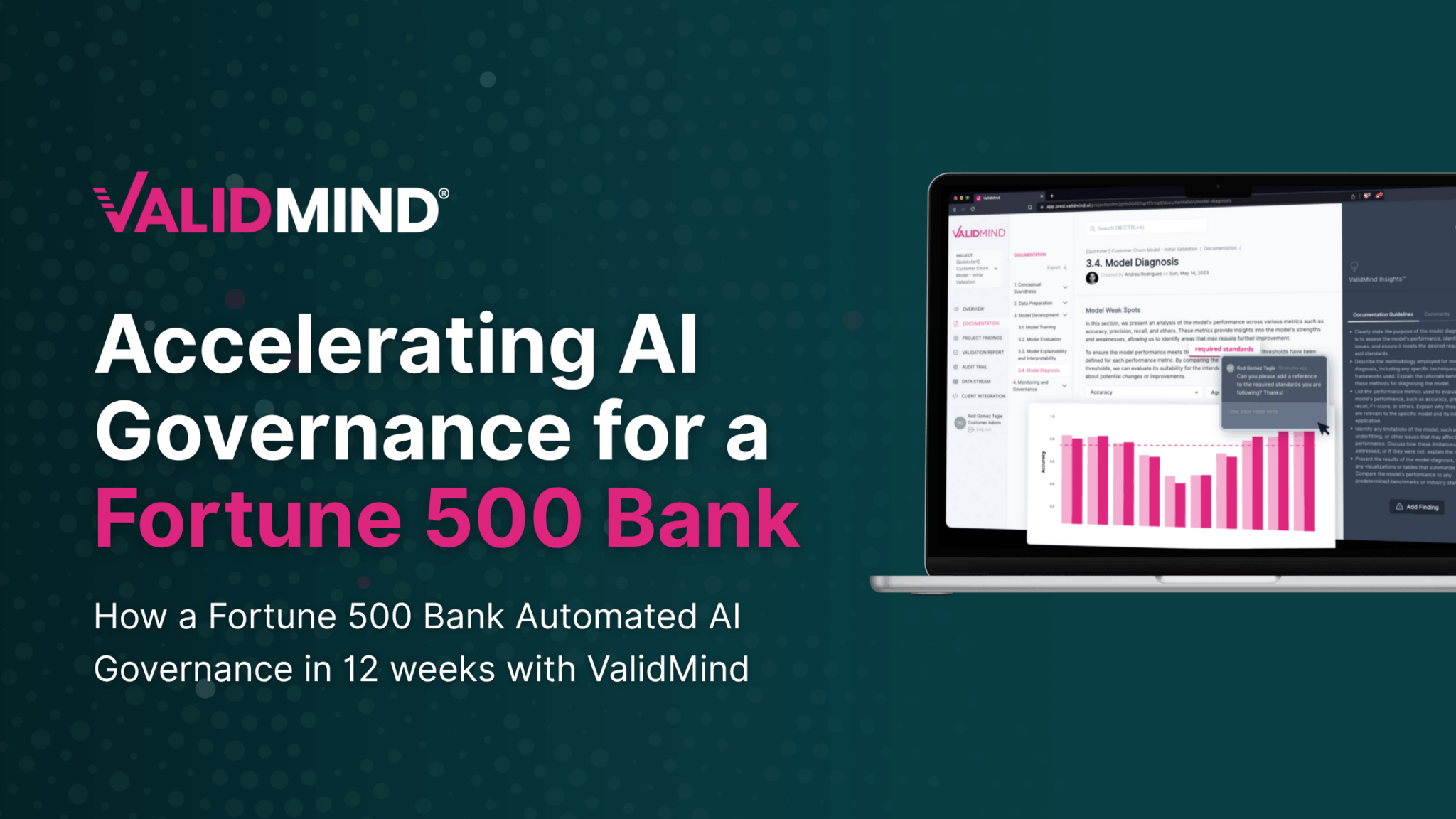
A Fortune 500 Bank fully transitioned from fragmented manual processes to a fully automated, auditable AI governance platform.
A leading insurance and financial services organization sought to modernize and streamline its AI Risk Management framework, using the ValidMind platform as a centralized AI governance hub, unifying risk management, validation, and compliance oversight across both traditional and GenAI models.
Ready to operationalize AI governance at enterprise scale? Explore how ValidMind supports centralized, federated, and hybrid governance models with a unified AI governance platform built for the complexity of modern AI portfolios. Book a demo today.
AI Governance Models FAQs
1. What are AI governance models in enterprise environments?
AI governance models are the organizational structures that define who owns AI-related decisions, how model validation is executed, and how accountability is distributed across teams. Unlike governance frameworks (which define rules) or governance tooling (which executes processes), a governance model defines the operating structure: centralized, federated, or hybrid. The right model determines whether governance enables or obstructs enterprise AI at scale.
2. How does a centralized AI governance model impact model validation workflows?
In a centralized model, all model validation routes through a single governance authority, typically a Model Risk Management function. This creates high consistency and strong audit traceability, but also creates bottlenecks as model volumes grow. Validation timelines can extend to weeks or months, making centralized governance difficult to sustain at scale without automation and workflow tooling.
3. What challenges arise in federated AI governance models?
Federated governance embeds governance ownership within business units, enabling faster decisions and more context-specific validation. The primary risks are inconsistency across teams, fragmented documentation, and poor audit readiness. Without standardized templates, shared tooling, and enterprise visibility, federated governance can produce the appearance of governance without the substance.
4. Why is a hybrid AI governance model considered more scalable?
Hybrid governance combines central policy-setting with distributed execution, enabling organizations to maintain regulatory consistency while giving business units the autonomy to operate efficiently. It’s more scalable because it doesn’t force all decisions through a central bottleneck, yet it prevents the inconsistency that characterizes pure federated approaches. Most enterprises with mature AI programs use some form of hybrid governance architecture.
5. How do AI governance models affect audit readiness?
Audit readiness depends on how consistently governance activities are documented and traceable, regardless of who executes them. Centralized models produce consistent documentation but at scale. Federated models risk inconsistent evidence. Hybrid models can achieve strong audit readiness when supported by governance platforms that standardize documentation across teams. The choice of model directly shapes how much effort is required to produce audit evidence.
6. What role does model inventory play in AI governance models?
A complete model inventory is the foundation of any governance model. Without knowing what models exist, where they’re deployed, and who owns them, governance is effectively blind. Centralized models typically maintain a single inventory; federated models risk fragmented, siloed registries. Hybrid models require a unified inventory with team-level access controls, a core use case for enterprise AI governance platforms.
7. How do AI governance models handle post-deployment monitoring?
Post-deployment monitoring is one of the most frequently neglected elements of AI governance. In centralized models, monitoring is often controlled centrally but under-resourced. In federated models, monitoring may be inconsistent or absent. Best-practice AI governance monitoring embeds ongoing tracking into the governance lifecycle itself, with automated drift detection, performance alerts, and revalidation triggers, regardless of which organizational model is used.
8. Why do traditional governance models fail with modern AI systems?
Traditional governance models were designed for static, rule-based systems in low-volume environments. Modern AI portfolios include complex machine learning models, generative AI systems, and rapidly iterating model versions, none of which fit comfortably into manual, approval-gate governance processes. The fundamental failure is organizational: governance structures that worked for five models cannot govern five hundred without structural and tooling investment.
9. How can AI governance platforms support different governance models?
Purpose-built AI governance platforms can adapt to centralized, federated, and hybrid operating structures by providing configurable workflows, role-based access, shared model inventories, and standardized documentation. The best platforms serve as the coordination layer that makes hybrid governance operational, giving central teams enterprise visibility while enabling local execution. ValidMind is designed to support all three governance models within a single platform.
10. What is the relationship between AI governance models and model risk management?
AI governance models define the organizational structure for overseeing AI systems. Model risk management (MRM) is one of the primary functions within that structure, responsible for validating models, assessing risk, and maintaining documentation. The effectiveness of an MRM function depends heavily on the governance model it operates within: centralized MRM functions have more control; federated ones have more context; hybrid structures attempt to balance both with appropriate coordination mechanisms.