8 Key Insights from the AI Governance Symposium
AI governance is entering a new phase, and the organizations that succeed will be those that fundamentally redesign governance for scale, speed, and complexity.
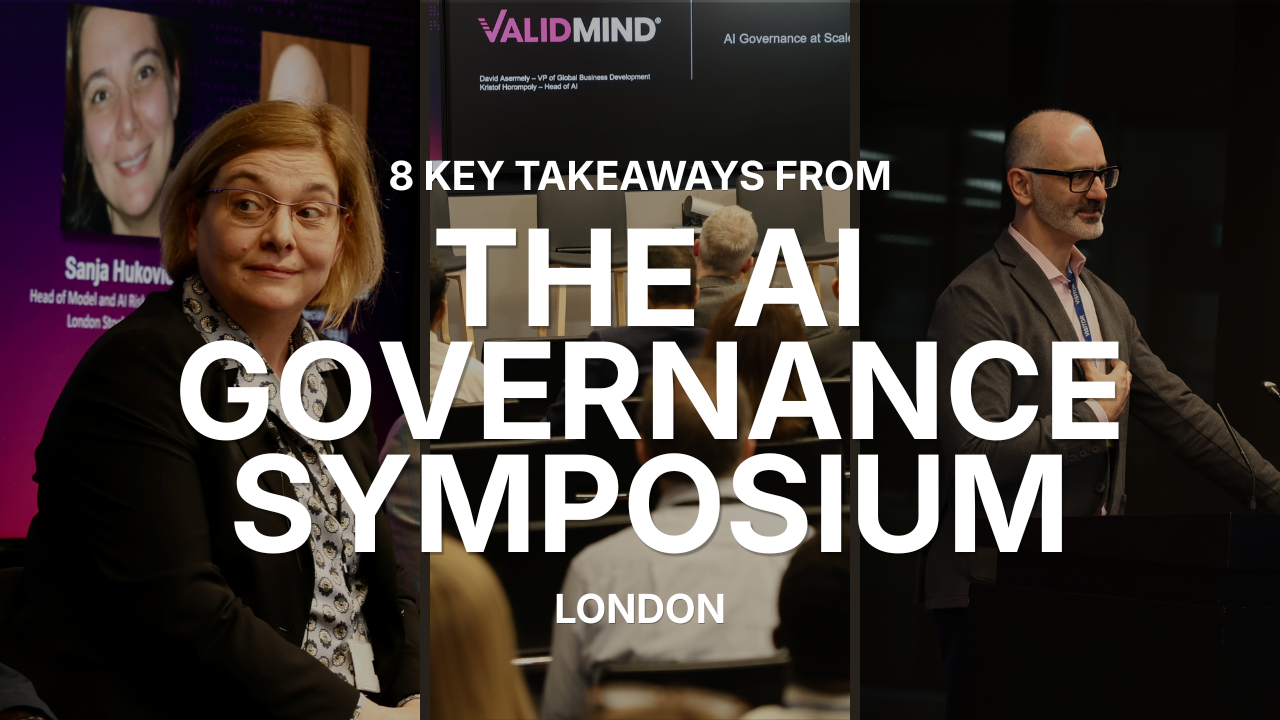
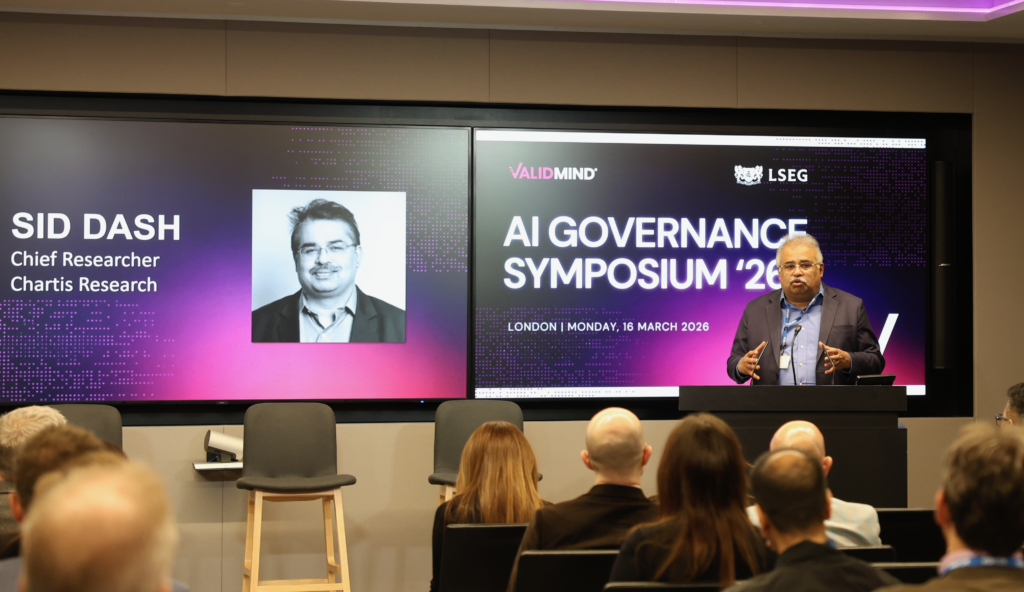
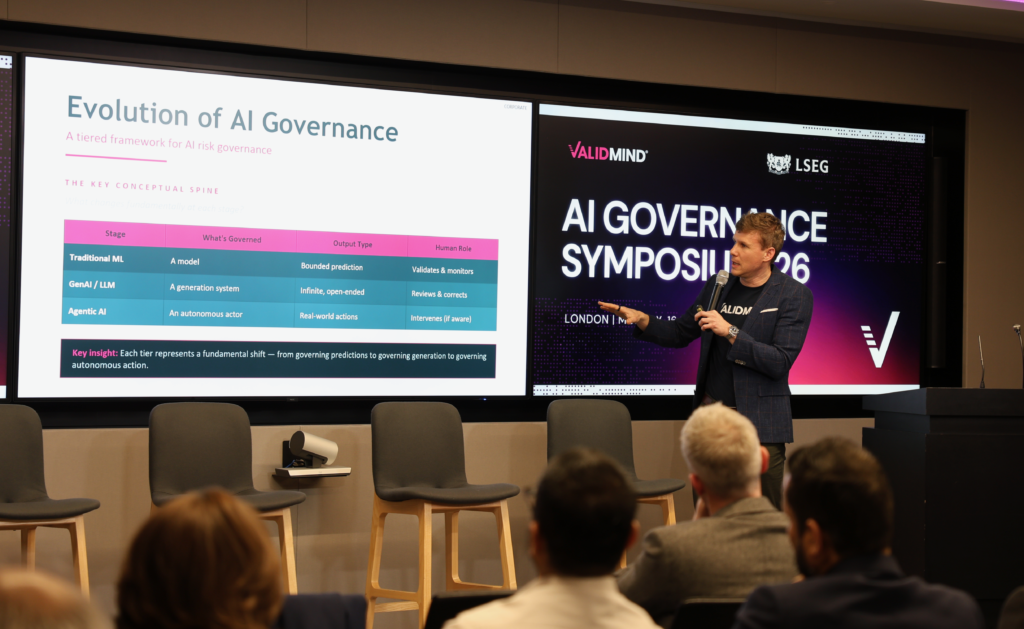
This fact was abundantly clear during yesterday’s AI Governance Symposium in London. ValidMind produced the event, which operated under Chatham House Rules, in partnership with its co-host, the London Stock Exchange. Through a mix of keynote speakers, lightning talks, and a panel, the robust discussions provided a candid look at the challenges and solutions shaping the future of AI governance as it enters this next chapter.
Here are some of the key insights drawn from the event:
1. AI Governance Must Shift from Model-Centric to Business Risk-Centric Thinking
A recurring insight was that traditional model-centric approaches are no longer sufficient. As generative and agentic AI systems are deployed across diverse business processes, risk increasingly manifests at the use case and operational level, not just within individual models.
Rather than asking “Is this model valid?”, organizations must ask:
- What business process is being impacted?
- What decisions are being automated or augmented?
- What are the downstream consequences of failure?
This reframing positions AI risk as a complex, interconnected business risk, requiring governance frameworks that extend beyond model inventories.
2. Model Inventories Remain Essential, but Must Evolve
A lively debate emerged around whether the traditional model inventory is still fit for purpose in a world of universal foundation models. The prevailing view was not that inventories should be abandoned, but that what gets inventoried needs to change: organizations should be moving toward cataloguing business processes, use cases, and operational activities, not just models in the classical sense. At the same time, speakers were emphatic that a dynamic, continuously updated inventory remains the absolute cornerstone of effective model risk management. A static list that gets dusted off for regulators is no longer adequate.

3. Data-Centric Governance is the New Imperative
While institutions are accustomed to deeply analyzing numerical data for distributions and seasonality, they must now apply that same rigor to unstructured textual and synthetic data. How textual data is represented, formatted, and fed into Large Language Models (LLMs) significantly alters the outcomes. AI governance will increasingly require domain-specific data thinking and complex multimodal integration to ensure the data feeding these models is valid and secure.
4. Automation Is No Longer Optional
A clear consensus emerged: manual governance cannot scale with AI adoption.
As AI systems become more autonomous and widespread:
- Validation must be increasingly automated
- Monitoring must be continuous, not periodic
- Governance tooling must integrate directly into AI workflows
This mirrors lessons from other industries (e.g., software engineering, cybersecurity), where reliability is achieved through standardized, automated testing and controls, not manual oversight.
5. Governance is Shifting from Pre-Production to Post-Production
With traditional statistical models, validators spent most of their time in pre-production testing. However, with the rise of autonomous agentic AI, pre-production validation can only cover a fraction of what the system might do in the wild. The argument was made that governance must now pivot heavily toward post-approval monitoring and real-time intervention. This includes engineering strict “escalation triggers” where an agent is forced to pause and request human approval before executing a high-risk action.

6. Proportionality Is Not the Same as Minimalism
Regulators have been clear that the principle of proportionality, or ensuring that controls are commensurate with the risk of a given model or use case, does not mean doing the minimum. It means doing the right things for the right cases. AI models frequently score highly on materiality (the impact if they fail) and complexity (the likelihood of failure), and firms should resist the temptation to use proportionality as a justification for lighter governance. Where AI amplifies risk through scale, opacity, or complexity, additional scrutiny is required.
7. Foundational Model Validation Requires a New Approach
Traditional validation methods are not feasible for large, externally hosted foundational models. Instead, organizations are shifting toward:
- Outcome-based validation (performance, behavior, reliability)
- Use-case-specific testing
- Ongoing monitoring rather than one-time validation
This represents a significant departure from classical model validation, reinforcing the need for lifecycle-wide governance.
7. “AI Teaming” is Required to Govern AI at Scale
Because AI adoption is growing exponentially, traditional governance teams are struggling to keep up using manual documentation and validation processes. The solution is “AI teaming”—equipping human governance experts with AI tools to automate the documentation, regulatory checks, and testing of low-to-medium risk models. By automating the governance of lower-tier models, organizations free up their human experts to focus 80% of their time on the riskiest AI deployments.
8. The Future of AI Governance Is Dynamic, Not Static
Perhaps the most important takeaway is that governance itself must evolve continuously.
Static frameworks will not keep pace with rapid model evolution, new AI capabilities (e.g., agents, multimodal systems), or expanding regulatory expectations.
Instead, organizations should build:
- Flexible, principle-based frameworks
- Feedback-driven governance systems
- Adaptive controls that evolve with use cases
In Conclusion …
The shift from models to systems, from validation to monitoring, and from manual to automated control represents a fundamental transformation. Organizations that succeed will be those that embrace this shift early. It will require a rethinking around the tools tools and the underlying assumptions about risk, accountability, and control.
At ValidMind, we see this as a defining moment for the industry and an opportunity to build governance frameworks that are not only robust, but truly scalable in the age of AI.
Presentations
Keynote: Market Focus: AI Governance
Sidhartha Dash, Chief Researcher, Chartis Research
Lightning Talk: Scaling AI for Financial Services
Sayantan Biswas, Senior Partner Development Specialist – Financial Services and Insurance, Amazon Web Services
AI Governance at Scale
Kristof Horompoly, Head of AI, ValidMind
David Asermely, Head of Growth Strategy & Development, ValidMind