What Is AI Governance? A Practical Guide for Risk and Compliance Professionals
AI governance is no longer optional. As organizations deploy AI systems across lending, fraud detection, HR, customer service, and beyond, regulators and boards are demanding clear answers to a simple question: who is accountable when AI goes wrong?
This guide breaks down what AI governance actually means, how it differs from model risk management (MRM), and what a practical governance program looks like in action.
What Is AI Governance?
AI governance is the organizational framework for directing and overseeing how AI is designed, deployed, and used. It establishes the policies, accountability structures, lifecycle controls, and ongoing oversight mechanisms that ensure AI operates responsibly within an organization.
Think of it as the operating system for responsible AI — not a one-time audit, but a continuous set of processes that spans the entire life of an AI system.
A mature AI governance framework sets:
- Policy and standards — what your organization requires of any AI system before and after deployment
- Accountability and decision rights — who owns each AI system and who has authority to approve or retire it
- Lifecycle controls — gates and checkpoints from initial intake through decommissioning
- Ongoing oversight — monitoring, periodic review, and escalation when something goes wrong
Critically, the primary unit of management in AI governance is the AI system or use case — not the individual model underneath it. Governance focuses on how AI is used, its impact on stakeholders, and organizational accountability. This applies equally to model-based AI, non-model AI systems, and automated decision systems.
AI Governance vs. Model Risk Management: What’s the Difference?
This is one of the most common points of confusion in the field, and it matters for how you structure your program.
AI governance and model risk management (MRM) are parallel disciplines; neither is a subset of the other.
| AI Governance | Model Risk Management | |
|---|---|---|
| Unit of management | AI system / use case | Individual model |
| Objective | Organizational oversight | Technical risk control |
| Scope | Ethics, compliance, accountability | Performance, validation, accuracy |
| Driven by | EU AI Act, internal policy | SR 11-7, SS1/23, E-23 |
That said, they do share some common ground. Both disciplines rely on an inventory, approval workflows, issue tracking, and ongoing monitoring. Organizations can choose to coordinate these programs or manage them separately. The right answer depends on your organizational structure and regulatory obligations.
The AI Governance Lifecycle
A well-designed AI governance program moves AI systems through a structured lifecycle, with clear roles and handoffs at each stage:
- Intake — The use case owner registers the AI system, capturing intended use, ownership, and initial information
- Assessment — Governance and risk teams classify the system by risk tier and assess potential harms
- Documentation — Owners and risk teams document the model and use case
- Validation — Validators test and validate the model
- Approval — A committee or compliance function provides formal sign-off
- Deployment — The owner and IT team deploy the system to production
- Monitoring — Risk and operations teams provide ongoing oversight
- Review — Governance and audit conduct periodic reviews, with a feedback loop back to re-assessment if the system changes materially
This isn’t a linear process that ends at deployment. The review-to-reassessment loop is what separates genuine governance from one-time checkbox compliance.
Risk Classification: The Foundation of Proportionate Governance
Not all AI systems carry the same risk. A customer-facing credit decisioning model warrants far more scrutiny than an internal tool that recommends meeting times. Risk classification is what makes governance proportionate rather than one-size-fits-all.
Higher-risk AI systems receive more rigorous review, additional documentation requirements, enhanced monitoring, and stricter approval gates. Lower-risk systems can move through lighter-weight processes.
Common classification frameworks include:
- EU AI Act: Prohibited, high-risk, limited-risk, minimal-risk
- Internal tiers: Critical, high, medium, low
- Numbered tiers: Tier 1 through Tier 4
Your classification scheme should align to the regulations most relevant to your industry and jurisdiction, and it should be configurable as those regulations evolve.
Impact Assessments: Asking the Right Questions Before Deployment
An impact assessment documents the potential harms an AI system could cause before it goes live. It’s a structured way to ask:
- Who is affected by this AI system?
- What decisions does it influence?
- Where could it cause harm or introduce bias?
- What controls mitigate those risks?
The output of an impact assessment feeds directly into the risk classification and approval process. It also creates the paper trail regulators expect to see when they ask how you evaluated an AI system before deploying it.
Key AI Governance Terminology
If you’re new to this space, the terminology can feel overwhelming. Here’s a quick reference:
Units of oversight: AI system, AI application, AI use case, automated decision system
Risk framing: AI risk, use case risk, impact/harm, ethical risk
Classification: Risk tier, impact level, criticality, prohibited/high-risk/limited-risk
Lifecycle stages: Intake, assessment, documentation, validation, approval, deployment, monitoring, review
What Regulations Apply to AI Governance?
The regulatory landscape is evolving fast. The most significant frameworks risk and compliance professionals need to understand include:
- EU AI Act — The world’s first comprehensive AI regulation, applying a risk-based classification to AI systems deployed in or affecting EU residents
- SR 11-7 (US Federal Reserve) — The foundational model risk management guidance, increasingly applied to AI/ML systems
- SS1/23 (UK PRA) — UK model risk management principles
- E-23 (OSFI, Canada) — Enterprise-wide model risk management guidance covering AI/ML risk
Each framework maps to specific governance activities: registration and classification requirements, technical documentation, approval and oversight processes, and continuous compliance monitoring.
What Good AI Governance Looks Like in Practice
Effective AI governance isn’t just a policy document, it’s a set of operational capabilities your team exercises regularly. That means:
A centralized inventory that tells you where AI is used across the organization, who owns each system, and its current lifecycle stage. Without this, you can’t demonstrate governance to regulators or manage aggregate risk exposure.
Configurable workflows that route AI systems through the right review process based on risk tier. High-risk systems get governance committee review and multiple approvers. Low-risk systems move faster. The workflow enforces this consistently, not through manual reminders.
Documented impact assessments with an audit trail showing who reviewed what and when. Approval history, change logs, and decision rationale are the raw material of audit readiness.
Human oversight mechanisms, especially for high-risk AI. The EU AI Act (Article 14) specifically requires that humans can understand AI outputs, intervene, override decisions, and provide feedback. Your governance program needs to document how you implement this.
Dashboards and reporting that give leadership and compliance teams visibility into the AI portfolio: risk distribution, workflow bottlenecks, pending approvals, and compliance metrics.
Continuous monitoring for performance drift, data quality issues, and emerging risks — with a clear process for escalating when something needs attention.
Getting Started with AI Governance
For risk and compliance professionals standing up or maturing an AI governance program, a practical starting point is:
- Build your inventory first. You can’t govern what you can’t see. Start by registering the AI systems your organization already uses.
- Define your risk classification scheme. Align it to your relevant regulatory frameworks and configure it before you try to apply it.
- Map your lifecycle. Document the stages an AI system moves through and who is responsible at each step.
- Configure your workflows. Intake, approval, and review processes should be repeatable and auditable — not ad hoc.
- Establish your monitoring cadence. Set review frequencies by risk tier and make sure someone is accountable for completing them.
How ValidMind Supports AI Governance
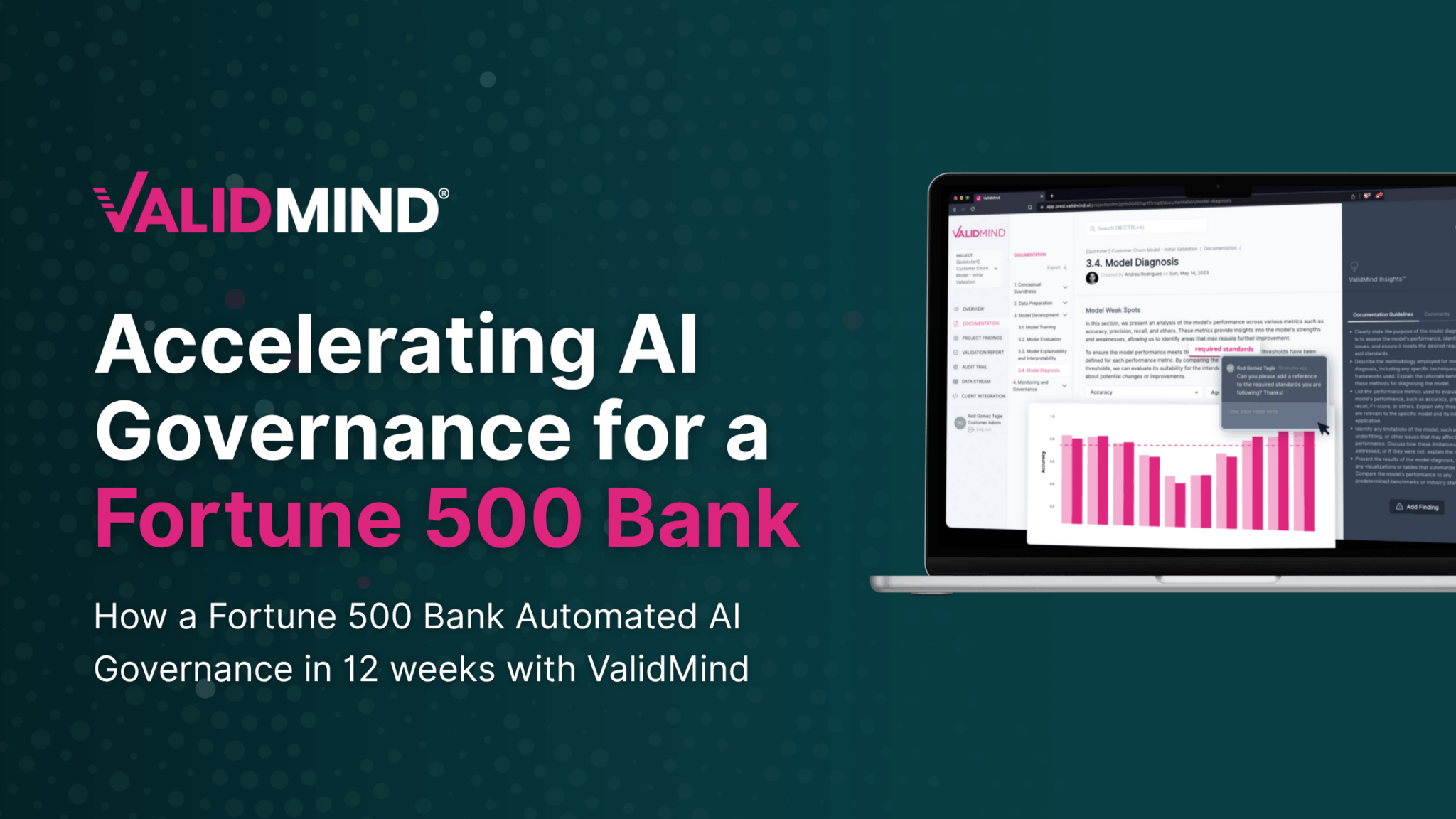
ValidMind is built to operationalize AI governance programs for risk and compliance teams. The AI governance platform provides:
- An Inventory to track AI systems, use cases, owners, and stakeholders across the organization
- Custom fields to configure risk tiers, impact levels, and classification schemes aligned to your frameworks
- Workflow automation for intake, approval, human oversight, escalations, and periodic reviews
- Documentation tools to run testing and generate governance documentation
- Issue tracking to identify, manage, and remediate validation findings
- Dashboards and analytics to monitor compliance and report to leadership and regulators
- A Document Checker to assess model documentation against regulations and internal policies
Whether you’re implementing the EU AI Act, SR 11-7, SS1/23, or E-23 — or building an internal AI governance policy from the ground up — ValidMind maps your regulatory requirements to platform capabilities so governance is built into your process, not bolted on after the fact.
Ready to see how ValidMind supports AI governance in practice? Request a demo →