Moloch’s AI Game: Why Governance is the Ultimate Accelerator

Free markets are incentivizing the rapid development of agentic AI, dangling dazzling advances and profitability as the reward. But at what cost?
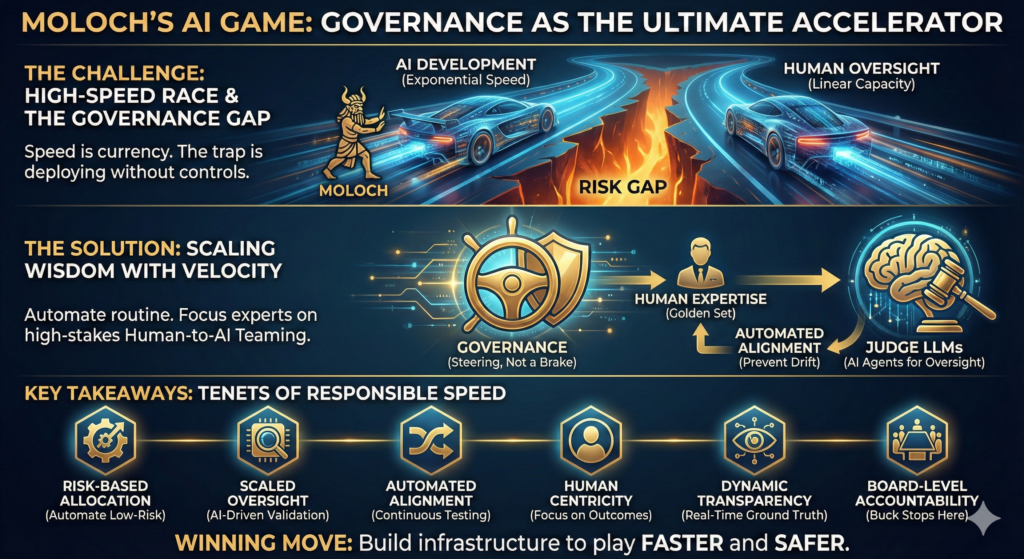
Enter Moloch’s dilemma. Evolving from ancient legend to modern game theory, Moloch is the force within competitive environments that pressures participants to prioritize near-term gains or risk being left behind. In 2025, it is the invisible hand pushing frontier AI labs and global enterprises to deploy powerful models faster than their rivals.
We are witnessing a classic race where speed is the currency of survival. But for the enterprise, the trap of Moloch is not the technology itself. It is the risk of deploying it without the controls to capture its full value sustainably.
The New Economic Imperative: Optimizing Intelligence per Unit of Cost
For the C-Suite, the Moloch dynamic has introduced a transformative new metric to the P&L. We are moving from an era constrained by the cost of labor to an era defined by the optimization of Intelligence per Unit of Cost.
AI is putting us on a trajectory where high-quality cognition: decisions, analysis, code generation, customer interactions, is becoming abundant and progressively more affordable. This is not a story about reduction. It is a story about massive expansion.
The economic logic is compelling. By dramatically lowering the cost of intelligence, firms can embed smart decision-making into every process, product, and interaction. This unlocks unprecedented levels of efficiency and creates entirely new competitive advantages that were previously uneconomical to pursue. The winners in this new world will be the organizations that can integrate and scale this new abundance of intelligence most effectively to drive their bottom line.
The Math of Moloch: The Scale Challenge
To fully realize the benefits of this new economic imperative, firms need to adopt AI exponentially. We are moving from deploying a handful of models to orchestrating thousands of autonomous agents across the enterprise.
However, this creates a specific, mathematical challenge that most boards have yet to solve.
AI adoption is exponential. Traditional governance capacity is linear.
You cannot double your risk and compliance teams every time you double your AI output.

As the adoption curve steepens, a “Scale Gap” emerges. The immense potential of cheap intelligence is bottlenecked by the capacity to oversee it effectively. If you rely solely on manual review processes, this gap widens every single day, effectively putting a speed limit on your own innovation and preventing you from capturing the full efficiency gains.
For our clients in banking and insurance, the goal is to remove this bottleneck so they can deploy AI confidently at scale.
AI Governance as a Competitive Advantage
How do we remove the bottleneck and unleash exponential growth? The answer lies in reframing our view of control.
Governance is not a brake that slows you down. It is the high-performance steering wheel that keeps you on the road while you accelerate.
While the regulatory landscape plays catch-up, forward-thinking firms are not waiting for permission to build safer, more scalable systems. They realize that in a Molochian race, the firm with the best controls can drive the fastest and most aggressively without crashing.
The New Playbook: Scaling Wisdom with Velocity
To close the Scale Gap and maximize intelligence per unit of cost, we must apply a new logic to governance: The only way to govern exponential AI is with AI.
We need a strategic approach that amplifies human expertise rather than replacing it. We must aggressively automate the governance of lower-risk, high-volume AI use cases. By allowing automated systems to handle the routine validation of standard models, we liberate our most valuable asset: human judgment.
This mechanism enables a modern Human-in-the-Loop framework that elevates the role of the expert. We cannot afford to have our best minds bogged down in routine compliance checks. Instead, we need them focused on “Human-to-AI Teaming” for high-stakes, complex models that drive true market differentiation.
In this new paradigm, domain experts evaluate a “golden set” of complex cases, defining the standards of excellence for the organization. We then use their feedback to train “Judge LLMs”, specialized AI agents designed to learn and apply that expert-level oversight. These Judge LLMs allow us to scale the organization’s best wisdom across the entire enterprise at the speed required to match exponential AI adoption.
The Tenets of Responsible Speed
This is how we break the Moloch cycle and turn the pressure for speed into a competitive advantage. Firms must embrace these updated tenets to lead:
- Risk-Based Allocation: Automate the routine to focus human capital on strategic, high-value oversight.
- Scaled Oversight via Judge LLMs: Use AI agents to enforce human-defined standards of excellence at machine speed.
- Automated Alignment: Continuously test Judge LLMs against human experts to ensure they remain aligned with corporate values and goals.
- Human Centricity: AI must serve to augment human potential and improve business outcomes, not just hit metrics.
- Dynamic Transparency: Maintain a trusted, real-time view of model performance for agile decision-making.
- Board-Level Accountability: Responsibility sits with the board, ensuring governance is treated as a strategic enabler.
Moloch’s game forces us to compete, but it doesn’t force us to be reckless. The only way to win is to realize that scalable governance is the key to unlocking the immense positive potential of AI. By using AI to amplify human wisdom, we can drive necessary bottom-line efficiencies, compete more effectively, and build a more prosperous future.