AI Is Scaling Faster Than Governance Can Keep Up

AI adoption is accelerating across enterprises. New use cases are launching every quarter. Generative AI is reshaping how teams build, deploy, and iterate. Investment continues to rise, and expectations from leadership are higher than ever.
Yet despite this momentum, many organizations struggle to move beyond pilots. According to MIT, 95% of generative AI pilots at companies are failing.
Models stall in review. Validation backlogs grow. Documentation becomes fragmented. Executives lack visibility into the AI production pipeline. They’re unsure of what’s been approved and what risk these use cases carry.
The issue isn’t a lack of AI capability. The issue stems from the fact that governance hasn’t kept pace with scale.
The New Reality of AI at Scale
AI portfolios today look nothing like they did even a few years ago.
Organizations are now managing:
- Dozens or hundreds of AI and traditional models
- GenAI systems with rapid iteration cycles
- Multiple teams building and deploying in parallel
- Increasing regulatory scrutiny across regions
At the same time, governance and risk processes often remain:
- Manual and document-heavy
- Fragmented across tools and teams
- Designed for low model volume and slow change
What once worked as a control mechanism is now a bottleneck.
How Governance Becomes Constraint
As AI scales, three governance challenges consistently emerge:
1. Fragmented Oversight
Without centralized visibility, organizations lose track of model ownership, approvals, and risk posture. Reporting becomes inconsistent, and leadership is forced to rely on snapshots instead of real-time insight.
2. Manual Processes That Don’t Scale
Documentation, validation, and review workflows often depend on manual effort. As model volume increases, these processes slow everything down, creating backlogs that delay deployment and frustrate delivery teams.
3. Governance Built for a Different Era
Traditional model risk frameworks weren’t designed for today’s AI landscape. GenAI, frequent updates, and diverse model types demand a more flexible, repeatable approach, one that supports speed without sacrificing control.
The result is a widening gap between AI ambition and operational reality.
What This Means for AI Adoption
When governance can’t scale:
- AI initiatives stall after early success
- Costs increase as teams compensate with manual effort
- Risk exposure grows due to limited visibility and inconsistency
- Executives lose confidence in the organization’s ability to scale AI responsibly
In other words, AI adoption slows just when it should accelerate.
How Leading Organizations Are Responding
Organizations successfully scaling AI aren’t eliminating governance; they’re modernizing it.
They are:
- Treating governance as a foundation for adoption, not a final hurdle
- Centralizing oversight across AI and traditional models
- Automating documentation, validation, and monitoring workflows
- Giving leadership clear visibility into risk, ownership, and progress
This shift allows them to move faster with confidence, even as AI portfolios grow.
The Bottom Line
AI is scaling faster than governance can keep up. Organizations that close this gap will be the ones that turn AI investment into real business impact.
Those that don’t will continue to struggle… not because AI failed, but because the systems around it couldn’t scale.
See What This Looks Like in Practice
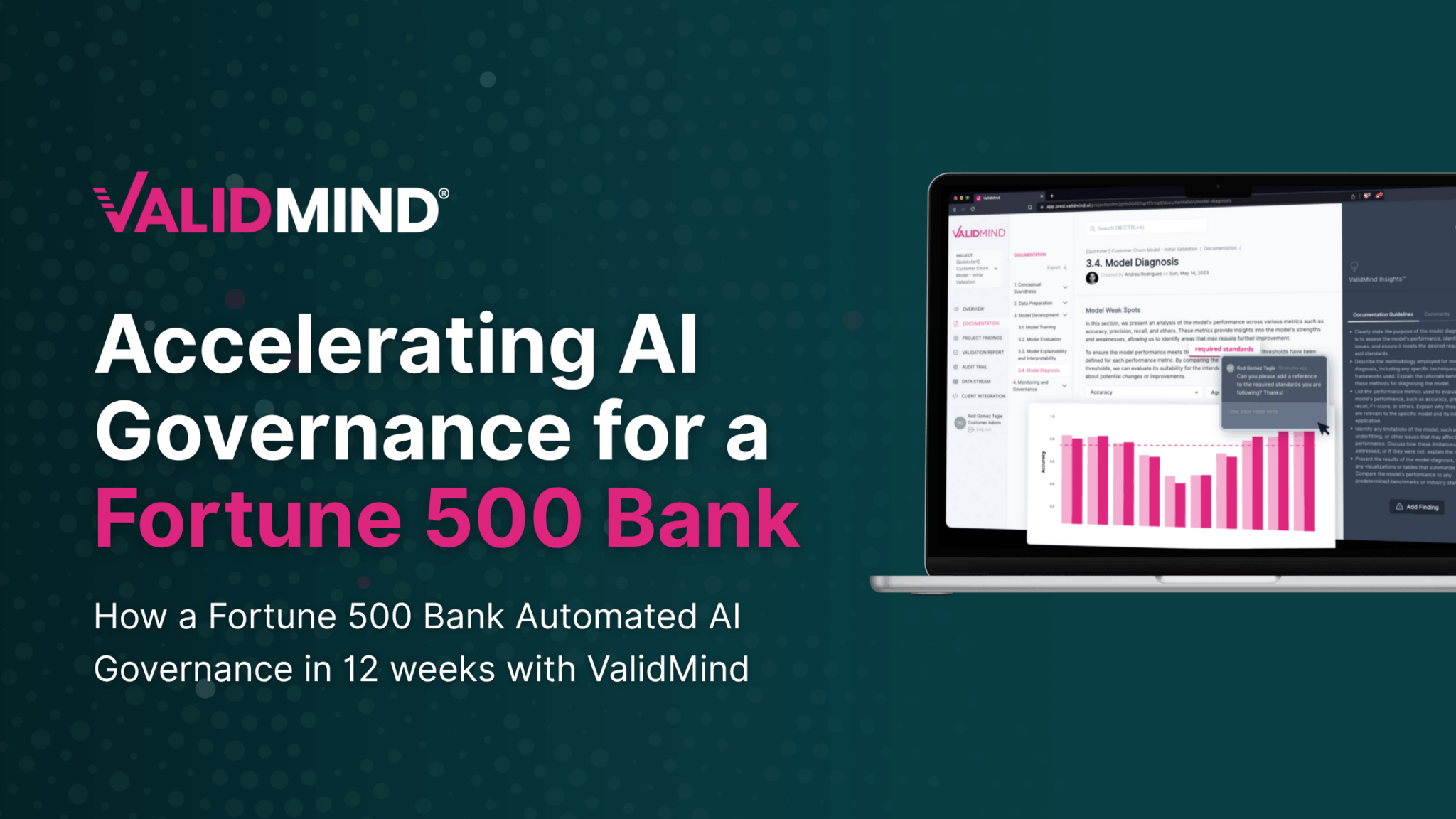
Learn how a Fortune 500 bank centralized AI governance, automated validation workflows, and accelerated AI adoption across the enterprise.
👉 Read the case study: Accelerating AI Governance for a Fortune 500 Bank