Observability for the Agentic Era: How ValidMind Brings Order to MCP-Based AI Ecosystems
As organizations race to deploy agentic AI, a new architectural reality is emerging: models don’t live in one place anymore.
They’re embedded across SaaS platforms like Salesforce, ServiceNow, and UiPath. They’re orchestrated through agents. They’re gated by MCP servers. They’re downloading skill and communicating with other agents. And they’re monitored, if at all, through a patchwork of observability and cost tools.
For many teams, the big question is no longer “Can we build this?”
It’s “How do we see it, govern it, and control the risk end to end?”
That’s exactly where ValidMind comes in.
MCP Servers Are Everywhere; Visibility Isn’t
MCP servers are quickly becoming a core part of modern AI architectures. They act as policy enforcement layers: deciding which agents can access which tools, models, or data, under what conditions. Skills take it further, exposing more capabilities to agents.
But MCP servers don’t exist in isolation.
- Models still live where they’re deployed (Bedrock, Salesforce, ServiceNow, etc.)
- Observability data lives in separate tools (LangSmith, Langfuse, vendor dashboards)
- Cost data comes from yet another system
- Risk signals (hallucinations, misuse, policy violations) are often invisible until it’s too late
What organizations end up with is fragmentation: plenty of signals, but no unified understanding.
A Single Pane of Glass for Agentic AI
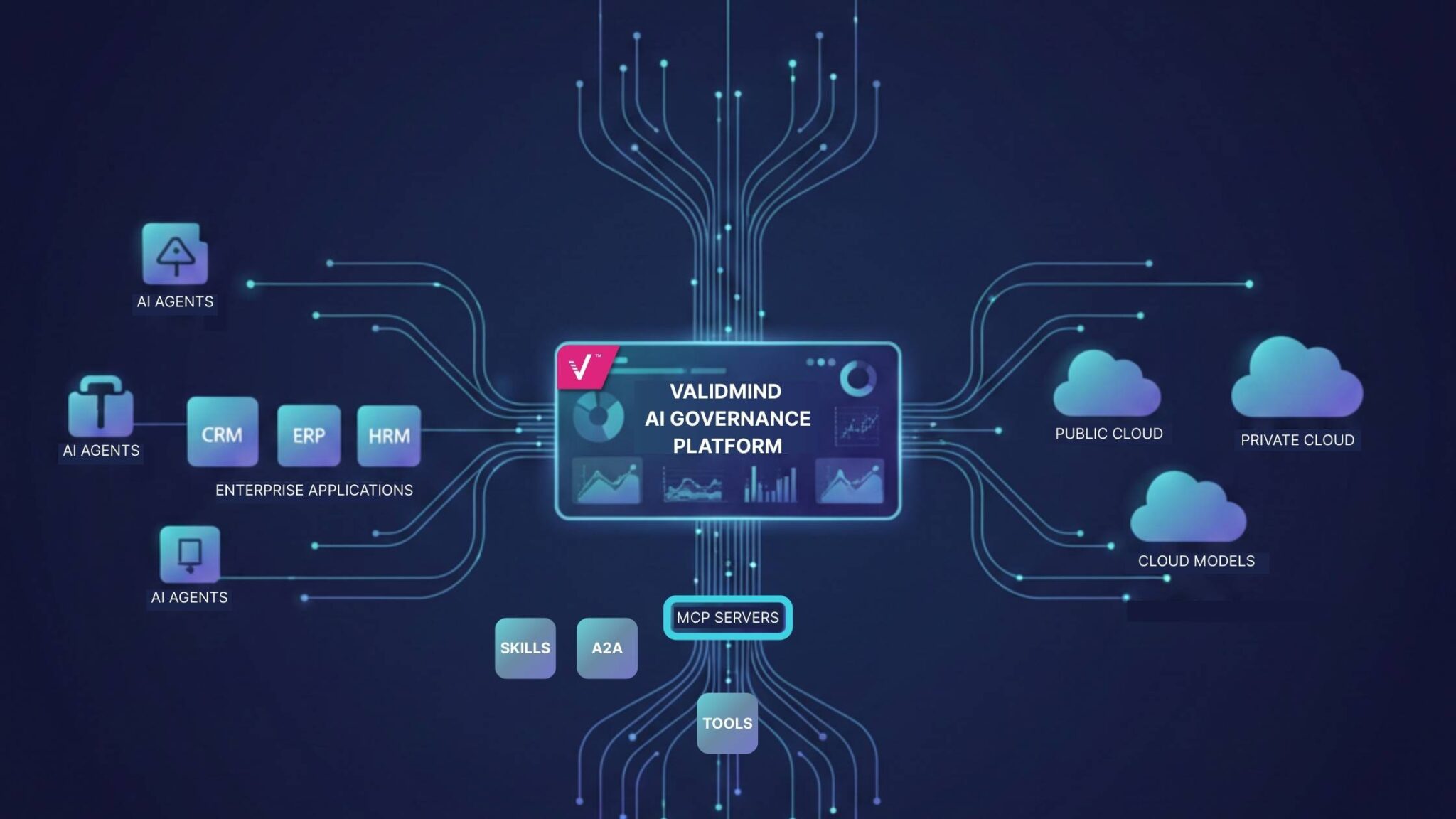
ValidMind is not a hosting platform. We don’t run your agents or your models.
Instead, we connect to where they already live.
ValidMind ingests signals from:
- MCP servers
- Observability frameworks
- Cloud providers (including raw token-level cost data)
- Agent workflows and prompt evaluations
- Skill invocations
- Agent to Agent (A2A) proxies and logs
- Platform-native AI tools embedded in enterprise applications
We then stitch those signals together into a single, coherent view of your AI ecosystem across time horizons that matter to the business (hourly, daily, quarterly).
The result: one place to understand what’s running, how it’s behaving, what it’s costing, and where risk is emerging.
From Passive Monitoring to Active Risk Response
Observability alone isn’t enough.
What makes agentic AI challenging is that failures propagate:
- A hallucination increases downstream risk
- A model starts being used for an unintended purpose
- An agent crosses a policy boundary it shouldn’t
ValidMind turns observability into action.
When risk signals spike, whether from hallucination detection, topic modeling, or policy violations, ValidMind can:
- Trigger alerts automatically
- Notify model owners, risk teams, or cybersecurity
- Kick off predefined workflows for investigation or documentation
- Orchestrate calls to third-party systems
This isn’t just monitoring dashboards, it’s operational governance.
Designed for the Real World (Even When Architectures Are Still Whiteboarded)
Most organizations aren’t fully consolidated yet. In fact, many are still in the discovery phase:
- AI tools are siloed within vendor platforms
- MCP, Skill, and A2A strategies are evolving
- “Central routers” are still conceptual
- Discovery remains a challenge
ValidMind is built for that reality.
Whether your AI tools are fully isolated or partially orchestrated, ValidMind acts as the central organizing layer:
- Maintaining a unified model and use-case inventory
- Normalizing documentation across vendors and platforms
- Supporting governance even before architectures fully converge
As consolidation increases, ValidMind doesn’t get in the way, it amplifies it.
Supercharging Validation, Documentation, and Compliance
One of the biggest bottlenecks in deploying AI responsibly is documentation and validation.
ValidMind automates this by:
- Knowing which tests need to run for which models
- Pulling the right information directly from MCP servers and source systems
- Running prompt and response evaluations using judge LLMs
- Assessing clarity, appropriateness, and alignment with policy
What typically stalls at 60–80% automation can reach 90–95% when backend orchestration is already in place.
And because ValidMind supports bring-your-own policy, organizations can tailor assessments to:
- Internal risk frameworks
- MCP-specific governance rules
- Regulatory requirements
- Institution-specific standards for agentic AI
Making Risk Explicit Before Production
Agentic systems introduce layered risk:
- What the agent is allowed to do
- What the MCP server permits
- What the underlying platform enables
- What the business actually intends
ValidMind helps teams document and reconcile those layers through model artifacts:
- Explicit assumptions
- Access rules and constraints
- Risk tiers
- Policy mappings
These artifacts roll up into aggregate risk views, ensuring nothing goes to production without being fully understood, documented, and reviewed.
Built for What’s Next
Agentic AI is moving fast. Architectures will evolve. MCP servers will mature. Tooling will proliferate.
ValidMind is designed to be the stable governance layer underneath it all, connecting systems, surfacing risk, and enabling confident deployment at scale.
If you’re building for the agentic future, visibility isn’t optional.
It’s foundational.